

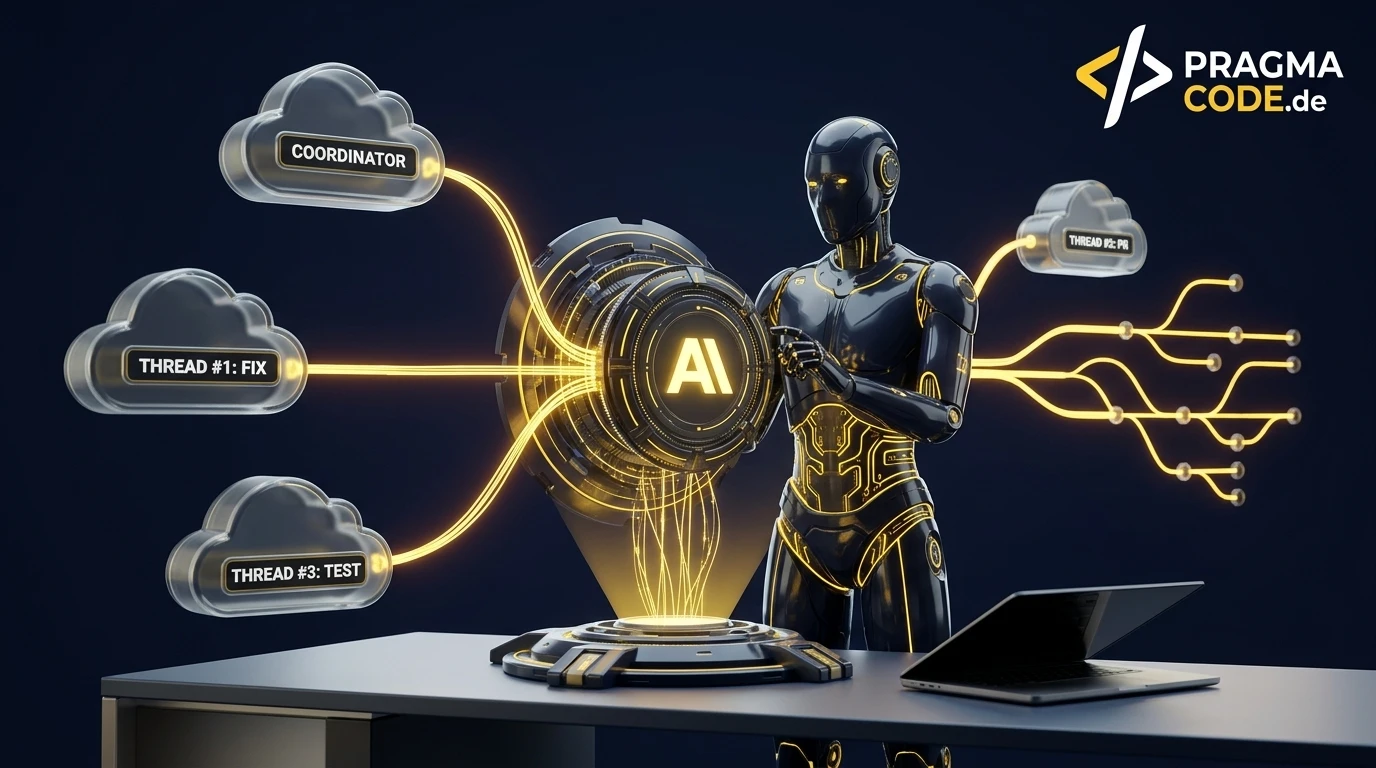
Anthropic moves beyond static chat windows and isolated terminal sessions: With the new 'Projects' beta feature, Claude Code becomes a persistent control center for parallel cloud threads. We rigorously evaluated the coordinator-worker architecture, shared MEMORY.md synchronization, and autonomous auto-fix pull requests.
This article is an in-depth expert contribution from our content cluster. Discover the complete overview on our main page:AI & Automation for Modern Enterprises →
- Paradigm shift from folder to dispatcher: In Claude Code, a project is no longer a passive repository of knowledge files. It is an ongoing coordinator conversation. A supervisory Coordinator Agent triages requests, decomposes objectives, and commands worker threads.
- Genuine asynchronous execution: Powered by Cloud Sessions on isolated Ubuntu virtual machines, Claude continues writing code, executing builds, and resolving test failures after you close your laptop or switch to your phone.
- Collective project memory via MEMORY.md: Architecture constraints, debugging discoveries, and coding rules persist across all active and future threads through Project Memory, eliminating repetitive re-prompting.
From interactive pair-programming to an autonomous cloud engineering team
Until recently, coding with AI meant being chained to a synchronous terminal session: Every command blocked local CPUs, ports, and developer attention. With Claude Code Projects, Anthropic shifts the paradigm from an in-terminal assistant to a decoupled, multi-agent operating system for modern software engineering.
- 1. Introduction: Breaking Free from the Local Terminal Trap
- 2. Architecture & Mechanics: The Coordinator-Worker Blueprint
- 3. Shared Context & MEMORY.md: The Collective Knowledge Graph
- 4. From Objective to Pull Request: The End-to-End Autonomous Pipeline
- 5. Enterprise B2B Scenarios: 5 Proven Applications for Software Teams
- 6. Governance, Security & Token Economics for Engineering Leaders
- 7. Conclusion, Checklist & Strategic Action Items
- 8. Official Sources & Primary Documentation
1. Introduction: Breaking Free from the Local Terminal Trap
The rapid acceleration of generative AI for software engineering over the past four years delivered undeniable productivity boosts. Yet, it retained a critical operational bottleneck: synchronous presence. Whether utilizing GitHub Copilot in the IDE, Cursor, or the command-line Claude Code CLI, the developer remained tethered to a blinking prompt. The workflow was inherently serial: type an instruction, watch the model inspect files for 45 seconds, inspect diffs, approve bash executions, wait for local test suites, and repeat.
This serial loop created severe friction. Local machine resources were strained by compiler cycles, package installations, and docker daemons, while the engineer's cognitive focus remained hostage to frequent micro-approvals. Multi-service refactorings, systematic lint cleanup across microservices, or writing missing end-to-end test suites demanded hours of active babysitting.
On September 17, 2026, Anthropic decisively addressed this friction. With the rollout of Projects in public beta for Pro and Max users, Claude Code transitions from a local command-line companion to an autonomous asynchronous cloud operations hub. Anthropic summarizes the core value proposition concisely in the product's onboarding interface:
„A project used to be a folder. Now it's an ongoing chat. Ask for things as they come up, and Claude works on each one in a thread and reports back as it goes. Close your laptop, and the threads keep running.“
Rather than executing every command on the engineer's local machine, Claude Code Projects offload heavy lifting to sandboxed cloud environments. The engineer shifts from an operator executing shell scripts to an Engineering Manager directing a squad of autonomous virtual contributors. This technical evaluation examines the underlying infrastructure, security boundaries, and enterprise implications of Anthropic's new architecture.
2. Architecture & Mechanics: The Coordinator-Worker Blueprint
To grasp why Claude Code Projects represents a structural leap, one must examine how session state is decoupled from execution environments. In conventional local setups, the chat interface and the execution runtime reside in the same process. Terminating the terminal or disconnecting from Wi-Fi immediately kills active compiler tasks, linters, or git operations.
Claude Code Projects establishes an enterprise-grade Coordinator-Worker architecture distributed across managed cloud infrastructure:
1. The Coordinator Agent
The primary project conversation functions as an orchestration cockpit. The coordinator does not execute destructive file operations itself. Instead, it evaluates incoming user goals, decomposes complex initiatives, maintains global memory, and spawns specialized worker threads.
2. Parallel Cloud Threads
Each assigned task triggers an independent Cloud Session on an isolated, Anthropic-managed Ubuntu VM. Each thread receives a clean clone of the designated repositories, operates on its own dedicated git branch, and executes commands inside a dedicated context window.
3. Shared Project Memory
Via a persistent markdown-based memory system (Project Memory centered around MEMORY.md), threads share knowledge. When Thread A fixes a broken build configuration or identifies an API nuance, that rule is instantly propagated to all subsequent threads.
4. GitHub Execution Engine
Through the official Claude GitHub App, threads autonomously interact with remote repositories. They push branches, author pull requests, inspect CI check results, and trigger autonomous remediation loops (Auto-Fix PR) without human involvement.
This structural separation resolves a perennial bottleneck: Engineers can dispatch multiple unrelated tasks into a single project conversation—such as resolving a database indexing bottleneck, refactoring a legacy CSS component, and updating OAuth test suites. The coordinator spawns three parallel threads. Each executes on a separate cloud container without conflicting over local ports, uncommitted working tree diffs, or branch checkouts.
3. Shared Context & MEMORY.md: The Collective Knowledge Graph
Historically, the primary failure mode of conversational coding assistants has been context amnesia. Every new conversation begins as a tabula rasa. Even if you spent an hour instructing the assistant yesterday that your microservices enforce pnpm, prohibit default exports, and require strict snake_case database schema mappings, that context evaporated upon opening a new session.
Claude Code Projects introduces a tiered context hierarchy that blends immutable project instructions with dynamic experiential memory:
Comparison: Local Terminal Sessions vs. Claude Code Projects
- Local machine lock-in: Consumes local CPU, memory, and working tree during build and test runs.
- Ephemeral context: Memory and conversation history vanish when the terminal closes or crashes.
- Manual multi-tasking: Parallel initiatives require complex git worktrees or multiple local directories.
- Repetitive prompt steering: Architectural guidelines must be reiterated in nearly every new session.
- Manual CI triage: Failed remote CI logs must be manually copy-pasted back into the terminal.
- True decoupling: Tasks run asynchronously in cloud VMs; developers can close laptops and walk away.
- Persistent MEMORY.md: Discovered pitfalls, architectural decisions, and preferences persist indefinitely.
- True concurrency: Up to 200 new threads per day run in parallel on isolated GitHub branches.
- Standing project instructions: Up to 16,000 characters of global governance rules injected into every thread.
- Autonomous Auto-Fix PRs: Claude monitors open pull requests, parses CI failures, and pushes fixes.
Autonomous Knowledge Persistence via Auto-Memory
At the center of this context mechanism sits MEMORY.md, an indexed memory store maintained autonomously by Claude. When an engineer tells any thread or the project coordinator, „Never use mock implementations for the payment webhook in staging tests; always use the sandbox stub container,“ Claude extracts this operational directive.
The system stores this rule under Project settings > Memory. When a subsequent thread is triggered—whether initiated manually, by a colleague, or via a scheduled routine—it loads the MEMORY.md index upon initialization. The model automatically honors the previously established rule, preventing redundant missteps.
Beyond dynamic memory, each worker thread automatically ingests existing repository assets upon cloning:
CLAUDE.md Repository Rules
Repository-specific build, test, code formatting, and linting instructions residing in the codebase root.
.claude/skills/ & Subagents
Modular agent skills, slash commands, and dedicated subagent definitions version-controlled in your repository.
Setup Scripts & Cloud Hooks
Cloud environment shell scripts that run before task execution to inject environment variables, install packages, and migrate schemas.
4. From Objective to Pull Request: The End-to-End Autonomous Pipeline
What does an operational workflow look like in Claude Code Projects? Consider a common production maintenance incident: An e-commerce API reports latency spikes on its checkout endpoint. The developer opens claude.ai/code or the desktop application and posts a request into the project conversation:
„Checkout endpoint latency escalated following this morning's deployment. Please profile the SQL query in src/services/checkout.ts, resolve the N+1 query issue, and add a comprehensive regression test.“
The subsequent execution pipeline unfolds autonomously across five distinct phases:
-
1. Triage & Thread Dispatch
The Coordinator Agent analyzes the request, verifies repository permissions, and identifies that code modification is required. Rather than generating prose inline, it creates a structured thread card titled „Optimize Checkout Query & Resolve N+1“ and launches an isolated cloud session.
-
2. Cloud Provisioning & Environment Setup
An Anthropic-managed Ubuntu container initializes. The designated repository is cloned onto a fresh feature branch. The configured setup script executes, installing dependencies and bootstrapping test databases. Thanks to environment caching, this phase typically completes in under 30 seconds.
-
3. Autonomous Code Modification & Verification
Claude reads the file, identifies redundant sequential database queries within a loop, refactors the query into an eager-loaded
JOIN, and writes a test case intests/checkout.test.ts. Claude runs the test suite inside the container, observes all green checks, and commits the changes. -
4. Branch Push & Auto-Fix Remediation
Claude pushes the branch to GitHub and creates a Pull Request. If a continuous integration check in GitHub Actions fails—for instance, due to a strict linter warning regarding an unreferenced type import—the thread activates its Auto-Fix capability. It captures the webhook event, reads the CI logs, pushes a patch commit, and re-triggers validation without human steering.
-
5. Human Review in the Overview Dashboard
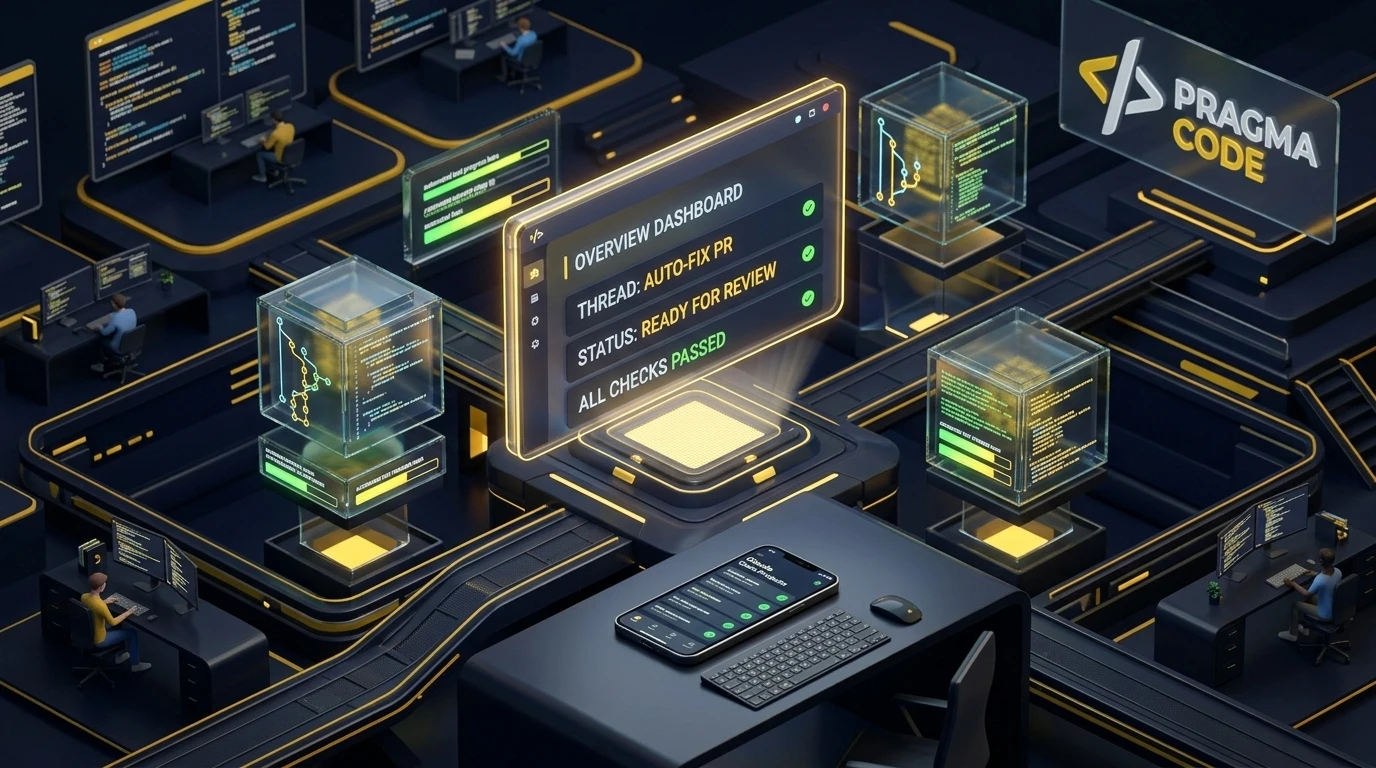
Within the Overview pane, the thread transitions to „Ready for review“. The engineer inspects the diff on desktop or mobile, verifies the test summary, and clicks Merge PR to finalize deployment.
The Overview Dashboard: A Multi-Thread Command Center
To prevent operational chaos when dozens of threads execute concurrently, the Overview Pane organizes threads into unambiguous lifecycle states:
Ready for review
The pull request is authored, all CI tests have passed, and the agent awaits human developer sign-off.
Waiting on you
The thread is paused and requires an interactive approval (Permission Prompt) or clarification on task specifications.
Working
The thread is actively running builds, static code analysis, or test iterations isolated in the cloud sandbox.
Landing
The pull request is approved and progressing through GitHub Actions into the automated merge queue.
Idle / Resolved
Successfully concluded or archived tasks whose code changes have been merged and documented.
Pro-Tip: Keep Setup Scripts Under 5 Minutes
Anthropic enforces a strict five-minute budget for building the initial cloud environment cache. If package installations, asset compilations, or large container downloads exceed this threshold, new session creation stalls. Optimize setup scripts by running independent package installs in parallel using & followed by wait, and defer heavy assets to background hooks.
5. Enterprise B2B Scenarios: 5 Proven Applications for Software Teams
Where do Claude Code Projects deliver the highest operational ROI for software agencies, high-growth startups, and mid-market IT organizations? We identified five enterprise scenarios where asynchronous cloud threads outperform traditional development tooling:
1. Cross-Repository Dependency Migrations
Rolling out security patches or major runtime upgrades (e.g., migrating to Node 24 or upgrading core ORMs) across 10 distinct microservices: A single project prompt dispatches 10 parallel threads. Each thread handles one service, resolves breaking changes, and delivers an independently verified PR.
2. Overnight Bug Triage („Close the Laptop“)
Before leaving the office, developers paste five error reports from application monitoring into the project chat. While the team sleeps, cloud threads reproduce the bugs in isolated sandboxes, craft unit tests, implement fixes, and provide five ready-to-merge pull requests by morning.
3. Monorepo Linter & Strict Typing Enforcement
Legacy enterprise codebases often accumulate technical debt via relaxed compiler flags. Claude Code Projects can systematically tackle directory by directory in parallel, fixing type errors without blocking active feature development on local developer workstations.
4. OpenAPI & SDK Synchronization
Whenever backend teams introduce or modify REST endpoints, a dedicated project thread inspects differences against the OpenAPI specification, updating client SDKs, frontend types, and integration documentation across downstream repositories.
5. Non-Code Knowledge Audits in Library Tab
Projects are not restricted to software code: Via the built-in Library tab, teams can upload PDF contracts, compliance audit questionnaires, or customer support ticket archives. Parallel threads analyze trends, extract clauses, and deliver structured synthesis reports.
The combination of multi-repository access and shared memory is especially impactful in distributed microservice landscapes. Previously, an engineer needed several terminal windows and multiple IDE workspaces to propagate an API contract update from backend microservices through an API gateway to web and mobile frontends. Within a single Claude Code Project, all related repositories are linked. Threads coordinate dependencies dynamically, maintaining architectural parity across service boundaries.
6. Governance, Security & Token Economics for Engineering Leaders
For CTOs, CISOs, and enterprise architects, deploying autonomous cloud agents requires rigorous evaluation of access permissions, data governance, and cost structures. Empowering AI agents to run code inside cloud virtual machines and push to production repositories demands robust guardrails.
Token Acceleration via Concurrency
Because projects easily execute four or five threads simultaneously, token consumption multiplies relative to linear chat sessions. On Pro and Max tiers, usage thresholds can be reached significantly faster. Engineering managers must calibrate model selection and thread limits deliberately.
Network Isolation & Egress Boundaries
Cloud environments default to Trusted network access, allowing outbound traffic to package registries (npm, PyPI) while blocking private internal endpoints. Tasks requiring internal service credentials require deliberate environment variable configurations and credential protection.
Permission Modes & Operational Governance
Claude Code Projects provides three granular permission levels to govern agent autonomy across cloud sessions:
Auto Mode (Classifier-Governed)
An internal safety classifier continuously assesses agent actions. Safe read, formatting, and unit test operations proceed without interruption; high-risk commands halt for approval.
Accept Edits (Continuous Delivery)
Claude makes code modifications and pushes branches autonomously, but halts for human confirmation before executing destructive shell commands.
Plan Mode (Architectural Gate)
The agent authors a detailed execution roadmap and waits for human sign-off before modifying any files in the repository.
When Projects Fit – and When Local Sessions Remain Essential
Despite the speed and autonomy of cloud threads, specific engineering tasks remain better suited for local CLI sessions or Remote Control:
1. Local Hardware & Device Emulators
Workflows dependent on physical hardware debuggers, local iOS/Android simulators, or specialized workstation GPU resources that cannot run inside cloud VMs.
2. Corporate VPNs & On-Premise Databases
Test suites requiring direct network connections to internal staging databases or protected services inaccessible without specialized corporate ingress.
3. Strict Zero Data Retention (ZDR) Mandates
Organizations bound by strict ZDR policies cannot utilize cloud sessions currently, as cloud VMs utilize temporary operational caching. Local CLI execution remains the standard operating model.
7. Conclusion, Checklist & Strategic Action Items
The launch of Projects in Claude Code represents a defining evolution in Agentic Coding. Anthropic elevates software engineers from manual prompt operators to orchestrators of autonomous engineering pipelines. By combining decoupled cloud containers, persistent shared memory via MEMORY.md, and self-healing auto-fix pull requests, the manual overhead of software maintenance is reduced by an order of magnitude.
For mid-market software teams and technology leaders, the strategic imperative is clear: Repositories configured with rigorous CLAUDE.md standards, modular CI pipelines, and high-coverage automated test suites will achieve unprecedented engineering velocity.
Quick-Check: Getting Started with Claude Code Projects
Are you planning autonomous AI agents and engineering workflows for your company?
Schedule a Free Initial ConsultationOfficial Sources & Primary Documentation
- Anthropic Claude Code Documentation (September 2026): "Let Claude coordinate ongoing work with Projects" – Official architectural guide to thread coordination, memory management, and repository setup.
- Anthropic Web Quickstart & Cloud Sessions (September 2026): "Get started with Claude Code in the cloud" – Comprehensive overview of cloud VMs, GitHub integration, and permission modes.
- Anthropic Cloud Environments Specification (2026): "Configure Cloud Environments and Setup Scripts" – Network access levels, caching time limits, and environment variable security.
Our Regional Expertise
We are your digital partner – regionally anchored and successfully scaling across borders.
Have a vision?
Let's check together how we can make your idea take flight.
Book your free strategy call nowExtended Specialized Glossary
Claude Code Projects
A development and orchestration environment by Anthropic that coordinates software tasks through a central conversation, dispatching them as parallel cloud threads across GitHub repositories.
Cloud Sessions
Autonomous, cloud-based execution environments for AI coding agents that run and persist on isolated virtual machines independently of the local developer machine.
Coordinator Agent
A supervisory AI agent that analyzes complex user objectives, decomposes them into granular subtasks, delegates them to specialized worker threads, and tracks overall progress.
Auto-Fix PR
An automated remediation mechanism in GitHub workflows where an AI agent monitors pull requests and autonomously pushes patches in response to CI test failures or reviewer feedback.
Project Memory
A persistent, file-based knowledge repository (MEMORY.md) that preserves architectural decisions, constraints, and operational learnings across all agent threads.