


In a wide-ranging 45-minute podcast interview with Marina Mogilko, Felix Rieseberg—Engineering Lead for Claude.ai, Claude Cowork, and Claude Code Desktop at Anthropic—delivers a candid diagnosis: organizations have access to models Anthropic CEO Dario Amodei compares to a 'country of geniuses in a datacenter,' yet most teams still operate them like 2024 chatbots. We analyzed the full episode and distilled its core lessons on AI workflows, adversarial verification, and software strategy.
This article is an in-depth expert contribution from our content cluster. Discover the complete overview on our main page: AI Automation for Modern Enterprises →
- The Capability-Usage Gap: Modern frontier models can analyze massive raw datasets, ship working prototypes, and operate software tools autonomously—yet most professionals remain stuck in 2024 habits like email summarization, persona prompting, and manual copy-pasting.
- Separate Generation from Evaluation: Felix Rieseberg rarely trusts a single AI session to grade its own work. Instead, he runs 5 to 10 parallel red-team streams to attack an output, followed by a separate LLM-as-a-Judge layer that filters signal from noise.
- Empathy and Process Design Beat Raw Code: When software prototypes can be built in days, competitive advantage shifts away from memorized framework syntax toward customer empathy, trusted relationships, and modernizing neglected real-economy legacy systems.
We Are Still in the Pre-iPhone Era of Artificial Intelligence
Speaking with Marina Mogilko, Anthropic Engineering Lead Felix Rieseberg draws a striking analogy: today's AI products are like feature phones right before the launch of the smartphone. Organizations that fail to evolve from isolated micro-prompts toward outcome-driven Agentic AI workflows risk leaving their biggest productivity lever untouched.
- 1. Introduction: A Datacenter of Geniuses Stuck in Email Mode
- 2. From Coder to Curator: Automation vs. Augmentation
- 3. Leaving 2024 Behind: Four AI Myths Holding Teams Back
- 4. Quality Without Domain Mastery: Adversarial Verification & the Judge Pattern
- 5. Escaping the Founder Bottleneck: Scaling Human Taste and Judgment
- 6. Software Economics, Legacy Opportunities & Careers in the AI Era
- 7. 5-Step Roadmap: Moving from 2024 Chat to 2026 Workflows
- 8. Conclusion: Operating on a 10-Week AI Cadence
1. Introduction: A Datacenter of Geniuses Stuck in Email Mode
When evaluating advice on enterprise AI adoption, the messenger's vantage point matters. In a 45-minute interview hosted by entrepreneur and podcaster Marina Mogilko—published on her Russian-language YouTube channel on November 13, 2026 („Руководитель Claude: Вы используете ИИ не на полную“) alongside the English-language original on Silicon Valley Girl (“Claude Engineering Lead: Stop Using Claude Like It’s 2024”)—Felix Rieseberg offers a rare look inside Anthropic's own product kitchen. Originally from Germany, Rieseberg previously led desktop and infrastructure engineering teams at Microsoft, Slack (where he co-maintained the Electron framework), Stripe, and Notion. At Anthropic, he has led engineering for Claude.ai, Claude Code Desktop, and Claude Cowork—an agentic desktop workspace whose initial version his team built in roughly a week and a half.
His core diagnosis resonates with engineering leaders and business executives worldwide in late 2026: there is a massive gap between what frontier models can actually accomplish and how everyday professionals use them. Anthropic CEO Dario Amodei famously compared advanced AI to a “country of geniuses in a datacenter.” Rieseberg translates that metaphor into a sobering reality check: many knowledge workers sit in front of that datacenter and ask it for the capital of France—or merely request a shorter, friendlier rewrite of a single email.
What makes Rieseberg's perspective particularly credible is its lack of hype. He openly admits that telling Claude “go make money” does not work, that a single chat thread is a poor judge of its own output, and that almost every tactical recommendation he makes today will likely need to be reconsidered within ten weeks. That pragmatic honesty makes the conversation an essential counterpart to our analysis of DHH on Agentic Engineering and the limits of Vibe Coding as well as our study on Andrei Doronichev on Digital Workers and the Trust Economy.
2. From Coder to Curator: Automation vs. Augmentation
What does a workday look like for an Anthropic engineering lead who no longer writes production code by hand? Rieseberg describes moving up a level of abstraction. Agents brief him on priorities in the morning, while the bulk of his day centers on human empathy, understanding how people work, generating product hypotheses, and rapid prototyping. He describes his current role as an unusual hybrid of product manager, technical director, people manager, and data analyst—because modern models reduce how often he needs to wait on specialists from other disciplines.
That shift has fundamentally altered how product ideas get evaluated. For the past 10 to 15 years, software decisions implicitly began with a cost calculation: Can we build this? What will maintenance cost? What opportunity cost are we accepting? Today, Rieseberg asks Claude to build working prototypes for multiple competing ideas at once, interacts with them directly, and discards most of them. Yet one constraint has not budged at all: human attention. Even if an AI can produce a thousand prototypes a day, you can realistically show a colleague or customer only one crisp idea before their judgment fatigues. As Rieseberg notes, great products still follow the classic rule that perfection is reached when there is nothing left to remove. The true signal of product quality is showing a prototype to a handful of users and watching it click immediately—enabling them to accomplish something they could not do before.
The Strategic Distinction: Cost Reduction vs. New Capabilities
When Marina Mogilko asks how he would evaluate a real company—such as her 35-person media and education business—to decide what to automate fully, partially, or keep human, Rieseberg draws a sharp line between two concepts:
Automation removes tedious, repetitive, or expensive work so teams can focus on higher-value activities. Rieseberg explicitly acknowledges that automation currently delivers the clearest, most measurable economic return on investment. Yet the domain that excites him even more is augmentation: empowering people to perform work they previously lacked the technical training, tooling, or background knowledge to attempt at all.
To illustrate augmentation, Rieseberg shares a story from just days before the recording: a product manager named Pavel fed a large set of public NASA space data into Claude and asked it to search for anomalies—and Claude flagged a candidate new exoplanet (which, as Rieseberg notes carefully, remains unconfirmed while NASA reviews it). The lesson for enterprise teams has nothing to do with astrophysics and everything to do with mindset: pointing capable models at vast, messy internal datasets to uncover overlooked patterns is now accessible to non-specialists—provided organizations are willing to reflect critically on how their own workflows operate.
Workflow Comparison: 2024 Habits vs. 2026 Outcome Orchestration
- Micro-Tasks: Summarizing emails, polishing isolated paragraphs, or asking single trivia questions.
- Human as Data Mule: Manually opening bug trackers, copying one issue at a time into chat, and pasting fixes back.
- Expert Role-Play: Prompts like “Act as a world-class accountant” trigger superficial jargon instead of rigorous methods.
- Rigid Agent Silos: Designing an artificial cast of narrow persona agents restricted to tiny pre-filtered data slices.
- Self-Grading Chats: Asking the same active session whether its own output is accurate and complete.
- Outcome Delegation: Giving the model the real business goal and pushing until you discover the true frontier ceiling.
- Direct System Access: Connecting raw logs, desktop browsers, tools, or Claude Tag directly in team channels.
- Pro Tooling & Methodology: Instructing the model to use the concrete tools and intermediate steps of top practitioners.
- Tool-Equipped Generalists: Letting a strong generalist model pull exactly the context it needs on demand through clean tools.
- Adversarial Verification: Running parallel red-team critique streams, an independent judge layer, and primary-source checks.
3. Leaving 2024 Behind: Four AI Myths Holding Teams Back
At the heart of the interview, Rieseberg dismantles four entrenched habits that many organizations codified as “best practices” in 2024—and that now actively degrade results with 2026 models.
1. The “Act Like an Expert” Costume
Telling a model “Act like a top accountant or senior engineer” often pushes it into role-play theater—mimicking industry vocabulary without adopting rigorous craft. What actually elevates output is asking Claude to execute the intermediate steps and real tools used by top professionals: for instance, using real animation toolchains for motion design with Claude Opus 5.5, or applying journalist Adam Davidson's editorial stress-test (“Take the strongest counterargument and amplify it 100x”).
2. Over-Engineering Multi-Agent Casts
Rieseberg offers an intentionally contrarian view: the industry is overdoing persona-based multi-agent setups. Humans find it comforting to box AI into familiar job titles, yet doing so artificially narrows generalist models that combine elite reasoning across biology, mathematics, and engineering. He points to the International Mathematical Olympiad: Google DeepMind first achieved silver with specialized math systems (AlphaProof/AlphaGeometry 2), only for generalist frontier models (Gemini with Deep Think) to reach gold-medal level shortly afterward.
3. Data Silos and Stale Skill Files
Pre-slicing tiny datasets for individual agents mirrors an engineering manager who can view source code but is barred from customer calls and product telemetry—stripped of context, their usefulness plummets. Modern models have become selective enough to fetch only what they need via well-described tools. Rieseberg adds an urgent caveat about Skills: instructions written to compensate for older model generations go stale remarkably fast, and removing an outdated skill sometimes improves results immediately.
4. Acting as a Human Conveyor Belt
A year and a half ago, Rieseberg realized he had turned himself into a conveyor belt: opening an error log, selecting one bug, copying it into Claude, waiting for a fix, and repeating. His mental model for breaking the cycle is simple: “Put yourself in the model's shoes for five seconds.” If you were Claude tasked with fixing bugs, what would you need? Direct access to all error reports, raw source files, and a real computer or browser environment.
The warning about stale skills and rigid project setups hits close to home for early enterprise adopters. Mogilko notes that her team spent a year refining Markdown files, rules, and custom projects—and now wonders whether to tear them down. Rieseberg's stance is refreshingly pragmatic: if a workflow genuinely works, do not break it for the sake of novelty. However, teams that want to scale alongside newer models should periodically benchmark a clean, unencumbered chat against their legacy setup to see whether heavy prompt scaffolding has quietly turned into drag. For a closer look at how this shift plays out in software repositories, see our hands-on review of Claude Code Projects and autonomous Cloud Threads.
4. Quality Without Domain Mastery: Adversarial Verification & the Judge Pattern
One of the most practical questions for any executive comes midway through the episode: How do you avoid getting fooled when AI confidently delivers wrong answers—especially in a field where you are not an expert yourself? Rieseberg's answer starts with a clear boundary.
“For me, the question is less about what I would never trust Claude with, and more about what I would never trust a single session—a single chat—to handle alone. I rarely want the current session to evaluate its own work.”
Whether working in Claude Code, Claude Cowork, or a standard project thread, asking an active session to grade its own performance remains unreliable. Rieseberg's solution borrows directly from software engineering and production AI Evals: Adversarial Verification paired with an independent Judge.
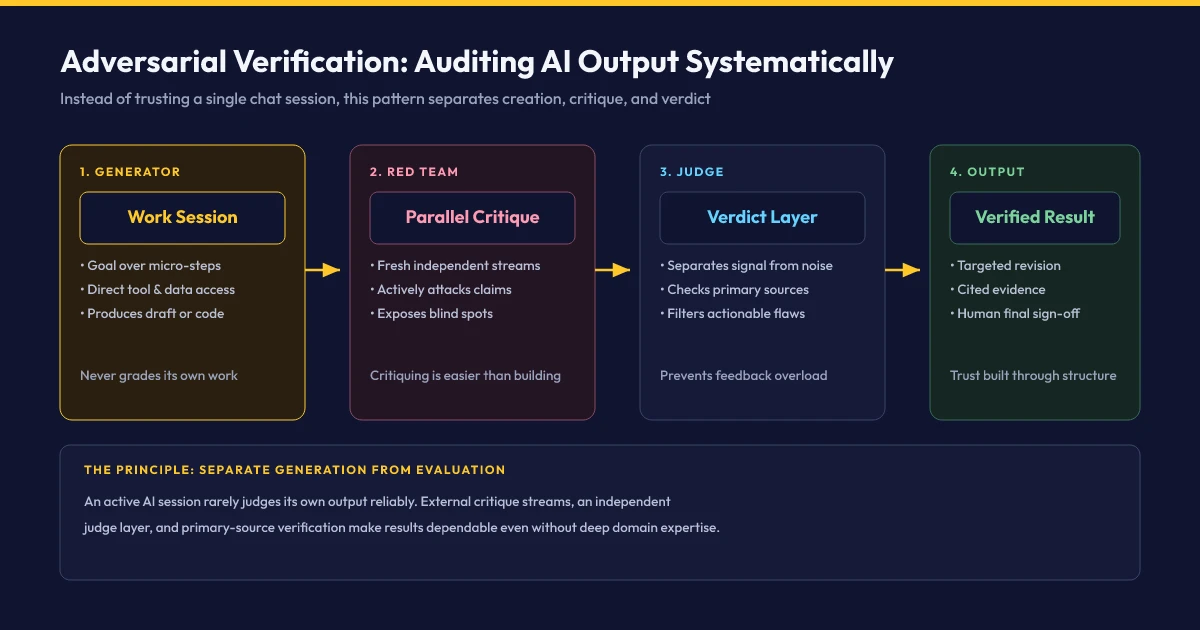
How the Four-Stage Review Loop Works in Practice
Whenever Rieseberg finishes an important artifact—such as a technical essay, strategy memo, or presentation—he spins up five to ten parallel, independent threads with an explicitly adversarial brief: Prove that this draft is wrong, expose flawed logic, challenge factual claims, and show where my thinking misses the mark. He compares this to hiring ethical hackers against your own work or shorting your own thesis. It also comes with a cost advantage: just as humans find it far easier to critique a finished smartphone than to design one from scratch, spotting flaws is easier for models than generating novel work—meaning a smaller, less expensive model tier often performs remarkably well in the red-team role.
Anyone who runs multiple critique streams quickly hits a second obstacle that Mogilko recognizes immediately: conflicting feedback from five models creates decision paralysis. That is why stage three introduces a dedicated Judge (LLM-as-a-Judge). A separate Claude instance evaluates the red-team objections, separates genuine defects from nitpicking or irrelevant advice, and sends only actionable findings back to the original working thread. When multiple hostile review passes yield only minor, non-actionable quibbles, you gain genuine structural confidence that the output holds up.
Expert Tip: When Single-Agent Fact-Checking Already Works at 100%
Rieseberg draws a clean distinction across three trust tiers. For editorial fact-checking (“Find a reliable primary source for every single number in this slide deck”), he already trusts a single Claude session at 100% without needing fifty agents. For unfamiliar technical domains where you cannot judge correctness yourself, his rule is to throw more tokens at verification via red-teaming and a judge. Finally, for subjective or visual outputs, acting like a discerning client is often enough: Rieseberg rebuilt his personal website with custom 3D graphics without ever opening Blender, simply because he could evaluate the visual result directly.
Equally important is rethinking how teams define “good” in non-deterministic work. Rieseberg illustrates this with a weather-reporting agent: if a model randomly guesses the exact outdoor temperature, that still counts as a failure because the underlying process is unreliable. Conversely, if an agent misses by half a degree after correctly identifying the location, consulting trustworthy sources, and deriving the answer honestly, that process deserves a much higher score. Enterprise teams building reliable evaluation pipelines can explore these exact scoring mechanics in our deep dive on AI Evals in Practice.
5. Escaping the Founder Bottleneck: Scaling Human Taste and Judgment
A standout segment of the podcast addresses a frustration familiar to almost every founder and department head adopting AI: becoming the company's primary bottleneck. Mogilko explains the trap vividly: Claude drafts roughly 70% of a piece of content, her team refines it, and she injects the decisive final 30%—her taste, voice, and editorial judgment—via chat feedback. Because the model never sees the final published delta, it fails to improve over time, forcing every deliverable back onto the founder's desk.
Rieseberg encounters the exact same challenge in engineering organizations where every senior engineer looks for different qualities during code review. His remedy avoids expensive custom model training and instead builds directly on existing communication channels (such as Slack, GitHub, or review logs) in four structured steps:
Harvest Historical Feedback Automatically
Rather than manually writing a style guide from scratch, give Claude direct access to the platforms where honest feedback already lives—Slack threads, GitHub pull request comments, or review docs—so it can gather your actual past critiques automatically.
Compress Critiques into Explicit Principles
Ask Claude to distill those scattered comments into a crisp list of rules, quality bars, and recurring priorities that capture what “good” genuinely means to you and your organization.
Surface Implicit Taste You Didn't Know You Had
Rieseberg highlights a powerful third prompt: “Which principles am I clearly applying in my feedback that I may not even be consciously aware of?” This turns tacit executive intuition into explicit, repeatable team standards.
Run in Shadow Mode, Then Deploy via Claude Tag
To build trust without handing over the wheel overnight, run Claude in parallel alongside yourself: write your own review notes on several deliverables, compare them against Claude's critique, and calibrate the gaps. Once aligned, Rieseberg recommends Claude Tag inside Slack—Anthropic's multiplayer channel integration—so multiple teammates can collaborate directly with a shared Claude instance grounded in your quality standards.
Even here, Rieseberg stays grounded: humans themselves are not perfectly consistent—ask the same executive to review a memo on Monday morning versus Friday afternoon and you will get different comments. Shadow mode works precisely because it makes alignment observable before delegating autonomy. For a broader leadership view on managing blended teams of people and agents, see our article on Alien Intelligence and Leading AI Agents.
6. Software Economics, Legacy Opportunities & Careers in the AI Era
In the final third of the interview, the discussion zooms out to software economics and career strategy. Mogilko poses the question weighing on every founder's mind: back in 2015, building a booking platform required hundreds of thousands of dollars and a full engineering team; today, a solo founder can assemble a comparable prototype in two days via Vibe Coding or Agentic Engineering. Where does a software company's competitive moat live now?
Rieseberg's answer cuts against popular tech determinism: fundamentally, less has changed than people assume. Lower upfront capital means one- or two-person teams may indeed build billion-dollar companies, and clunky software that users previously tolerated solely for lack of alternatives will likely vanish. Yet the enduring secret of great software has always been deep empathy for the customer, understanding what people truly value enough to pay for, and lasting relationships. Rieseberg jokes about an old blog post he once wrote dismissing the iPhone as foolish because it lacked a physical keyboard: the products we love most are almost always designed by someone who understood our needs better than we could articulate ourselves. As implementation becomes cheap, business insight and customer discovery—what Rieseberg playfully calls a potential “revenge of the MBA graduates”—become disproportionately valuable.
1. The Overlooked Opportunity: Real-Economy Legacy Software
In Silicon Valley, it is easy to assume the whole world runs on brand-new laptops. Glance behind an airport gate counter, a hotel front desk, or a dental clinic screen and you will still find clunky Windows utilities and monochrome text terminals. Modernizing these neglected operational systems represents massive greenfield potential.
2. Deeply Embedded Intelligence vs. Weak Sidebar Chatbots
Rieseberg criticizes the wave of products cluttered with cheap sidebar chatbots that do little more than parrot an FAQ page. The winning next generation of B2B applications embeds truly capable frontier models into the core workflow and adapts organically to each user.
3. Redefining the Developer: System Composition Over Memorized Syntax
Software engineers face an identity shift: memorizing every API in React or any single framework is rapidly losing value. What commands a premium now is combining five disparate systems creatively, talking to customers, and shipping tangible products that people actually want to buy.
4. Practice Over Ivory Towers: The University of Waterloo Model
Drawing on his German computer science background—heavily theoretical and math-focused—Rieseberg praises the University of Waterloo's co-op approach. Graduates who complete four or five real-world internships learn how organizations actually function: how to pitch ideas, secure resources, and navigate legal or cross-functional teams from day one.
That pragmatic philosophy carries directly into hiring and career advice. Both Mogilko and Rieseberg agree that formal degrees fade into the background whenever real proof of work exists. For junior developers wondering how to stay relevant over the next three years, Rieseberg's advice is straightforward: stop memorizing single technical tools, build a portfolio of real shipped projects rather than mockups, develop customer empathy, and practice connecting multiple systems into cohesive solutions. Notably, he observes that younger engineers often adapt faster to this paradigm than senior developers accustomed to executing tickets without questioning the underlying business goal.
7. 5-Step Roadmap: Moving from 2024 Chat to 2026 Workflows
How can executives, product managers, and IT teams turn Rieseberg's insights into measurable progress without getting trapped in over-engineered setups? The five-step roadmap below translates the interview into an actionable rollout plan—complementing the system patterns in our guide to Agentic AI Workflows 2026:
-
1. Start Light with Desktop & Browser Instead of Weeks of Prep
Skip months of writing tone-of-voice documents or complex data exports up front. Follow Rieseberg's onboarding tip: install the Claude desktop app with its built-in browser and Claude Cowork, let it operate directly inside your real tools, and discover where it creates immediate leverage. Only wire direct APIs or MCP connectors once a workflow proves its value.
-
2. Eliminate Human Conveyor Belts and Delegate Full Outcomes
Audit every workflow where employees manually copy error reports, tickets, or spreadsheets into a chat box. Grant scoped, secure tool access to raw operational data and delegate end-to-end objectives—specifying professional methodologies and real toolchains instead of superficial expert personas.
-
3. Standardize Adversarial Verification and Primary-Source Fact-Checking
Make it a team norm that no high-stakes deliverable—whether code architecture, legal analysis, or an executive deck—is signed off by the same session that drafted it. Implement parallel red-team critique streams, a separate Judge layer, and mandatory primary-source verification for every cited metric.
-
4. Extract Leadership Feedback and Validate in Shadow Mode
Break the founder bottleneck systematically: let Claude extract historical review comments from Slack or GitHub into explicit quality principles, run it in parallel against your own reviews until alignment is proven, and then roll out shared team collaboration through Claude Tag in Slack.
-
5. Schedule a 10-Week Audit for Skills and Workflows
Institutionalize Rieseberg's closing warning: every two to three months, benchmark your saved Skills, custom prompts, and multi-agent chains against a fresh frontier model with minimal scaffolding. Ruthlessly prune any legacy constraints that were only built to work around yesterday's model limitations.
Quick-Check: Is Your Team Operating in 2026 AI Mode?
8. Conclusion: Operating on a 10-Week AI Cadence
What makes Marina Mogilko's conversation with Felix Rieseberg so valuable is how firmly it anchors AI strategy in day-to-day execution. We are not witnessing the finished state of artificial intelligence—we are standing in its pre-iPhone moment. Because capability growth is exponential, our human intuition routinely underestimates how quickly yesterday's impossible benchmarks turn into everyday defaults.
For modern businesses, the decisive bottleneck in 2026 is rarely access to a smarter model; it is organizational workflow maturity. Teams that retire 2024 chat habits, replace fragmented data silos with clean tool access, separate creation from evaluation through Adversarial Verification, and double down on human empathy and real-economy problem solving will capture durable advantage—while re-examining their own playbook every ten weeks as the frontier keeps moving.
Official Sources & Primary Documentation
- Marina Mogilko (YouTube, Nov 13, 2026): “Руководитель Claude: «Вы используете ИИ не на полную»” – Full 45-minute podcast interview with Felix Rieseberg (primary basis of this analysis).
- Silicon Valley Girl / Marina Mogilko (YouTube, 2026): “Claude Engineering Lead: Stop Using Claude Like It’s 2024” – Original English-language video episode with Felix Rieseberg.
- Felix Rieseberg (Official Profile): “Felix Rieseberg – Engineering Leadership & Projects” – Career background across Anthropic, Notion, Stripe, Slack/Electron, and Microsoft.
- Anthropic Support Documentation (2026): “Get started with Claude Cowork” – Official documentation for Anthropic's agentic desktop workspace.
- Anthropic Newsroom (2026): “Introducing Claude Tag” – Official announcement of Claude Tag for multiplayer team workflows in Slack.
- Dario Amodei (October 2024 & January 2026): “Machines of Loving Grace” and “The Adolescence of Technology” – Primary essays behind the “Country of Geniuses in a Datacenter” metaphor referenced in the episode.
- Google DeepMind (July 2024 & July 2025): “AI achieves silver-medal standard solving International Mathematical Olympiad problems” and “Advanced version of Gemini with Deep Think officially achieves gold-medal standard at the IMO” – Official primary milestones illustrating the shift from specialist systems to generalist frontier models.
Our Regional Expertise
We are your digital partner – regionally anchored and successfully scaling across borders.
AI automation for your business?
I deliver this for small and mid-sized businesses: at a fixed price agreed upfront, working directly with the person who builds it. Process, scope and pricing are on the service page.
See service & pricing Or request a free intro callExtended Specialized Glossary
Claude Cowork
An agentic desktop workspace developed by Anthropic that extends the autonomous workflow model of Claude Code beyond the developer terminal to general knowledge work with direct file and browser access.
Claude Tag
Anthropic's collaborative Slack integration for Team and Enterprise workspaces, allowing a shared Claude instance to work directly inside channels via @Claude mentions, read thread history, and execute tasks asynchronously.
Adversarial Verification
A quality assurance pattern for AI workflows where independent critique sessions (red teams) actively attack a generated draft for factual, logical, or architectural flaws before a separate judge layer approves revisions.
LLM-as-a-Judge
An evaluation pattern where an independent language model reviews outputs or critiques produced by other AI sessions against defined criteria to separate substantive flaws from noise.
Agentic Engineering
A software development paradigm in which autonomous AI agents execute multi-step tasks—planning, coding, testing, and refactoring—under human architectural oversight and curation.
Vibe Coding
An informal development practice where users generate software primarily through natural-language prompts without closely inspecting the underlying source code or system architecture.