

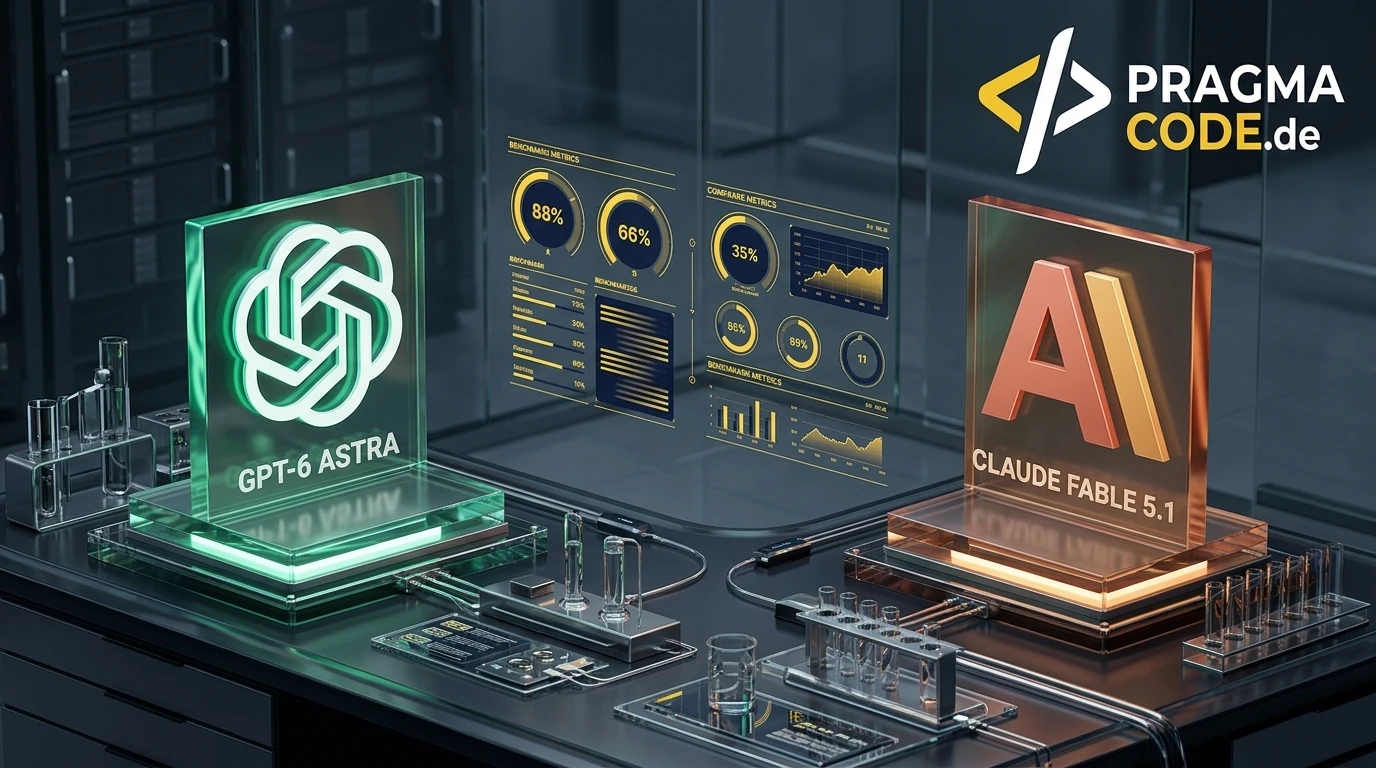
Late summer 2026 represents a historic inflection point in enterprise artificial intelligence. With the back-to-back releases of OpenAI GPT-6 Astra and Anthropic Claude Fable 5.1, two distinct paradigms of frontier intelligence collide. Explore our comprehensive B2B benchmark breakdown to evaluate which flagship leads in software engineering, desktop control, governance, and operational total cost of ownership.
This article is an in-depth expert contribution from our content cluster. Discover the complete overview on our main page: AI Automation & Intelligent Agents →
- Frontier-Class Paradigm Shift: While OpenAI's GPT-6 Astra emphasizes radical action-token efficiency and autonomous graphical desktop control (OSWorld 2.0: 72.6%), Anthropic's Claude Fable 5.1 focuses on deterministic precision and zero regressions across multi-hour software engineering pipelines.
- The Economics of Context: Despite identical baseline sticker prices ($10.00 input / $50.00 output per 1M tokens), architectural differences dictate overall total cost of ownership (TCO). With Fable 5.1, Anthropic cut the cache-read price to $0.25 per 1M tokens, which according to Anthropic makes highly agentic tasks up to about 45% cheaper than on the predecessor Fable 5. Astra, in turn, needs far fewer tokens per task than its predecessor GPT-5.6 Sol, according to Artificial Analysis.
- Strategic Dual-Gateway Architecture: For modern IT enterprises and mid-market organizations, single-vendor lock-in represents an unnecessary risk. A unified, model-agnostic routing gateway enables teams to capitalize dynamically on the complementary strengths of both premier frontier engines.
From Generative Text Assistants to Autonomous Enterprise Operators
The era of simple conversational chatbots has concluded. In late summer 2026, enterprise CTOs and software architects evaluate foundation models not by conversational eloquence, but by their ability to autonomously resolve complex, multi-hour engineering tickets across actual operating systems, build environments, and container runtimes. With GPT-6 Astra and Claude Fable 5.1, two premier models now claim readiness for critical, unsupervised production workloads.
- 1. The September 2026 Frontier Showdown: OpenAI vs. Anthropic at the Summit
- 2. Architectures & Core Philosophies: Action-First vs. Deep Deliberation
- 3. The Benchmark Comparison: What the Vendor Numbers Show
- 4. Real-World Software Engineering: Agentic Coding in Production Workflows
- 5. Enterprise Governance: OpenAI Daybreak vs. Anthropic Enterprise Frontier Safeguards
- 6. TCO & Tokenomics Breakdown: Sticker Prices, Context Caching & Actual Task Costs
- 7. The Dual-Gateway Strategy & 5-Phase Adoption Roadmap for Enterprises
- 8. Strategic Decision Matrix & Key Recommendations for IT Leadership
1. The September 2026 Frontier Showdown: OpenAI vs. Anthropic at the Summit
The first week of September 2026 witnessed an unprecedented acceleration in generative AI capabilities. Within a 48-hour window, the industry's leading research labs released their most advanced models to date. On September 1, 2026, Anthropic introduced Claude Fable 5.1 alongside its restricted, high-assurance sibling Mythos 5.1. OpenAI swiftly answered on September 3 by unveiling GPT-6 Astra, the direct successor to its celebrated GPT-5.6 Sol model.
This dual release signifies a fundamental paradigm shift in Agentic AI. Early generations of large language models functioned primarily as reactive text generators. In contrast, Astra and Fable 5.1 operate as autonomous system engineers. They ingest multi-hundred-thousand-line monorepos, construct mental dependency graphs, formulate architectural specifications, build and test code in isolated runtime environments, diagnose low-level operating system faults, and apply verified security patches with zero human supervision.
For engineering executives, CTOs, and digital transformation teams, the strategic imperative has shifted from questioning the viability of autonomous agents to deciding how to allocate workloads between these two premier systems to maximize velocity while mitigating compliance and operational risks.
2. Architectures & Core Philosophies: Action-First vs. Deep Deliberation
Beneath the surface, OpenAI and Anthropic have engineered contrasting architectures reflecting fundamentally distinct perspectives on computational problem solving.
OpenAI GPT-6 Astra: The Action-First Architecture
OpenAI designed GPT-6 Astra around execution density and minimal interactive latency. Rather than producing lengthy internal monologues prior to executing actions, Astra treats problem solving as an iterative sequence of stateful tool invocations. It generates concise, atomic commands, runs them directly within terminal or browser runtimes, and refines its trajectory dynamically based on real-time environmental feedback.
A key strength is token efficiency: according to Artificial Analysis, Astra at maximum reasoning effort uses only one third of the tokens of GPT-5.6 Sol per task in the Coding Agent Index. OpenAI has not disclosed how this is achieved internally. Fewer tokens also mean shorter waits on interactive tasks, which makes Astra attractive for developer tools and GUI automation.
Anthropic Claude Fable 5.1: The Deliberative Verification Paradigm
Anthropic engineered Claude Fable 5.1 with a focus on mathematical rigor and preemptive correctness. Before executing any write command or initiating external API requests, Fable 5.1 builds an internal dependency graph of the entire repository. It systematically models downstream side effects, validates type contracts, and simulates potential breaking changes.
This process, termed Recursive Self-Verification, provides Fable 5.1 with industry-leading reliability when refactoring complex enterprise monoliths, migrating relational database schemas, or auditing compliance policies. While Astra occasionally converges on solutions through rapid trial and error, Fable 5.1 consistently produces production-ready, regression-free code on the first attempt, preventing subtle cascading bugs across interdependent microservices.
Architectural Comparison: GPT-6 Astra vs. Claude Fable 5.1
- Core Philosophy: High-velocity, iterative tool execution in terminal and GUI environments with minimal task latency.
- Tool Integration: Empirical trial and error; leverages shell return codes and runtime stdout/stderr to steer execution.
- Token Behavior: Extreme token compression across code diffs and tool payloads; minimizes net tokens generated per task.
- Target Domains: Visual desktop automation, interactive DevOps debugging, systems administration, and formal mathematics.
- Core Philosophy: Deterministic architectural modeling, formal correctness verification, and regression prevention.
- Tool Integration: Preemptively constructs full code dependency graphs prior to performing file mutations.
- Token Behavior: Leverages high-performance prompt caching ($0.25 / 1M tokens) to sustain massive persistent contexts cost-effectively.
- Target Domains: Multi-file enterprise refactoring, compliance auditing, safety-critical systems, and research workflows.
3. The Benchmark Comparison: What the Vendor Numbers Show
There is no shared test suite that both vendors accept. The most reliable figures are the tables OpenAI and Anthropic published at launch, plus independent indices such as Artificial Analysis. The values below come from OpenAI’s GPT-6 Astra launch table (September 3, 2026), Anthropic’s benchmark table for Claude Opus 5.5, which includes GPT-6 Astra and Fable 5.1, as well as Artificial Analysis and ARC Prize.
In-Depth Analysis of Individual Benchmark Disciplines
The picture is less balanced than often claimed: on the coding, math and computer-use tests OpenAI published, GPT-6 Astra leads. Claude Fable 5.1, in turn, leads on knowledge work. On Artificial Analysis’ composite Intelligence Index, the two are tied.
1. Agentic Coding: Terminal-Bench 4.0, DeepSWE & FrontierCode
On Terminal-Bench 4.0, GPT-6 Astra scores 57.9% and Claude Fable 5.1 55.8%; Anthropic reports the same figure for Fable. The gap is wider on DeepSWE v1.1, with 74.1% for Astra versus 67.4% for Fable 5.1. On FrontierCode 1.1 (Extended) the two are practically tied at 64.5% and 63.6%. By these numbers, Fable 5.1 has no lead in long-horizon software engineering.
2. Math & Science: FrontierMath and Terminal-Bench-Science
On FrontierMath Tier 4 (v2), OpenAI reports 97.6% for GPT-6 Astra and 87.8% for Claude Fable 5.1. On Terminal-Bench-Science 0.1, which tests scientific workflows in the terminal, the score is 64.6% to 52.6%. On GPQA Diamond the models are closer at 96.0% and 93.7%.
3. Computer Use & Abstraction: OSWorld 2.0 and ARC-AGI-3
For OSWorld 2.0, OpenAI reports 72.6% for GPT-6 Astra; neither vendor has published a score for Claude Fable 5.1 on this version. On the interactive ARC-AGI-3, Astra reaches 62.7% according to the ARC Prize leaderboard; no verified score for Fable 5.1 is listed there. The benchmark is deliberately designed so that models must discover unfamiliar game mechanics through trial and error; no model currently comes close to 100%.
4. Cybersecurity: ExploitBench
On the ExploitBench cybersecurity benchmark, OpenAI reports 100% for GPT-6 Astra, even at its lowest tested reasoning level. No comparable score has been published for Claude Fable 5.1. This result is the background to the restrictive Daybreak program (see Chapter 5).
5. Knowledge Work & Composite Index: GDPval-AA, HLE and Artificial Analysis
On tasks drawn from real office work, the picture flips: on GDPval-AA v2.1, Claude Fable 5.1 scores 1,735 Elo and GPT-6 Astra 1,542 Elo. Fable 5.1 also leads on Humanity’s Last Exam with tools at 65.6% versus 57.2% for Astra. On the Artificial Analysis Intelligence Index both score 53 points; according to Artificial Analysis, Astra gets there at roughly 40% of the cost per task.
4. Real-World Software Engineering: Agentic Coding in Production Workflows
Synthetic benchmarks provide valuable baseline comparisons, but how do both flagship models perform in production development environments? Pragma Code evaluated both engines across Google Antigravity, Cursor, Claude Code, and GitHub Copilot Workspace across five demanding engineering scenarios.
1. Multi-File Monolith Refactoring
When converting legacy class-based codebases into modern functional TypeScript and Go architectures, Claude Fable 5.1 plays to its strength in long, carefully self-checked work sessions. For changes spanning many files, a compiler and test run nevertheless remains mandatory to rule out orphaned imports or broken typing contracts.
2. Autonomous Terminal & DevOps Orchestration
GPT-6 Astra dominates this space: it initializes multi-container Docker Compose environments, triages failed Kubernetes pod deployments in live clusters, inspects streaming logs, and resolves network binding conflicts autonomously.
3. Automated Zero-Day Security Patching
Astra identifies obscure memory safety and logic vulnerabilities with unmatched speed. Fable 5.1, however, writes cleaner, backward-compatible patches that reliably pass static analysis gates (SonarQube, Snyk) without unintended regressions.
4. Database Migrations & Schema Evolution
When migrating relational PostgreSQL schemas to distributed NoSQL architectures, Fable 5.1 maintains strict data safety protocols, generating comprehensive idempotent rollback scripts and data validation invariants.
5. Autonomous End-to-End Test Synthesis
Both models generate robust Playwright and Vitest test suites. Astra leverages its computer-use expertise to generate realistic visual regression tests, while Fable 5.1 constructs exhaustive boundary-condition tests for core business logic.
5. Enterprise Governance: OpenAI Daybreak vs. Anthropic Enterprise Frontier Safeguards
For European enterprises and global organizations, raw model intelligence cannot be separated from regulatory compliance. The EU AI Act, GDPR requirements, and intellectual property confidentiality establish strict deployment constraints. In this domain, OpenAI and Anthropic offer distinct governance models.
OpenAI Daybreak Program: High-Assurance Cyber Access Control
Triggered by Astra's perfect 100% ExploitBench performance, OpenAI designated GPT-6 Astra a "Critical" capability model under its safety charter. To mitigate dual-use hazards, OpenAI launched the Daybreak Program:
Enterprise customers utilizing Astra undergo stringent compliance verification. Offensive exploit generation is actively restricted via hardware and API guardrails, with unrestricted cyber capabilities reserved for certified national security entities and validated critical infrastructure operators. For regular commercial enterprises, this provides defense-in-depth against accidental vulnerability generation, though it limits autonomous offensive penetration testing simulations.
Anthropic Enterprise Frontier Safeguards (EFS): Dedicated European Data Sovereignty
Anthropic tailors Claude Fable 5.1 specifically for enterprise data privacy through its Enterprise Frontier Safeguards (EFS) framework:
EFS offers contractually binding Zero-Data Retention (ZDR): customer prompts, code repositories, and completions are strictly isolated and never utilized for model training. Anthropic also guarantees data residency within European cloud regions (Frankfurt and Dublin) and delivers audit documentation designed to satisfy the General Purpose AI (GPAI) with systemic risk obligations established under the EU AI Act.
Zero-Data Retention & IP Protection
Anthropic EFS ensures complete intellectual property isolation. Prompts, source trees, and trade secrets reside in dedicated private tenant spaces and are expunged immediately post-inference.
EU AI Act & GPAI Systemic Risk Compliance
Both models satisfy European transparency, evaluation, and documentation standards. Fable 5.1 provides pre-packaged compliance dossiers to streamline corporate risk audits.
NIS 2 & Critical Infrastructure Alignment
Deployable via sovereign cloud infrastructures (AWS European Sovereign Cloud, Microsoft Cloud for Sovereignty), both models integrate compliantly into audited enterprise supply chains.
Deterministic Safety Guardrails
Anthropic's Constitutional AI prevents semantic drift and invalid outputs, while OpenAI's Daybreak framework enforces granular RBAC and audit telemetry across API endpoints.
6. TCO & Tokenomics Breakdown: Sticker Prices, Context Caching & Actual Task Costs
A high-level inspection of API pricing suggests price parity. Both providers published identical baseline rates for their flagship tiers:
Input Tokens (List Price)
Parity on initial prompt ingestion:
$10.00per 1 Million Tokens (Astra & Fable 5.1)
Output Tokens (List Price)
5x multiplier on generated output tokens:
$50.00per 1 Million Tokens (Astra & Fable 5.1)
However, assuming identical monthly cloud expenditures based on list prices ignores how modern agentic workflows consume compute. In practice, Total Cost of Ownership is determined by two critical factors: prompt caching efficiency and action-token density.
The Prompt Caching Advantage of Claude Fable 5.1
In iterative agentic coding workflows, the agent re-reads the entire project context (architecture documents, library interfaces, source files, and test output) on every execution turn. For a monorepo containing 150,000 tokens, sending that entire payload across 15 iterative tool steps creates immense recurring input volume.
This is where Anthropic plays its biggest economic lever: Prompt Cache Reads on Claude Fable 5.1 cost just $0.25 per 1 million tokens according to Anthropic's price list — a 97.5% discount relative to the standard input rate. On the predecessor Fable 5, it was still $1. Anthropic puts the savings compared with Fable 5 at about 25% for typical workloads and up to about 45% for highly agentic, context-heavy tasks (Anthropic's announcement). This is not a comparison with GPT-6 Astra.
The Action Token Efficiency of GPT-6 Astra
OpenAI counters this cache advantage with token efficiency. According to Artificial Analysis, GPT-6 Astra matches Claude Fable 5.1 in the Intelligence Index at about 40% of the cost per task ($3.26 vs. $7.63), and in the Coding Agent Index at about 60%. Because output tokens are billed at $50.00 / 1M (five times the input rate), Astra's conciseness weighs especially heavily on write-heavy tasks.
Cost Trap: Uncached Monorepos in Autonomous Loops
Running agentic workflows on large repositories without prompt caching means paying for the full context again at every step. A worked example using Claude Fable 5.1 list prices: an agent run with 15 steps on a 200,000-token context consumes 3 million input tokens and costs $30 uncached. With caching, it costs $2.50 once to write the cache plus $0.70 for 14 cache reads, about $3.20 in total — almost 90% less. At 100 runs per day, that is a difference of about $2,700 per day on input alone.
7. The Dual-Gateway Strategy & 5-Phase Adoption Roadmap for Enterprises
Given the distinct technical proficiencies of both frontier systems, Pragma Code advises organizations against committing exclusively to a single vendor. The optimal enterprise architecture is a Dynamic Dual-Gateway Architecture.
Intelligent Task Routing
A centralized gateway (such as OpenClaw or LiteLLM) analyzes incoming engineering tickets, classifying tasks by latency sensitivity, context depth, and tool requirements before dispatching to the optimal engine.
Claude Fable 5.1 Specialization
Dedicated routing for complex multi-file refactoring, architecture redesigns, database migrations, and long-horizon tasks benefiting heavily from prompt caching.
GPT-6 Astra Specialization
Dedicated routing for desktop operating system automation, DevOps cluster triage, interactive terminal diagnostics, visual testing, and formal mathematical optimization.
Unified Telemetry & Guardrails
Centralized logging of token usage, prompt histories, and code diffs through a compliant governance gateway fulfilling ISO 27001, SOC 2, and EU AI Act mandates.
5-Phase Enterprise Adoption Roadmap
To integrate autonomous frontier models into enterprise software teams while controlling risk, Pragma Code recommends the following phased rollout roadmap:
-
Phase 1: Task Inventory & Context Auditing
Audit development workflows to map context sizes and tool types, identifying high-context refactoring pipelines (Fable 5.1 caching candidates) and interactive DevOps tasks (Astra candidates).
-
Phase 2: Sandboxed Runtime Environment Setup
Deploy secure containerized execution sandboxes (Docker, WebAssembly runtimes) with strict network boundaries, enabling agents to run terminal commands safely.
-
Phase 3: Multi-Model Gateway Deployment
Implement resilient routing middleware with automated failover and rate-limit mitigation to ensure high availability across upstream provider outages.
-
Phase 4: Targeted Developer Sprint Pilot
Roll out the architecture to a pilot engineering squad, tracking pull request cycle times, test coverage, first-pass merge rates, and effective cost per resolved ticket.
-
Phase 5: Enterprise Scaling & Governance Governance
Scale adoption across engineering squads with automated spend caps, continuous vulnerability scans, and standardized prompt-engineering guidelines.
Expert Tip: Hybrid Orchestration with Flash Models
For routine classification, code formatting, and simple unit test generation, route workloads to cost-effective workhorse models like Gemini 3.8 Flash ($0.75 input / $3.75 output per 1M tokens according to Google, introductory pricing until the end of 2026). Escalate requests dynamically to premier models like GPT-6 Astra or Claude Fable 5.1 only when multi-file dependencies, formal mathematical logic, or architectural refactorings are detected.
8. Strategic Decision Matrix & Key Recommendations for IT Leadership
The confrontation between GPT-6 Astra and Claude Fable 5.1 does not produce a single universal winner. Instead, it equips technology leaders with two specialized instruments designed for complementary software challenges:
Decision Matrix: Which Frontier Model for Your Enterprise Workflows?
- Desktop & GUI Automation: You need autonomous graphical desktop operating system control across multi-app environments (OSWorld 72.6%).
- Formal Logic & Mathematics: Your workflows demand algorithmic theorem proving, quantitative optimization, or advanced math (FrontierMath 97.6%).
- Interactive DevOps Density: You require rapid shell execution, automated container diagnostics, and low-latency developer tooling.
- Knowledge Work: You want to automate documents, analyses and reports from real office work (GDPval-AA v2.1: 1,735 Elo versus 1,542 for Astra).
- Sustained Agent Loops: You run long, context-heavy agent loops in which cheap cache reads ($0.25 / 1M tokens) make up most of the cost; Anthropic cites savings of up to about 45% for such workloads compared with Fable 5.
- European Governance: Your organization requires European data residency, strict Zero-Data Retention, and formal EU AI Act guarantees.
Quick-Check: Enterprise Frontier Readiness Checklist
Are you planning to deploy autonomous frontier agents across your software organization?
Schedule a complimentary AI architecture consultationOur Regional Expertise
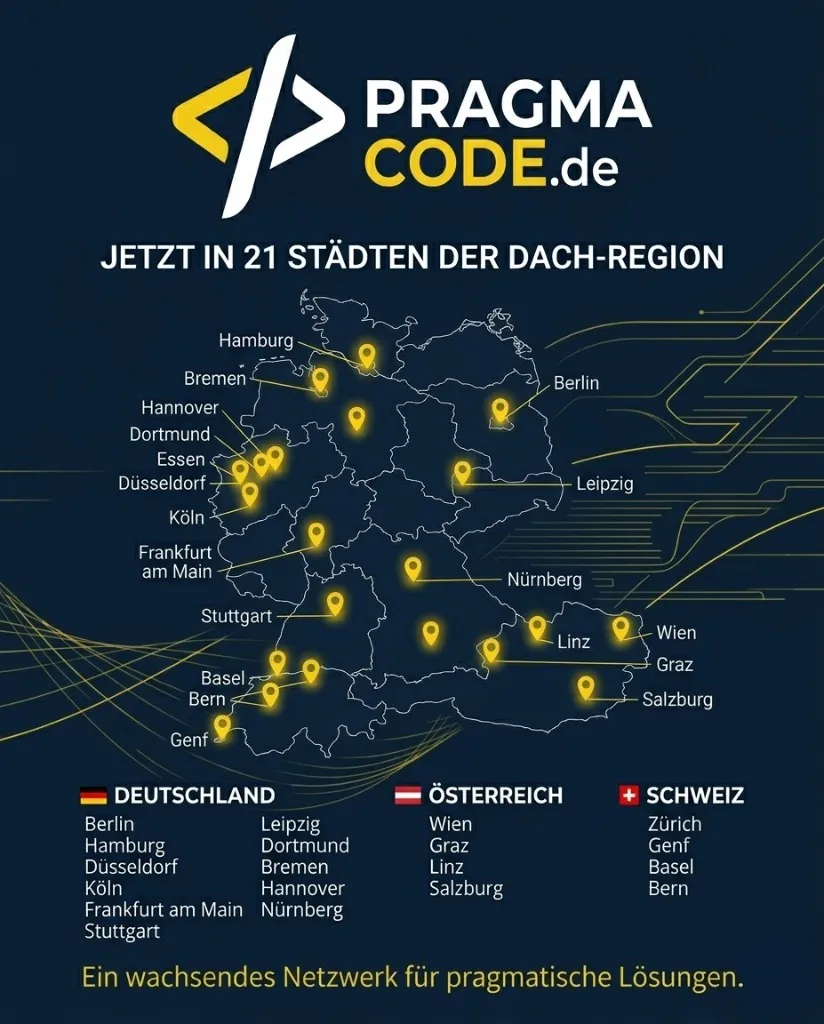
We are your digital partner – regionally anchored and successfully scaling across borders.
Have a vision?
Let's check together how we can make your idea take flight.
Book your free strategy call nowExtended Specialized Glossary
GPT-6 Astra
OpenAI's flagship frontier AI model released in late summer 2026, featuring native computer-use capabilities, unprecedented action-token efficiency, and leading benchmark scores in mathematical and logical reasoning (FrontierMath Tier 4: 97.6% according to OpenAI).
Claude Fable 5.1
Anthropic's premier frontier model released in September 2026, optimized for autonomous software engineering, massive codebase refactoring, and scientific research. It features ultra-low prompt cache costs ($0.25 / 1M tokens) and robust multi-hour agentic stability.
ARC-AGI-3
The third iteration of the Abstraction and Reasoning Corpus benchmark, evaluating an AI system's ability to solve novel visual-abstract reasoning puzzles without task-specific pre-training.
FrontierMath
An exceptionally challenging evaluation benchmark composed of unpublished problems from modern mathematical research, testing deep abstract proof generation and reasoning in AI systems.
ExploitBench
A standardized cybersecurity benchmark evaluating an AI agent's capability to autonomously discover, verify, and remediate software vulnerabilities in realistic enterprise environments.
OSWorld 2.0
The definitive benchmark for multimodal computer-use agents, testing autonomous operating system navigation and multi-application task completion via visual GUI control.
Daybreak Program
OpenAI's high-assurance safety framework governing frontier AI models with critical cyber capabilities, restricting offensive exploit generation while empowering defensive infrastructure operators.
Enterprise Frontier Safeguards (EFS)
Anthropic's enterprise security and governance framework providing zero-data-retention guarantees, compliant European infrastructure isolation, and deterministic guardrails for frontier model deployments.