

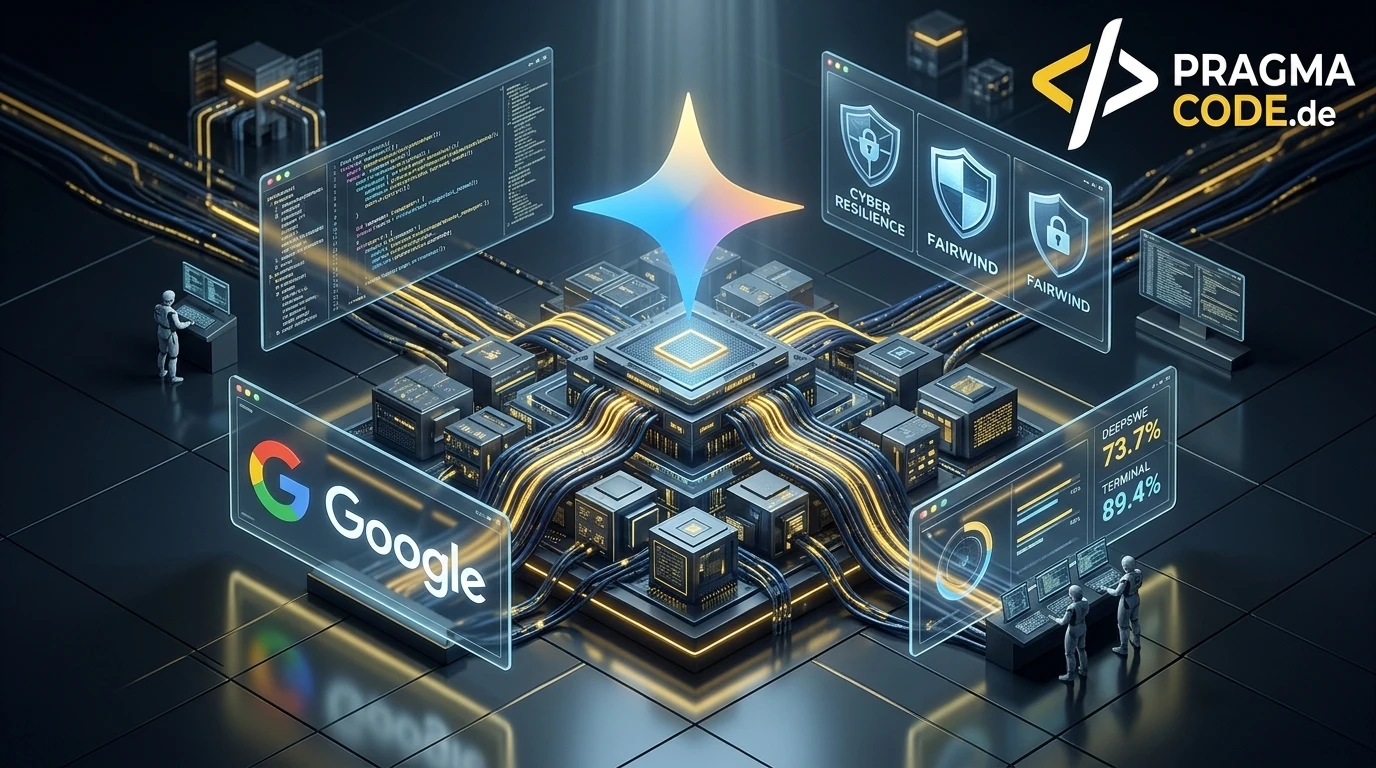
With Gemini 3.8 Flash and its specialized cybersecurity counterpart 3.8 Flash Cyber, Google DeepMind shatters the classical trade-off of generative AI: at an introductory rate of just $0.75 per million tokens, the new model generation outperforms established frontier models across software engineering and agentic benchmarks — powered by an architecture that works harder.
This article is an in-depth expert contribution from our content cluster. Discover the complete overview on our main page: AI Automation & Intelligent Agents →
- Frontier-Grade Intelligence at Flash Economics: Gemini 3.8 Flash achieves 73.7% on DeepSWE v1.1 and 89.4% on Terminal-bench 2.1, surpassing frontier models like GPT-5.6 Sol at an introductory price of only $0.75 per million input tokens.
- The „Works Harder“ Architecture: Rather than prioritizing naive brevity, the model invests extra iterative reasoning steps and tool calls to complete complex engineering, financial, and scientific tasks with zero defects.
- Proactive Cyber Defense: With Gemini 3.8 Flash Cyber, vetted defenders gain prioritized access through the Fairwind Program to a defensive model delivering 47.2% Pass@1 on CWE-Bench and 2.6x more correct Chrome patches than larger commercial models.
From Prompt Responders to Long-Horizon Software Engineers
While early LLMs merely generated isolated code snippets, Gemini 3.8 Flash acts as an autonomous software engineer. Equipped with a 1-million-token context window, a 64k output token capacity, and native computer use, the model executes multi-hour engineering tasks in agentic workflows deterministically and autonomously.
- 1. The New Workhorse Class: Three Flash Releases in Six Weeks
- 2. Benchmark Evaluation: DeepSWE, Terminal & Knowledge Work
- 3. The „Works Harder“ Architecture: Iterative Tool Loops & Thinking Effort
- 4. Gemini 3.8 Flash in Google Antigravity: Production Showcases for Developers
- 5. Gemini 3.8 Flash Cyber & the Fairwind Program: Defensive Cyber Sovereignty
- 6. Enterprise Architecture: 4 Pillars for Reliable Production Deployment
- 7. TCO & Cost Analysis: Flash Economics vs. Expensive Frontier Inference
- 8. 5-Stage Implementation Roadmap: Deploying Autonomous Coding Agents
- 9. Conclusion & Executive Quick-Check for Decision-Makers
1. The New Workhorse Class: Three Flash Releases in Six Weeks
The pace of artificial intelligence innovation reached unprecedented velocity in late summer 2026. With the launch of Gemini 3.8 Flash, Google DeepMind marked its third major Flash release within just six weeks. What might initially seem like a rapid version increment represents a profound paradigm shift: Google is transferring frontier-tier reasoning capabilities directly into the cost structure of high-speed workhorse models.
Historically, enterprise CTOs and software architects faced an acute trade-off. Engineering teams tackling multi-file refactoring, deep algorithmic reasoning, or long-horizon debugging had no choice but to route requests to expensive frontier models such as Claude Opus 5 ($5.00 input / $25.00 output per million tokens) or GPT-5.6 Sol. Meanwhile, budget-friendly models offered low latency for basic chatbots but consistently broke down during long-running agentic workflows, creating infinite recursion loops or invalid pull requests.
Simultaneously, Google DeepMind unveiled Gemini 3.8 Flash Cyber, a specialized model fine-tuned specifically for defensive cybersecurity specialists, enterprise incident response teams, and critical infrastructure operators. While conventional LLMs identify theoretical code vulnerabilities but struggle with actionable remediation, Flash Cyber autonomously pinpoints zero-day exploits and outputs syntactically and semantically verified code patches in seconds.
2. Benchmark Evaluation: DeepSWE, Terminal & Knowledge Work
To rigorously assess Gemini 3.8 Flash, industry-standard benchmarks that capture real-world engineering workflows, tool execution, and multi-turn problem-solving provide the empirical ground truth. Traditional academic benchmarks like MMLU are no longer sufficient to evaluate production-readiness.
The empirical benchmark results reveal remarkable leaps across core disciplines:
On DeepSWE v1.1 (Long-Horizon Software Engineering), which tests an agent's ability to autonomously resolve complex GitHub pull requests and architecture tickets from end to end, Gemini 3.8 Flash scores an exceptional 73.7%. This puts the model virtually on par with Claude Opus 5 (74.0%) while soundly defeating GPT-5.6 Sol (72.7%), GPT-5.6 Terra (69.6%), and Claude Sonnet 5 (53.8%). Compared to Gemini 3.7 Flash (65.3%), this represents a massive +8.4 percentage point surge in software engineering reliability.
On Terminal-bench 2.1 (Agentic Terminal Coding), which measures command-line syntax execution, Git workflows, dependency management, and systems diagnostics, Gemini 3.8 Flash takes the outright worldwide #1 position at 89.4%, beating both Claude Opus 5 (89.1%) and GPT-5.6 Sol (88.8%).
In highly regulated professional domains, the performance divergence is even more pronounced:
On Vals Finance Agent v2, Gemini 3.8 Flash achieves 61.4%, outpacing Opus 5 (58.6%) and Sol (53.8%). On the demanding Harvey's Legal Agent Benchmark, which evaluates multi-step legal synthesis and contract analysis under real-world conditions, Gemini 3.8 Flash posts 10.0% — becoming the first model in industry history to break into double digits, leaving Opus 5 (6.7%), Sol (2.5%), and Terra (0.8%) far behind.
These achievements are reinforced by 54.9% on HLE-Verified (Humanity's Last Exam for multidisciplinary expert science) and 86.2% on CharXiv Reasoning for complex chart and graphical data synthesis without external vision tools.
3. The „Works Harder“ Architecture: Iterative Tool Loops & Thinking Effort
How does a model engineered with Flash-tier pricing match or surpass frontier parameter clusters? The explanation lies in a conscious architectural philosophy from Google DeepMind: Gemini 3.8 Flash works harder.
Historically, inference optimizations prioritized compressing answers into the smallest token count and lowest latency. For complex software engineering or multi-layered logic, this aggressive compression frequently resulted in hasty assumptions, broken imports, and subtle runtime bugs. Gemini 3.8 Flash rejects this false economy:
1. Recursive Reflection Loops & Iterative Tool Calling
When encountering an unexpected compilation failure or broken test suite, Gemini 3.8 Flash does not terminate its turn. Instead, it iteratively calls compilers, test runners, and file inspection tools, evaluates runtime errors dynamically, and refines its codebase within the same request cycle.
2. Granular Thinking Effort Levels (low, medium, high)
Developers configure cognitive depth via the thinking_config.thinking_budget parameter. The rudimentary minimal setting has been eliminated; even at low, the model enforces mandatory logical validation passes to eliminate basic architectural oversights.
3. 64k Output Token Ceiling for Production Codebases
While previous LLMs hit strict caps at 4,096 or 8,192 output tokens, the 64k output limit (65,536 tokens) enables the synthesis of complete multi-file components, comprehensive end-to-end test suites, and database migration scripts without artificial chunking.
4. 1M Context Window with Native Context Caching
With 1,048,576 input tokens, Gemini 3.8 Flash ingests entire enterprise software repositories, architecture documentation, or API specifications in a single prompt. Implicit context caching reduces repeated token costs by up to 75%.
Expert Tip: Calibrating Thinking Effort for Production
For interactive user interfaces, quick search queries, and pre-processing tasks, set thinking effort to low to ensure sub-second response times. For automated pull request reviews, deep architectural refactoring, and security audits, always elevate thinking to high: the additional reasoning tokens amortize immediately by preventing costly downstream bugs.
4. Gemini 3.8 Flash in Google Antigravity: Production Showcases for Developers
The operational strengths of Gemini 3.8 Flash shine brightest within specialized agentic development platforms such as Google Antigravity (Antigravity 2.0). During the launch showcase, the Antigravity engineering team revealed compelling real-world demonstrations of what autonomous software engineering looks like in practice:
Development Workflows: Traditional AI Assistance vs. Antigravity Agentic Engineering
- Isolated Snippets: Produces code blocks without understanding project-wide dependencies.
- Manual Debugging: Developers must copy-paste stack traces back into the chat window.
- Syntax-Only Focus: Complex mathematical or procedural algorithms are hallucinated.
- Framework Friction: Implementations must be manually ported across different platforms.
- Design Systems in 12 Frameworks: Transforms minimal color and typography rules into complete UI component packages across React, Vue, Svelte, Flutter, SwiftUI, and more.
- Autonomous Codebase Exploration: Inspects thousands of files, maps dependency graphs, and produces interactive visual documentation.
- Complex Procedural Algorithms: Connects Wave Function Collapse with pathfinding algorithms to build dungeon level editors with mathematically guaranteed solutions.
- Looping Instructions: Builds fully playable 3D games like „Chronomancers“ or functional DOS versions of Google Maps from a single prompt.
The model's capacity to synthesize interactive visual artifacts represents another major leap forward. A standout example from Google AI Studio is Hardware Anatomy: given a simple hardware description prompt, Gemini 3.8 Flash constructs a physically proportioned, interactive 3D exploded view using Three.js — complete with a real-time deconstruction slider enabling engineers to inspect individual circuit boards and chassis layers.
5. Gemini 3.8 Flash Cyber & the Fairwind Program: Defensive Cyber Sovereignty
A central pillar of the September 2026 launch is Gemini 3.8 Flash Cyber. For years, enterprise security teams relied on static code analysis tools (SAST/DAST) notorious for high false-positive rates, or experimented with generic LLMs that generated syntactically plausible but vulnerable code patches.
Gemini 3.8 Flash Cyber was trained from the foundation to prioritize defensive cyber capabilities. On the standardized CyberGym benchmark, Flash Cyber outperforms both 3.5 Flash Cyber and larger commercial frontier models in autonomous vulnerability detection. In internal evaluations across codebases spanning 20 programming languages, the model achieves a vulnerability discovery success rate exceeding 70%.
Pareto Frontier on CWE-Bench (47.2%)
In automated software vulnerability repair on Collinear's rigorous CWE-Bench, Flash Cyber reaches 47.2% Pass@1 — matching the world's leading commercial frontier model (47.8%) at a tiny fraction of the cost.
2.6x More Patches for Google Chrome
The Google Chrome Security team reported that Gemini 3.8 Flash Cyber produced 2.6 times more verified, working security patches for Chrome browser vulnerabilities than much larger commercial models.
Wiz Pentesting: Higher Recall at 5x Lower Cost
Cloud security leader Wiz demonstrated that Gemini 3.8 Flash Cyber achieved +7.5% to +9.7% higher recall on internal penetration testing benchmarks while reducing inference costs by 2.3x to 5.2x compared to leading frontier LLMs.
Prompt Injection Immunity (Gray Swan)
The model sets new industry benchmarks in resisting Indirect Prompt Injections (IPI) on Gray Swan evaluations, protecting production agents from adversarial inputs embedded in external data.
To prevent malicious misuse, Google DeepMind governs deployment strictly under the Frontier Safety Framework: while Gemini 3.8 Flash incorporates standard mitigations against CBRN and cyber offensives, Gemini 3.8 Flash Cyber is accessible exclusively through the Fairwind Program. This initiative provides vetted governmental cybersecurity agencies, critical infrastructure operators, and open-source software maintainers with prioritized defensive access.
6. Enterprise Architecture: 4 Pillars for Reliable Production Deployment
Unlocking the full value of Gemini 3.8 Flash requires a coherent enterprise architecture that synchronizes regulatory compliance, low-latency performance, and cost governance.
1. Context Caching & Batch API
Enterprise system instructions, architecture patterns, and codebase dumps are cached in memory via the context caching API. For asynchronous background evaluations like nightly test runs, the Batch API cuts token costs by an additional 50%.
2. Antigravity Agent Orchestration
Integrate Gemini 3.8 Flash directly into CI/CD workflows and developer terminals using the Antigravity SDK. Autonomous subagents execute specialized roles such as code review, unit test synthesis, and dependency upgrades in parallel.
3. Zero-Data-Retention & EU Hosting
Deploy via Google Cloud Agent Platform with contractual zero-data-retention guarantees. Customer proprietary code is never used for model training, fulfilling EU AI Act and GDPR compliance standards.
4. Dynamic Model Routing
An intelligent API gateway routes simple queries to Gemini 3.7 Flash, while complex multi-step debugging, refactoring, and security sweeps route dynamically to Gemini 3.8 Flash.
7. TCO & Cost Analysis: Flash Economics vs. Expensive Frontier Inference
The economic impact of Gemini 3.8 Flash for enterprises and software organizations is dramatic. In modern agentic architectures, a single engineering ticket triggers between 20 and 50 internal model calls as the agent builds, tests, analyzes logs, and re-parses source files.
Cost Trap: The Frontier Token Explosion
A team of 10 software engineers running autonomous agents powered by Claude Opus 5 consuming 50 million tokens per month incurs over $1,250 monthly in token expenses alone. Powered by Gemini 3.8 Flash, identical operations cost less than $180 — while delivering superior terminal execution rates.
Cost Trap: The Illusion of Cheap Mini Models
Deploying underpowered micro-models in multi-agent loops leads to frequent execution loops, invalid Git merge conflicts, and expensive human debugging. Real enterprise ROI is achieved through first-pass resolution, not the lowest headline token price.
Gemini 3.8 Flash's introductory pricing remains fixed through December 31, 2026, at $0.75 per 1M input tokens and $3.75 per 1M output tokens. Even after introductory pricing concludes on January 1, 2027 ($1.50 input / $7.50 output), the model remains 3x to 4x cheaper than frontier rivals such as Claude Opus 5 ($5.00 / $25.00) or GPT-5.6 Sol ($4.00 / $20.00).
8. 5-Stage Implementation Roadmap: Deploying Autonomous Coding Agents
For organizations seeking to integrate Gemini 3.8 Flash safely and effectively, we recommend a disciplined five-stage rollout:
-
1. Audit & High-Leverage Use Case Identification
Map repetitive engineering bottlenecks consuming senior developer hours: unit test coverage, OpenAPI documentation, dependency migrations, and issue triage across repositories.
-
2. Google Antigravity & AI Studio Evaluation
Set up a sandbox testing environment in Google Antigravity. Benchmark company codebases against Gemini 3.8 Flash across varying thinking levels (low vs. high) to evaluate latency and code quality.
-
3. Context Caching & Security Guardrails
Inject organizational architectural patterns via Context Caching. Configure zero-data-retention agreements and containerized terminal sandboxing to safeguard development infrastructure.
-
4. Fairwind Program Application (Cyber Defense)
For teams managing critical cloud workloads or customer data, apply to the Fairwind Program to integrate Gemini 3.8 Flash Cyber into automated vulnerability remediation workflows.
-
5. Enterprise Scaling & Dynamic Model Routing
Deploy across developer teams with intelligent API gateways balancing Gemini 3.7 Flash for interactive requests and 3.8 Flash for multi-turn autonomous coding tasks.
9. Conclusion & Executive Quick-Check for Decision-Makers
Gemini 3.8 Flash and Gemini 3.8 Flash Cyber demonstrate that the frontier of AI is no longer defined strictly by parameter scale, but by architectural diligence, tool mastery, and sustainable economics. With 73.7% on DeepSWE v1.1 and the world-leading score of 89.4% on Terminal-bench 2.1, developers now have access to a digital software engineering workhorse that scales reliably within enterprise budgets.
Quick-Check: Is Your Organization Ready for Gemini 3.8 Flash?
Organizations establishing robust agentic engineering workflows and automated cyber resilience today will capture significant operational advantages in the months ahead.
Ready to integrate autonomous AI agents and Gemini 3.8 into your engineering workflows?
Schedule a Free Technical ConsultationOur Regional Expertise
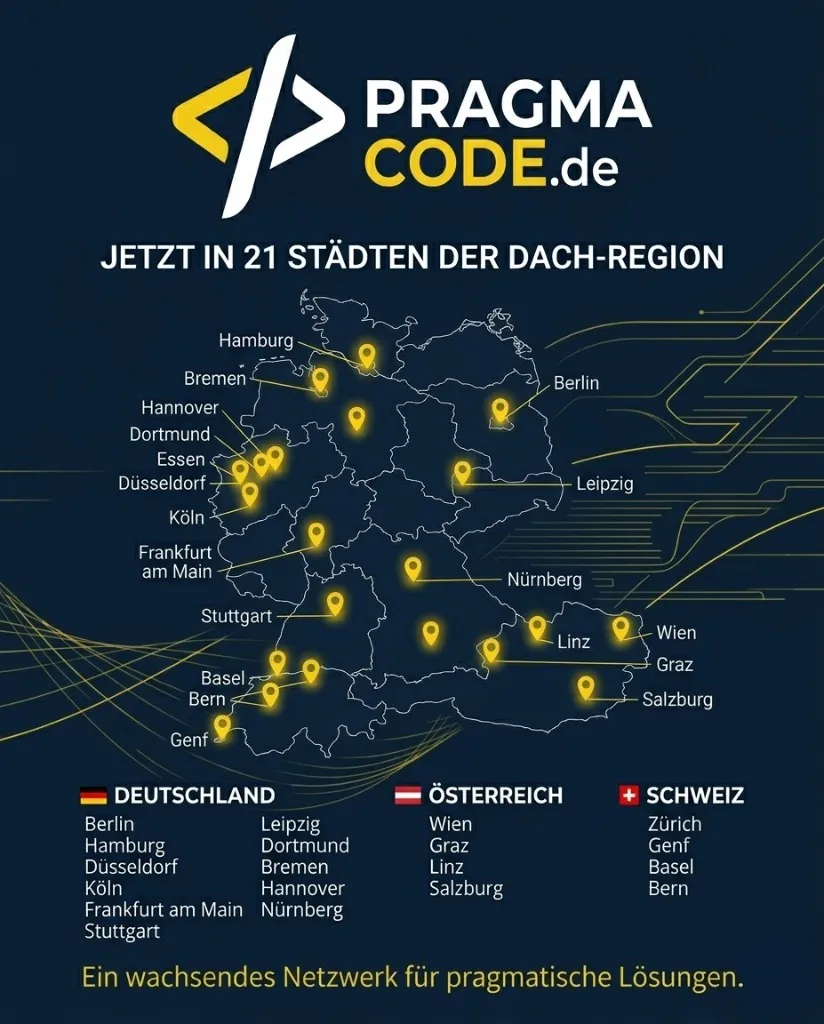
We are your digital partner – regionally anchored and successfully scaling across borders.
Have a vision?
Let's check together how we can make your idea take flight.
Book your free strategy call nowExtended Specialized Glossary
Gemini 3.8 Flash
Google DeepMind's flagship multimodal workhorse model featuring a 1M token context window, native computer use support, and industry-leading performance on long-horizon software engineering and agentic workflows.
Gemini 3.8 Flash Cyber
Google DeepMind's specialized cybersecurity model delivering frontier-level performance in autonomous vulnerability discovery and automated code patching across production codebases.
DeepSWE v1.1
Leading industry benchmark evaluating the autonomous end-to-end software engineering capabilities of AI agents across complex, long-horizon development and debugging cycles.
CyberGym
Standardized evaluation benchmark measuring the capabilities of AI models in autonomously discovering and pinpointing software vulnerabilities in real-world codebases.
Fairwind Program
Google DeepMind's security initiative granting vetted defenders, critical infrastructure operators, and public authorities prioritized access to advanced defensive cyber AI models.
CWE-Bench
Independent benchmark evaluating automated software repair and patching capabilities of AI systems on standardized Common Weakness Enumeration security vulnerabilities.