
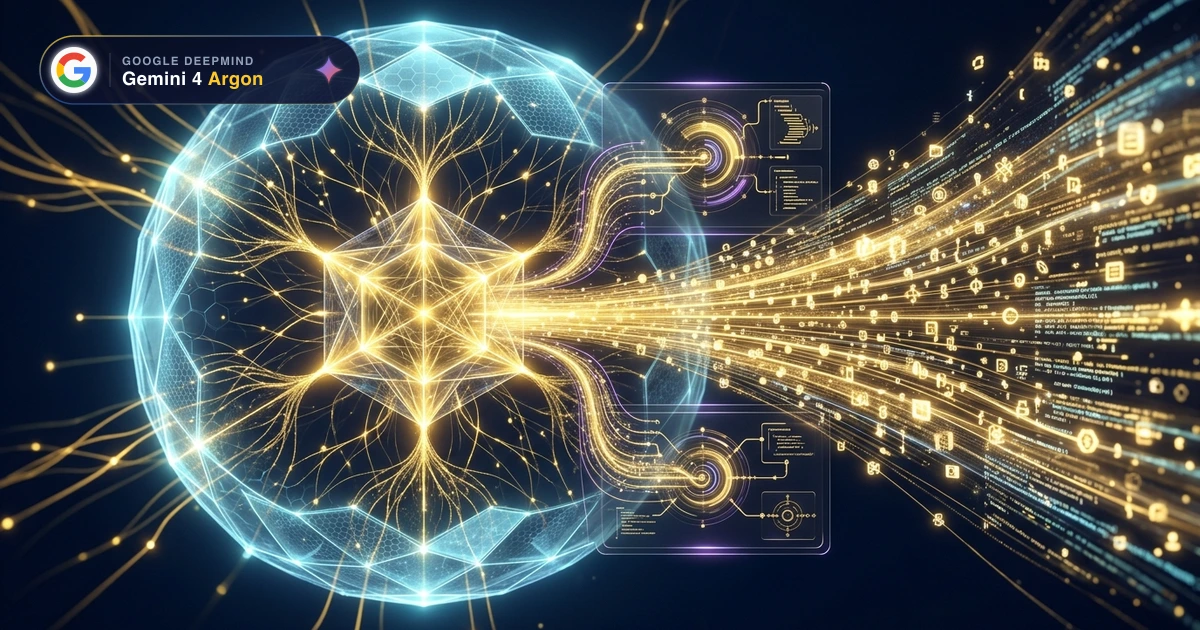
With the official announcement of Gemini 4 Argon, Google DeepMind achieves a historical milestone in generative AI: A massive output limit of 1 million tokens, a benchmark-topping 77.9% on DeepSWE v1.1, and the controlled release of defensive cyber capabilities via the Fairwind Program mark the end of artificial token barriers for long-horizon software engineering and enterprise workflows.
This article is an in-depth expert contribution from our content cluster. Discover the complete overview on our main page: AI Automation & Intelligent Agents →
- The 1-Million Output Token Paradigm Shift: Gemini 4 Argon shatters the previous 64k output token ceiling by supporting 1,000,000 tokens per response. Full codebase migrations, architecture refactorings, and multi-hundred-page audit reports can now be generated in a single coherent trajectory.
- State-of-the-Art Software Engineering: With 77.9% on DeepSWE v1.1 and 68.0% on CWE-bench, Argon overtakes frontier leaders like Claude Opus 5.5 (74.2%) and GPT-6 Astra (74.1%) in autonomous long-horizon programming.
- Controlled Rollout via the Fairwind Program: Following months of safety-driven development, Google is staging deployment. Verified cyber defenders gain immediate unconstrained access for patch validation, while broad API availability rolls out progressively.
From Iterative Code Assistants to Autonomous System Architects
While previous LLM generations required engineers to chop complex programming jobs into brittle snippets and stitch fragmented outputs together, Gemini 4 Argon orchestrates end-to-end engineering cycles in a single unified pipeline. A million-token output buffer combined with deep long-horizon reasoning converts agentic software engineering into a predictable production process.
- 1. The Announcement After Delays: Why Google Pushed the Launch
- 2. The 1M Output Breakthrough: Ending Artificial Token Ceilings
- 3. Benchmark Analysis in Practice: DeepSWE, CWE-bench & Knowledge Work
- 4. The Fairwind Program: Cyber Defense Without Artificial Inhibitors
- 5. Architectural Analysis: 4 Pillars of Modern Frontier Infrastructure
- 6. TCO & Economic Analysis: Flash Workhorse vs. Argon Frontier
- 7. 5-Step Roadmap: Preparing Enterprise Infrastructure for Gemini 4
- 8. Conclusion & Action Guide for CTOs and Software Leaders
1. The Announcement After Delays: Why Google Pushed the Launch
The official introduction of Gemini 4 Argon by Koray Kavukcuoglu, Senior Vice President of Google DeepMind and Google's Chief AI Architect, on September 30, 2026, marks the end of extensive industry anticipation. Financial news wires including Reuters and MarketScreener framed the announcement as a strategic milestone, with Alphabet shares responding with an immediate post-market uptick of over two percent.
The fact that Google's flagship model was preceded by several months of internal delays illustrates the heightened responsibility surrounding next-generation frontier intelligence. While early internal roadmaps targeted a mid-summer debut, executive leadership and safety teams addressed several critical engineering and policy hurdles before public disclosure:
1. Dual-Use Cybersecurity Concerns
Argon's autonomous capability to uncover zero-day vulnerabilities and synthesize executable binary patches introduced severe proliferation risks if released without rigorous gatekeeping and defensive verification mechanisms.
2. 1M Output Inference Infrastructure
Serving continuous streams of up to 1,000,000 output tokens per request required major architectural overhauls, advanced KV cache compression, and massive cluster deployments on Google's Trillium (TPU v6e) hardware.
3. Pre-Deployment Safety Audits
Google engaged in extensive voluntary pre-launch reviews with governmental and academic bodies to verify that sustained long-horizon reasoning trajectories remain stable under edge-case stress testing.
4. Competitive Pressure from Opus 5.5
Rather than shipping an incremental update, Google ensured that Argon would decisively outperform rival frontier architectures on the most demanding autonomous software engineering leaderboards.
Consequently, Google opted for a staged deployment strategy. Rather than an unthrottled immediate public API release, Gemini 4 Argon is initially deployed through the gated Fairwind Program to trusted cyber defenders and critical infrastructure operators, with broader developer access on Google Cloud Vertex AI following progressively.
2. The 1M Output Breakthrough: Ending Artificial Token Ceilings
To grasp the significance of Gemini 4 Argon for modern enterprise engineering, one must recognize the fundamental asymmetry that constrained previous LLMs. While input context windows expanded rapidly to one and two million tokens, output capacities remained tightly constrained at 64,000 or even 8,192 tokens per response.
Expert Insight: The Bottleneck of Fragmented Outputs
Until now, engineering teams deploying coding agents were forced to partition large tasks into fragile, micro-scoped prompts. Migrating a enterprise monolith to modern modular microservices or updating complex ORM schemas across hundreds of endpoints required intricate external state managers. When individual API calls cut off mid-file, models suffered from context drift, conflicting interface contracts, and hallucinatory regressions.
Gemini 4 Argon removes this limitation entirely. Supporting up to 1,000,000 output tokens in a single unbroken trajectory, the model unlocks transformative capabilities across production environments:
- End-to-End Codebase Refactoring: An agent can ingest dozens of interdependent classes, refactor entire service layers, and generate every updated file, migration script, and integration test in one pass without loss of structural integrity.
- Exhaustive Compliance & Architecture Documentation: Security teams can provide multi-gigabyte server logs or audit trails and receive a fully articulated 500-page compliance report aligned with NIS-2, ISO 27001, or SOC 2 standards.
- Coherent Long-Horizon Problem Solving: The model can allocate tens of thousands of tokens to internal verification, step-by-step mathematical reasoning, and simulation loops before emitting final implementation code.
64k vs. 1M Output
A 15.6x expansion in uninterrupted generation capacity within a single API session.
Zero Stitching Drift
Guaranteed consistency across multi-file outputs due to shared attention states during generation.
Deep Loop Resilience
Agents execute up to 200 sequential tool calls and compiler verifications in a single transaction.
3. Benchmark Analysis in Practice: DeepSWE, CWE-bench & Knowledge Work
As conventional synthetic benchmarks like MMLU encounter ceiling effects, Google DeepMind grounded Gemini 4 Argon's validation in rigorous real-world programming, security, and economic task environments. The published performance metrics substantiate its frontier status across enterprise-grade disciplines.
Three core conclusions emerge from this evaluation landscape:
- Decisive Leadership on DeepSWE v1.1: Reaching 77.9%, Argon outpaces Claude Opus 5.5 (74.2%) and GPT-6 Astra (74.1%). The model demonstrates notable proficiency in avoiding regression bugs by analyzing surrounding test harnesses before declaring a fix complete.
- Sustained Vulnerability Remediation: On CWE-bench v1, Argon scores 68.0%, leading second-place Opus 5.5 by 4.5 percentage points. It excels at identifying the root causes of security flaws rather than proposing cosmetic syntactic edits.
- Knowledge Work via the Vals Index: Reaching 68.9% on the Vals Index, Argon demonstrates that its long-horizon reasoning generalizes beyond coding to complex corporate financial analyses, contractual reconciliations, and strategic multi-variable synthesis.
4. The Fairwind Program: Cyber Defense Without Artificial Inhibitors
A standout element of Google's release is the Fairwind Program. Commercial foundation models frequently struggle with over-sensitive alignment: When cybersecurity analysts inspect malicious binaries or simulate adversarial attack vectors, standard models tend to decline assistance with generic safety refusals. In rapid-response incident scenarios, these false-positive refusals severely impede defensive teams.
Argon's 68.0% success rate on CWE-bench highlights its capacity for active defensive remediation:
Autonomous Memory Safety Remediation
Argon pinpoints complex use-after-free conditions and buffer overflows in legacy C/C++ services, restructuring them into memory-safe implementations.
Cryptographic Integrity Verification
Automated auditing of cipher suites and transport protocols, accelerating enterprise migrations to post-quantum cryptographic standards.
Zero-Regression Patch Validation
Generated security patches are compiled, verified in sandboxes, and checked against integration suites before reaching production review.
5. Architectural Analysis: 4 Pillars of Modern Frontier Infrastructure
Deploying a frontier model of this magnitude in enterprise environments requires robust architecture. Gemini 4 Argon integrates into enterprise environments through four fundamental engineering pillars:
1. Context Caching & 95% Savings
Large codebases, documentation sets, and API schemas are cached directly in TPU high-bandwidth memory. Subsequent reasoning turns access the warm context with a 95% price reduction, making continuous loops economically viable.
2. Dynamic Thinking Budgets
Engineers can dial compute allocations for pre-generation planning. High-risk architectural refactorings receive substantial thinking budgets, while routine requests execute with minimal latency.
3. Native Multi-Tool Execution
Direct interaction with AST analyzers, test runners, container runtimes, and shell terminals without brittle JSON wrapper layers. Argon runs build processes and Git commands natively.
4. Dual-State Guardrail Routing
Strict isolation of proprietary internal code from public prompts. Native PII masking, cryptographic output watermarking, and audit logging ensure full GDPR and EU AI Act compliance.
6. TCO & Economic Analysis: Flash Workhorse vs. Argon Frontier
For CTOs and engineering directors, the central economic question is clear: When does upgrading to the frontier flagship make financial sense, and when does Gemini 3.8 Flash remain the more cost-effective choice? Google has established a distinct two-tier pricing model.
Comparison: Workhorse Tier vs. Frontier Flagship
- Pricing: Exceptionally low at $0.75 input / $3.75 output per 1M tokens.
- Latency: Ultra-fast time-to-first-token for live IDE autocompletion and interactive chat.
- Output Buffer: Tailored for standard code spans up to 64,000 output tokens.
- Best Application: Continuous code linting, ticket triage, unit test generation, and customer service.
- Pricing: $2.00 input / $10.00 output (introductory) or $4.00 / $20.00 (standard).
- Latency: Deliberate execution time reflecting extended internal planning and multi-turn verification.
- Output Buffer: Massive throughput of up to 1,000,000 output tokens per transaction.
- Best Application: Full repository migrations, deep security audits, zero-day remediation, and system architecture.
The optimal enterprise strategy is hybrid orchestration. Gemini 3.8 Flash serves as the agile frontline triage agent within CI/CD pipelines, processing routine validations and classifying pull requests. When a task demands deep architectural changes or multi-file refactoring, the orchestrator elevates the assignment to Gemini 4 Argon.
7. 5-Step Roadmap: Preparing Enterprise Infrastructure for Gemini 4
To capitalize on Gemini 4 Argon as general developer availability expands, engineering teams should begin preparing their tooling and processes today:
-
Step 1: Conduct a Codebase and Token Bottleneck Audit
Review current internal developer tooling. Identify where developers are forced to manually bridge truncated outputs or split refactoring PRs due to token limits.
-
Step 2: Implement Context-Caching API Gateways
Update your internal LLM gateways to support persistent context caching. Because Argon offers a 95% discount on cached inputs, storing active codebases yields substantial financial savings.
-
Step 3: Evaluate Eligibility for the Fairwind Program
If your organization manages critical infrastructure or maintains an internal Security Operations Center (SOC), review admission criteria for Google's Fairwind initiative for early access.
-
Step 4: Establish Multi-Agent Hierarchies with Dynamic Fallbacks
Structure your Agentic AI Workflows so that high-volume tasks remain on Flash while complex reasoning jobs route dynamically to Argon.
-
Step 5: Deploy Automated Sandbox Verification Pipelines
Establish automated containerized test harnesses. When a frontier model produces thousands of lines of interconnected code, automated verification must instantly confirm runtime behavior.
8. Conclusion & Action Guide for CTOs and Software Leaders
The September 30, 2026 announcement of Gemini 4 Argon marks a pivotal evolution in enterprise software engineering. By eliminating arbitrary token barriers and delivering 1,000,000 output tokens alongside benchmark-leading scores of 77.9% on DeepSWE and 68.0% on CWE-bench, Google DeepMind demonstrates that autonomous agentic engineering has transitioned from experimental curiosity to robust production capability.
Quick-Check: Next Steps Toward Gemini 4 Argon
Official Sources & Primary Documentation
- Google Official Blog (September 30, 2026): "Gemini 4 Argon: our next era of frontier intelligence" – Official announcement by Koray Kavukcuoglu (SVP Google DeepMind & Chief AI Architect).
- Google DeepMind Research (September 30, 2026): "Gemini 4 Argon Technical Report & System Card" – Complete benchmark evaluations across DeepSWE v1.1, CWE-bench v1, and the Vals Index.
- Google Cloud Security (September 2026): "The Fairwind Program: Empowering Cyber Defenders with Frontier AI" – Documentation on controlled access for critical infrastructure operators.
- Reuters Financial Dispatches (September 30, 2026): "Google announces flagship AI model Gemini 4 after months of delays" – Market reporting on the launch and Alphabet share response.
Do you want to integrate autonomous AI agents into your software infrastructure?
Schedule a Free Technology ConsultationOur Regional Expertise
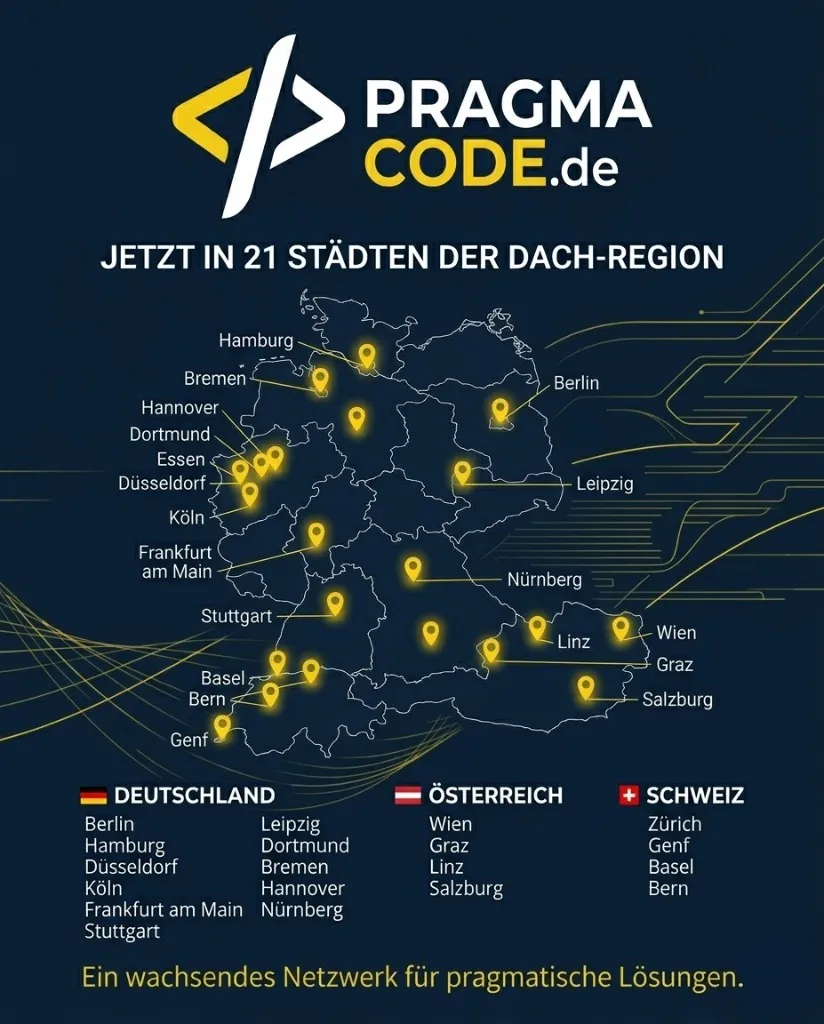
We are your digital partner – regionally anchored and successfully scaling across borders.
Have a vision?
Let's check together how we can make your idea take flight.
Book your free strategy call nowExtended Specialized Glossary
Gemini 4 Argon
Google DeepMind's next-generation frontier AI model, purpose-built for long-horizon reasoning, autonomous software engineering, and defensive cybersecurity.
1M Output Tokens
A breakthrough in model sampling that allows outputting up to 1,000,000 continuous tokens without truncation or forced chunking in a single inference session.
Long-Horizon Reasoning
The capability of modern AI systems to solve complex multi-step problems across hundreds of sequential thinking, tool-calling, and verification steps without semantic drift.
Fairwind Program
Google DeepMind's security initiative granting verified cyber defenders and critical infrastructure operators priority access to advanced defensive AI models.
DeepSWE v1.1
Industry-standard benchmark measuring autonomous end-to-end software engineering capabilities of AI agents across complex real-world repositories.
CWE-Bench
Standardized evaluation benchmark measuring automated software repair and precise remediation of Common Weakness Enumerations.