


With Gemini 3.7 Flash, Google DeepMind shatters the fundamental dogma of modern language models: the rigid dichotomy between fast, affordable flash models and slow, expensive reasoning giants is obsolete. Through customizable hybrid reasoning, software engineers control thinking latency on a per-request level.
This article is an in-depth expert contribution from our content cluster. Discover the complete overview on our main page: AI Automation & Intelligent Agents →
- Hybrid Reasoning on Demand: Developers no longer need to choose between a lightweight flash model and a heavy reasoning engine – Gemini 3.7 Flash switches on internal reasoning dynamically via a configurable Thinking Budget from 0 up to 64,000 output tokens.
- New Benchmark Champion in Coding: Achieving 43.6% on the FrontierCode 1.1 Main Benchmark and dominant efficiency on DeepSWE V1.1, the model surpasses frontier flagships at a fraction of the cost per resolved developer task.
- Massive 1M Token Multimodality: Native processing of audio, video, high-resolution documentation, and full code repositories paired with multi-step agent orchestration for enterprise systems.
The Paradigm Shift in Enterprise AI Engineering
Until recently, AI architectures forced software engineers into frustrating compromises: either lightning-fast responses for interactive user interfaces with limited reasoning depth – or multi-second latency and soaring API bills for heavy reasoning models. Gemini 3.7 Flash eliminates this trade-off, establishing the paradigm of customizable inference-time compute scaling at production grade.
- 1. The Architecture of Gemini 3.7 Flash: Understanding Hybrid Reasoning
- 2. Benchmarks, Token Economics & DeepSWE V1.1 in Practice
- 3. Production Code Quality & Software Engineering in Enterprise Systems
- 4. Multimodal Processing & 1M Context Window for Large Repositories
- 5. Agentic Workflows & Tool Orchestration in Production
- 6. Developer Guide: API Integration & Thinking Budget Control
- 7. ROI & Business Impact: Slashing Cloud Inference Costs
- 8. Strategic Recommendations for CTOs & Software Architects
1. The Architecture of Gemini 3.7 Flash: Understanding Hybrid Reasoning
For the past two years, the generative AI landscape was split into two separate paradigms. On one side stood lightweight, latency-optimized Large Language Models in the Flash or Haiku tier. They delivered responses within 200 to 400 milliseconds but struggled with complex multi-step logic, nested code refactoring, or mathematical edge cases. On the other side were pure reasoning models (such as o1 or o3-mini), which generated lengthy internal chain-of-thought tokens prior to generating the output, resulting in noticeable latency and high token expenditures.
With the release of Gemini 3.7 Flash, Google DeepMind introduces a unified foundation model. Rather than operating as a rigid single-speed system, the model features native Hybrid Reasoning. The exact same neural network seamlessly supports both direct, low-latency next-token generation and hidden, iterative thinking pathways before producing the final response.
Comparison: Traditional Inference vs. Hybrid Reasoning with Thinking Budget
- Static Latency: Fixed inference speed regardless of prompt complexity.
- Model Splitting: Developers must build routing heuristics to separate simple and complex queries.
- Zero Self-Correction: Code generation runs in one-shot mode without intermediate evaluation.
- Uncontrolled Costs: Dedicated reasoning models burn thousands of hidden tokens on trivial questions.
- Dynamic Scaling: Thinking Budget can be tuned via API from 0 tokens (real-time) to 64,000 tokens (deep work).
- Unified Pipeline: A single model powers interactive chat interfaces, streaming assistants, and autonomous coding agents.
- Iterative Planning: The model evaluates edge cases, forms hypotheses, and corrects flawed assumptions prior to output.
- Precise Budget Caps: Hard token limits guarantee predictable cloud expenses while optimizing solution accuracy.
The architectural breakthrough centers around fine-grained control through the Thinking Budget parameter. Using standard API configurations in Google AI Studio and Google Cloud Vertex AI, engineering teams determine exactly how much compute the model should dedicate to problem solving. For simple sentiment classification or content localization, thinking is disabled or capped at minimal tokens. When confronting a nuanced race condition in a distributed Node.js backend, the budget is expanded to thousands of tokens, allowing the model to simulate execution paths thoroughly.
Pro Tip: Adaptive Thinking Budgets in Multi-Agent Pipelines
Implement dynamic thinking budgets in agentic systems: Assign the orchestrator agent a moderate budget of 2,048 tokens for sub-task planning. If a subordinate agent encounters unit test failures, adaptively increase the correction loop budget to 8,192 tokens. This strategy maximizes resolution success while maintaining minimal average token costs.
2. Benchmarks, Token Economics & DeepSWE V1.1 in Practice
Evaluating Gemini 3.7 Flash objectively requires examining industry benchmarks. In autonomous software engineering, high pass rates previously demanded disproportionately expensive frontier models. Independent evaluation data from platforms like Datacurve AI with the DeepSWE V1.1 Benchmark presents a transformative perspective.
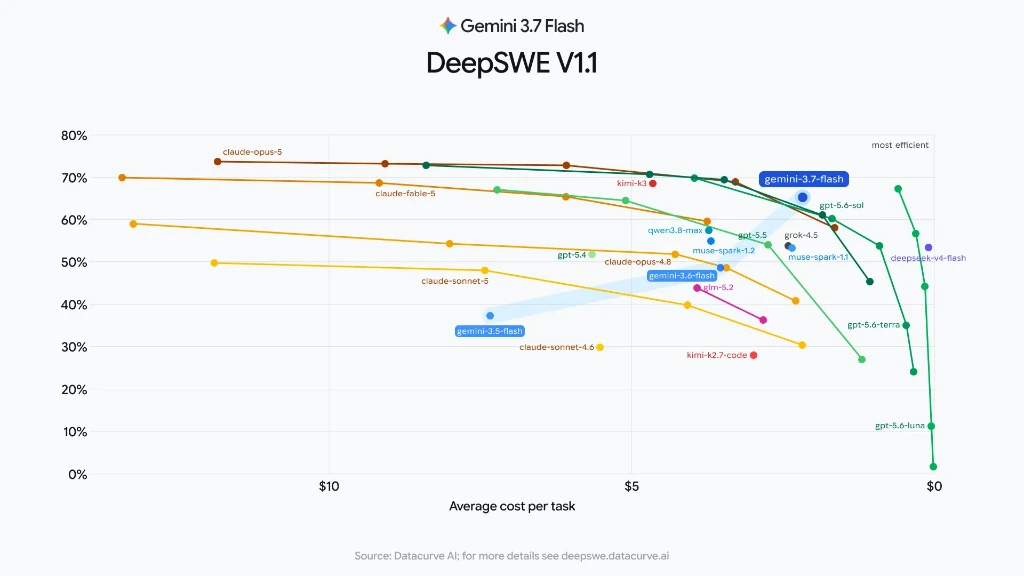
The DeepSWE V1.1 Benchmark chart demonstrates the correlation between average cost per resolved GitHub task (X-axis) and benchmark pass rate percentage (Y-axis). Three strategic takeaways stand out for IT leaders:
Steep Efficiency Leap
Gemini 3.7 Flash achieves an approximate 65% pass rate in DeepSWE at an average cost below $1.50 per task, drastically outperforming predecessors like Gemini 3.6 Flash (~46%) and Gemini 3.5 Flash (~37%).
Flagship Disruption
While legacy frontier heavyweights like Claude Opus 5 or Claude Fable 5 demand $7.00 to $8.50 per task for pass rates in the 70–74% range, Gemini 3.7 Flash delivers comparable capability at nearly one-fifth of the operational expense.
Dominance in the Flash Tier
Compared to competing models such as DeepSeek-V4-Flash, Grok 4.6, or Qwen 3.8 Max, Gemini 3.7 Flash anchors itself in the optimal quadrant of maximal economic efficiency for automated CI/CD pipelines.
Complementing DeepSWE, official Google DeepMind model card evaluations highlight remarkable gains across standardized benchmarks including SWE-bench Verified and HumanEval. With reasoning enabled, Gemini 3.7 Flash eliminates typical next-token pitfalls: framework syntax hallucinations, missing boundary conditions, and incorrect type inferences in TypeScript or Rust are resolved during internal thinking stages.
3. Production Code Quality & Software Engineering in Enterprise Systems
For CTOs, principal engineers, and software architects, practical utility extends beyond passing unit tests. The maintainability, readability, documentation, and security of generated code dictate real-world value. Brittle spaghetti code and OWASP Top 10 vulnerabilities degrade automated development tools.
The FrontierCode 1.1 Main Benchmark specifically evaluates production readiness, documentation hygiene, and structural soundness in enterprise software engineering. In this benchmark, Gemini 3.7 Flash sets a new high-water mark:
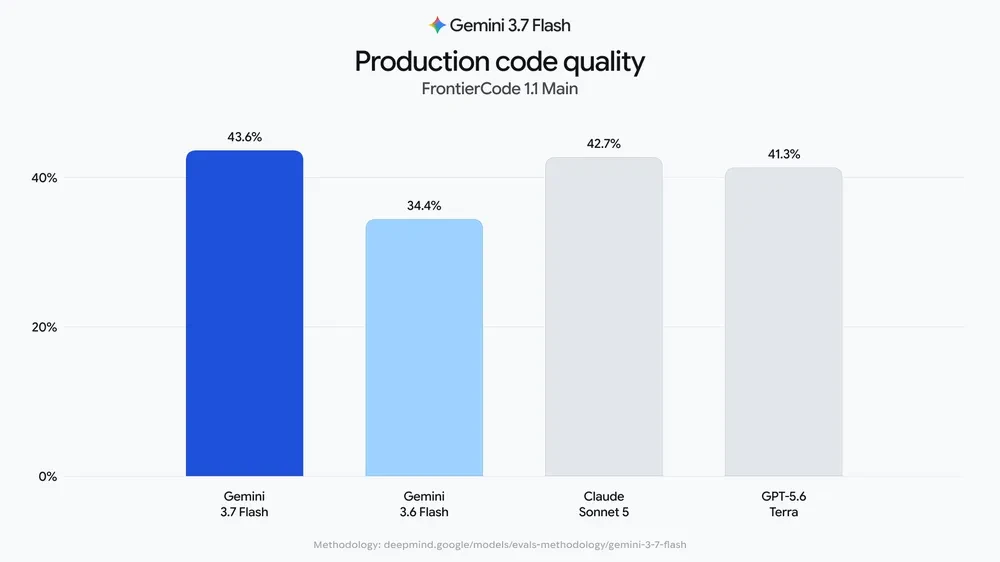
Recording a score of 43.6% in Production Code Quality, Gemini 3.7 Flash outperforms Gemini 3.6 Flash (34.4%) by nearly ten percentage points while surpassing Claude Sonnet 5 (42.7%) and GPT-5.6 Terra (41.3%). This quality edge translates directly into production benefits:
Strict Type Safety & Edge Case Handling
In TypeScript, Rust, and Go, Gemini 3.7 Flash generates explicit generics, non-nullable guards, and exhaustive error-wrapping patterns rather than sloppy fallbacks.
Modular Architecture & SOLID Adherence
Code transformations avoid monolithic sprawl. The model isolates domain logic, data access layers, and API controllers into modular, independently testable units.
Proactive Vulnerability Prevention
SQL injections, insecure deserialization, hardcoded credentials, and Cross-Site Scripting (XSS) vulnerabilities are identified during internal thinking and remediated prior to final output.
4. Multimodal Processing & 1M Context Window for Large Repositories
A defining hallmark of the Gemini architecture is native multimodality. Rather than gluing external vision or audio modules onto a text-only backbone, Gemini 3.7 Flash was trained natively across text, high-resolution imagery, video feeds, and audio streams.
Coupled with a 1-million-token context window and up to 64,000 output tokens, the model unlocks game-changing enterprise workflows:
Full Monorepos in Active Memory
Engineers can load complete codebases exceeding 500,000 lines of code, API specs, and database migrations into a single context. The model traverses dependency graphs with pinpoint accuracy.
Video-Driven Bug Triage & QA
Quality assurance teams can attach screencasts of faulty UI interactions. Gemini 3.7 Flash correlates visual anomalies with browser console logs and pinpoints the exact line in frontend source code.
Technical Manuals & Engineering Schematics
In manufacturing and aerospace, the model ingests 800-page PDF operating manuals, circuit diagrams, and telemetry logs simultaneously, answering engineering queries without hallucination.
Combining deep reasoning with million-token context effectively solves the notorious "needle-in-a-haystack" challenge: even when critical configuration settings are buried deep within distributed microservices, the model identifies root causes and formulates comprehensive fixes.
5. Agentic Workflows & Tool Orchestration in Production
Autonomous AI agents (Agentic AI) represent the core engine of enterprise automation in 2026. A production agent must ingest high-level objectives, decompose them into operational steps, execute external tools (APIs, databases, CLI shells), handle runtime errors, and iteratively refine plans.
Gemini 3.7 Flash excels as the ultimate workhorse model in these architectures. While heavyweight reasoning models prove too sluggish for interactive multi-turn loops (adding 15-20 seconds per tool hop), Gemini 3.7 Flash offers rapid tool execution combined with dependable structured output.
Objective Analysis & Planning
The agent receives a broad task (e.g., "Upgrade outdated dependencies across the monorepo and resolve all resulting build breaking changes"). It applies 1,024 thinking tokens to formulate a structured execution roadmap.
Parallel Tool Calling & Inspection
Utilizing native function calling, the model triggers shell operations (npm outdated, git diff), inspects dependency trees, and catalogs conflicting API signatures.
Code Synthesis & Automated Test Cycles
The agent updates source files and runs test suites. If tests fail, the model examines the stack trace within its thinking buffer and iterates autonomously until all suites pass.
Summary Documentation & PR Creation
Once CI checks pass, the agent generates structured change notes, authors a clean Git commit, and opens a thoroughly documented pull request.
With reliable JSON schema enforcement and deterministic tool calling, Gemini 3.7 Flash integrates seamlessly into multi-agent frameworks including LangGraph, AutoGen, CrewAI, and proprietary in-house orchestration engines.
6. Developer Guide: API Integration & Thinking Budget Control
Integrating Gemini 3.7 Flash is straightforward via the official Google Gen AI SDK (TypeScript, Python, Go) or REST endpoints in Google Cloud Vertex AI. The thinking budget is configured through the thinking_config property.
Here is an enterprise-ready TypeScript implementation showcasing dynamic budget allocation:
import { GoogleGenAI } from '@google/genai';

// Initialize the official Google Gen AI client
const ai = new GoogleGenAI({ apiKey: process.env.GEMINI_API_KEY });

interface CodeReviewRequest {
    codeSnippet: string;
    complexityLevel: 'low' | 'medium' | 'critical';
}

export async function performIntelligentReview(req: CodeReviewRequest) {
    // Dynamically assign thinking budgets based on task criticality
    const budgetMap = {
        low: 0,         // Instant inference for basic syntax checks
        medium: 2048,   // Standard reasoning for business logic and style
        critical: 8192  // Deep reasoning for security, concurrency, and race conditions
    };

    const thinkingBudget = budgetMap[req.complexityLevel];

    const response = await ai.models.generateContent({
        model: 'gemini-3.7-flash',
        contents: [
            {
                role: 'user',
                parts: [
                    {
                        text: `Perform an exhaustive code review of this module. Evaluate security, concurrency, and performance:\n\n${req.codeSnippet}`
                    }
                ]
            }
        ],
        config: {
            temperature: 0.2, // Low temperature for deterministic code analysis
            thinkingConfig: {
                thinkingBudget: thinkingBudget
            }
        }
    });

    return {
        review: response.text,
        usageMetadata: response.usageMetadata
    };
}
Thinking Budget = 0
Pure Next-Token Generation
< 350 ms LatencyIdeal for real-time autocomplete, conversational bots, formatting, and classification tasks.
Thinking Budget = 4,096 – 16,384
Advanced Logical Reasoning
Top-Tier Code QualityOptimal for unit test generation, complex SQL optimization, security audits, and data pipelines.
7. ROI & Business Impact: Slashing Cloud Inference Costs
For technology leaders, deploying generative AI is no longer an experimental curiosity; it is a financial calculation governed by ROI, payback periods, and Total Cost of Ownership (TCO). Embedding AI agents into production operations (such as customer service, invoice automation, or code generation) with legacy frontier models often yields five-figure monthly API bills.
Gemini 3.7 Flash restructures these unit economics. By unifying speed and reasoning, it eliminates redundant multi-tier model architectures:
Legacy Cost Trap: Over-Provisioning
Companies routed all traffic to expensive reasoning models because lightweight alternatives failed on 10% of edge cases. As a result, 90% of token budgets were wasted on routine prompts.
Complexity Trap: Fragile Classification Routers
Building intermediary AI routers to triage between fast and deep models introduced extra latency, double prompt costs, and routing classification errors.
With Gemini 3.7 Flash, a single endpoint scales its compute investment dynamically. An enterprise engineering team of 50 developers running 100,000 monthly code reviews typically cuts cloud inference expenses by 60% to 75% while simultaneously boosting production code quality.
8. Strategic Recommendations for CTOs & Software Architects
The introduction of Gemini 3.7 Flash proves that "Flash" speed no longer equates to compromised reasoning capability. To capture maximum competitive advantage, we recommend the following strategic steps:
Quick-Check: Enterprise Action Plan for Gemini 3.7 Flash
Pragma-Code empowers technology leaders and mid-sized enterprises to architect, validate, and scale high-performance AI systems. From multi-agent orchestration to cloud inference cost optimization, we build production-ready digital solutions.
Ready to integrate Gemini 3.7 Flash into your enterprise architecture?
Schedule a Free AI ConsultationOur Regional Expertise
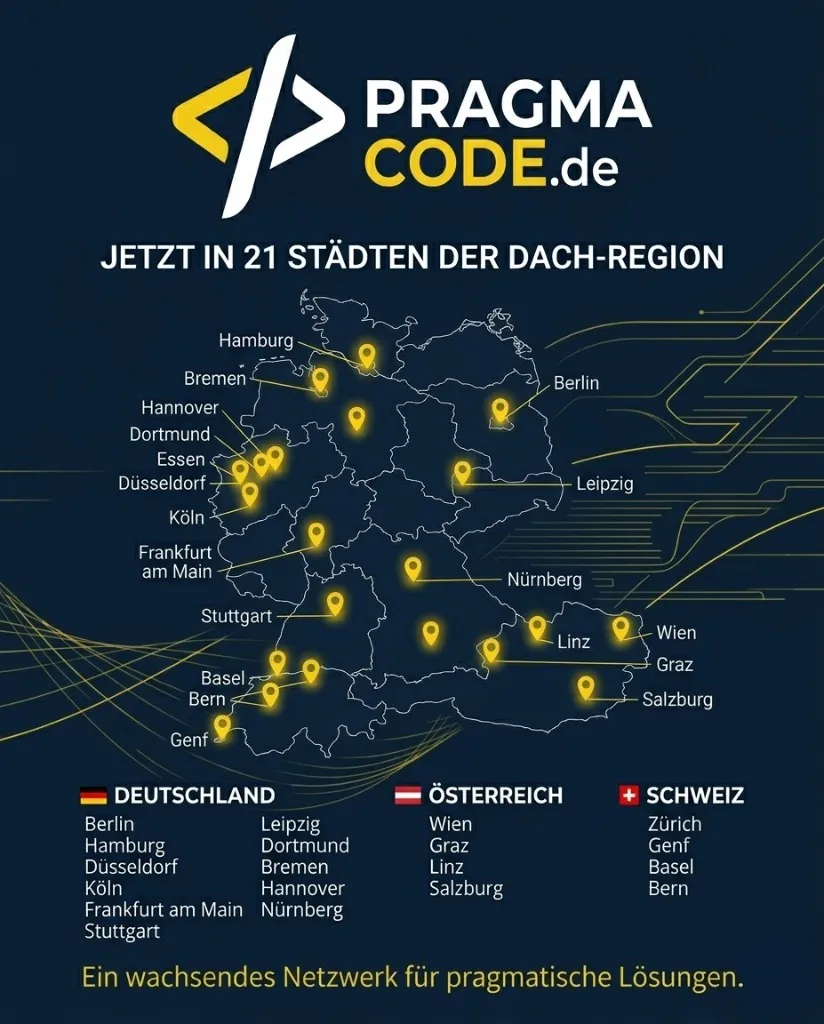
We are your digital partner – regionally anchored and successfully scaling across borders.
Have a vision?
Let's check together how we can make your idea take flight.
Book your free strategy call nowExtended Specialized Glossary
Gemini 3.7 Flash
Google DeepMind's multimodal AI model featuring native hybrid reasoning architecture and a 1M token context window.
Hybrid Reasoning
The architectural capability of an AI model to seamlessly transition between instant standard inference and deep, multi-step logical deduction.
Thinking Budget
An API parameter allowing developers to set the exact maximum number of internal reasoning tokens to balance latency, cost, and output quality.
Agentic AI
Autonomous software systems capable of pursuing multi-step goals, calling external tools, and validating intermediate results independently.
SWE-bench
A gold-standard industry benchmark evaluating an AI model's ability to solve real-world GitHub issues and complex software bugs.
Large Language Model
A deep neural language model trained on massive datasets of text and code to execute complex cognitive tasks.