

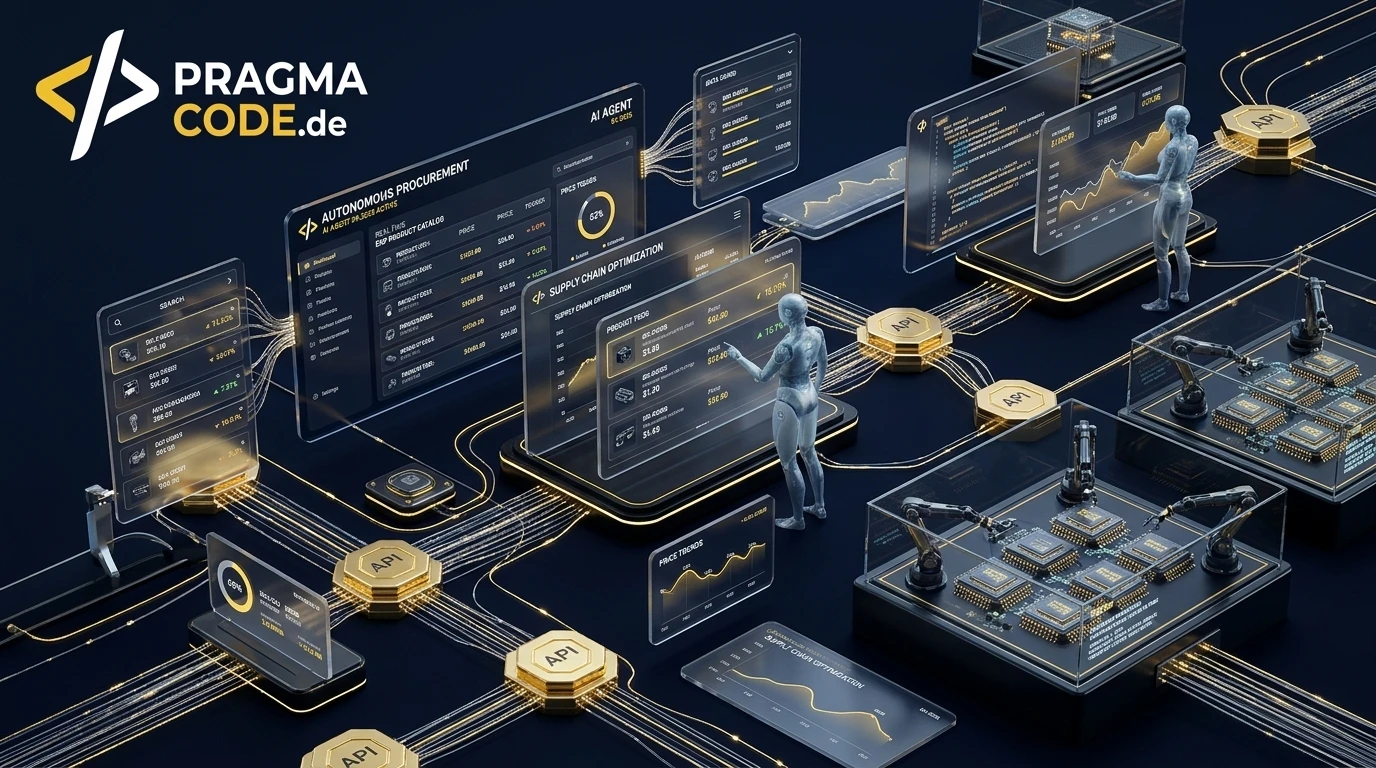
B2B commerce in 2026 is undergoing its most fundamental transformation since the birth of the World Wide Web: Autonomous AI agents are taking over enterprise procurement. Suppliers that fail to deliver machine-readable product catalogs, dynamic tier pricing, and stock levels are silently excluded from automated tenders.
This article is an in-depth expert contribution from our content cluster. Discover the complete overview on our main page: E-Commerce Solutions →
The M2M Shift in B2B E-Commerce
While traditional e-commerce relies on human buyers navigating through promotional banners, emotional imagery, and manual search filters, 2026 is defined by specialized Agentic Procurement systems across European industries. Autonomous AI agents ingest technical spec sheets, negotiate contract pricing via APIs, validate compliance certificates, and execute orders in milliseconds. Suppliers that fail to open their digital storefronts to machine agents are silently losing access to the decade's most lucrative sales channel.
- The M2M Paradigm Shift: B2B purchasing decisions are increasingly orchestrated or completed directly by autonomous software agents (e.g., SAP Ariba AI, Coupa bots, or custom LLM-based procurement agents).
- Data Quality as a Disqualifier: AI buyers require machine-readable catalog data (JSON-LD OfferCatalog, OpenAPI 3.1, UCP). PDF data sheets and login walls without structured metadata trigger immediate exclusion from automated supplier shortlists.
- Real-Time ERP Conditions & Authorization: High-performing B2B platforms synchronize with ERP backends with zero latency, issue scoped OAuth2 tokens for AI agents, and enforce automated approval gates (Human-in-the-Loop) for high-value orders.
- 1. The Paradigm Shift: From Click-Buyers to Autonomous M2M Purchasing Agents
- 2. The Anatomy of a B2B AI Buyer: Decision Logic, Filters, and Selection
- 3. Architecture Comparison: Human-Centric Store vs. Agent-Ready B2B Platform
- 4. The 4 Technical Pillars of Maximum Agentic Readiness
- 5. The 5-Step Roadmap to B2B Agentic Commerce Transformation
- 6. Governance, API Security & Human-in-the-Loop Safeguards
- 7. Quick-Check: Is Your B2B Store Ready for AI Purchasing Agents?
- 8. Extended Specialized Glossary for Decision-Makers
1. The Paradigm Shift: From Click-Buyers to Autonomous M2M Purchasing Agents
For more than two decades, digital B2B sales operated under a simple assumption: Design the web storefront so intuitively, visually appealing, and clear that human procurement managers, plant supervisors, or managing directors could easily fill their shopping carts and place orders. Large product imagery, promotional copy, faceted filtering, and multi-level category navigation formed the bedrock of e-commerce success.
In 2026, the underlying market dynamics have flipped. A persistent shortage of commercial talent combined with relentless margin pressure has accelerated the deployment of Agentic Procurement across European mid-market enterprises. Industry data indicates that over 25% of mid-sized companies already utilize AI agents in daily operations, with another 41% actively deploying autonomous procurement infrastructure this year.
An autonomous AI purchasing agent does not click through mega-menus or read marketing taglines. It processes structured data streams, reconciles CAD drawings and technical specifications (such as DIN/ISO tolerances, material grades, RoHS compliance) against internal ERP Bill of Materials (BOM), queries real-time tier pricing, and calculates total logistics costs including guaranteed delivery windows.
Strategic Insight: The Invisibility of Unstructured Storefronts
When a B2B store hides pricing behind mandatory logins, buries product specifications inside unstructured PDFs, or lacks clean REST/MCP endpoints, AI procurement agents classify the vendor as unavailable. The supplier is not rejected with a formal notice—it simply receives a score of 0 during automated supplier evaluation.
2. The Anatomy of a B2B AI Buyer: Decision Logic, Filters, and Selection
To optimize a B2B store for machine buyers, engineering teams must understand how modern autonomous purchasing agents operate. Enterprise systems built on frameworks like LangChain, n8n Enterprise, or specialized procurement stacks execute a standardized four-phase decision process:
Requirement Extraction & BOM Ingestion: The agent parses internal procurement requisitions from the ERP (e.g., 5,000 units of precision ball bearings conforming to DIN 625-1 with dual contact seals, required on site within 10 business days).
Global Discovery & Machine-Readable Crawling: The agent queries indexed suppliers via Generative Engine Optimization (GEO), evaluates Schema.org OfferCatalog metadata, and queries registered Model Context Protocol (MCP) endpoints across potential suppliers.
Terms Negotiation & Compliance Verification: Through authenticated API endpoints, the agent requests personalized volume tiers, verifies compliance certificates (ISO 9001, BFSG, CE), and computes total landed cost including customs and hazardous freight surcharges.
Autonomous Transaction & ERP Posting: Upon successful verification, the agent authenticates via OAuth2 tokens or cryptographic signatures, generates EDI/E-Invoicing-compliant purchase orders (ZUGFeRD/XRechnung), and logs the invoice directly into the buyer's ERP.
This reality underscores a fundamental truth: Emotional selling points in B2B commerce take a backseat to precision, latency, structured consistency, and API availability. The B2B website is transforming from a digital marketing brochure into a high-performance data and transaction server.
3. Architecture Comparison: Human-Centric Store vs. Agent-Ready B2B Platform
The gap between a conventional B2B store and a modern M2M-Commerce architecture lies deep within the software stack. While legacy setups rely on monolithic server-side rendering pipelines, modern platforms leverage Headless Commerce with decoupled API endpoints.
Comparison: Traditional B2B Webshop vs. Agent-Ready Platform
- Target Audience: Exclusively human visitors using desktop or mobile web browsers.
- Data Delivery: Rendered HTML DOM, unstructured narrative copy, PDF catalogs, and graphical overlays.
- Pricing Visibility: Locked behind manual login screens or requiring email quotation requests.
- Integrations: Monolithic architectures reliant on slow XML batch syncs or nightly CSV imports.
- Discovery: Traditional Google SEO (keyword stuffing, meta tags, manual backlink campaigns).
- Checkout Workflow: Multi-step manual checkout with CAPTCHAs and cumbersome input forms.
- Target Audience: Hybrid: Human buyers AND autonomous AI purchasing agents.
- Data Delivery: Structured JSON-LD schemas, OpenAPI 3.1 specs, UCP, and
/llms.txtindexes. - Pricing Visibility: Granular pricing APIs with token-based authentication and dynamic tier discounts.
- Integrations: High-performance headless APIs (edge caching, sub-100ms latency, event webhooks).
- Discovery: GEO (Generative Engine Optimization) and direct AI integration via MCP servers.
- Checkout Workflow: Programmatic checkout via signed API tokens, wallet delegation, and automated EDI receipts.
4. The 4 Technical Pillars of Maximum Agentic Readiness
To equip an existing B2B store for machine buyers, engineering and digital teams must implement four tightly integrated architectural pillars:
1. Machine-Readable Data Structuring: JSON-LD OfferCatalog & UCP
Every product page must expose structured Schema.org markup (@type: "Product" and @type: "OfferCatalog"). Beyond basic SKUs, MPNs, and GTINs, technical attributes must be formatted as machine-typed additionalProperty entries. Supporting the Universal Commerce Protocol (UCP) ensures AI agents can reliably ingest product parameters into their mathematical scoring matrices without hallucinations.
2. Model Context Protocol (MCP) Server for E-Commerce
By implementing an open Model Context Protocol (MCP) server, your store provides dedicated function tools directly to LLMs (such as check_stock(sku), get_custom_pricing(customer_id, volume), reserve_quota(sku, amount)). AI buyers no longer need to scrape brittle HTML; they interact with your catalog via verified, type-safe remote procedure calls.
3. Zero-Latency ERP Integration for Dynamic Customer Conditions
B2B trade rarely operates on static retail pricing. Customer-specific contract tiers, bulk discounts, payment terms, and fluctuating raw material surcharges demand direct integration with enterprise ERP systems (SAP, Microsoft Dynamics 365, proALPHA, DATEV). Utilizing serverless edge compute and in-memory Redis caches ensures price calculations are returned in under 150 milliseconds, eliminating agent timeouts.
4. Fine-Grained Agent Authentication & Budget Delegation
Software agents must not share generic user credentials. Through granular OAuth2 scopes and short-lived API tokens, AI buyers receive explicitly bounded permissions (for example: "Authorized to retrieve quotes up to €50,000 and autonomously issue purchase orders up to €10,000"). Every transaction is logged with tamper-evident audit trails complying with international data privacy standards.
5. The 5-Step Roadmap to B2B Agentic Commerce Transformation
Transforming a traditional B2B sales channel into an agent-ready e-commerce powerhouse requires an orderly, structured methodology. We advise enterprise merchants to execute along our field-tested 5-step roadmap:
-
Step 1: Master Data Audit & Semantic Standardization
Audit all product attributes in your ERP and PIM (Product Information Management) systems. Transform unstructured narrative descriptions into normalized key-value pairs, attaching universal identifiers (GTIN, MPN, HS customs codes, UNSPSC / eCl@ss taxonomy classifications).
-
Step 2: Deployment of JSON-LD & UCP Data Layers
Enrich all product and catalog pages with structured Schema.org markup. Deploy accessible
/llms.txtand/llms-products.jsonfiles in your website root to serve as index maps for AI crawlers exploring your catalog specifications and API endpoints. -
Step 3: Implementation of a Dedicated MCP E-Commerce Server
Deploy a lightweight Model Context Protocol (MCP) server on Cloudflare Workers or Node.js edge infrastructure. Define tools for semantic product lookups, live inventory verification, tiered quotation, and sample orders.
-
Step 4: Real-Time ERP Synchronization & Webhook Architecture
Establish bi-directional event streaming between your e-commerce platform and central ERP. When inventory thresholds or volume prices change, registered purchasing agents receive real-time webhook notifications to keep procurement pipelines synchronized.
-
Step 5: Security Boundaries, Rate Limiting & Governance
Configure spending limits, cryptographic order verification, rate limiting to protect against scraper bots, and automated Human-in-the-Loop workflows for orders exceeding critical monetary thresholds.
6. Governance, API Security & Human-in-the-Loop Safeguards
Unrestricted autonomous transactions introduce risks for suppliers and buyers alike: What occurs if an errant procurement bot misinterprets a prompt and orders 500,000 units instead of 500? Or what if pricing misconfigurations are exploited by external arbitrage scripts in fractions of a second?
A resilient B2B Agentic Commerce platform incorporates robust multi-tier guardrails:
The 3 Core Security Principles for M2M E-Commerce
1. Dynamic Anomaly Detection: If an agent's order volume or frequency deviates by more than 300% from its historical average, the transaction is automatically placed into a temporary review hold.
2. Asymmetric Cryptographic Signatures: API purchase orders must carry cryptographic signatures generated by the buyer organization's private key to ensure non-repudiation and legal enforceability under commercial law.
3. Human-in-the-Loop Thresholds: While standard repeat orders of MRO supplies under €5,000 proceed automatically, custom fabrications or high-value orders exceeding €25,000 require instant 1-click human confirmation by account managers via Slack, Teams, or email.
7. Quick-Check: Is Your B2B Store Ready for AI Purchasing Agents?
Evaluate your current B2B architecture against this checklist to gauge your readiness for the autonomous procurement era:
Quick-Check: Agentic B2B Readiness 2026
/llms.txt file available in your domain root for AI crawlers?
8. Extended Specialized Glossary for Decision-Makers
Essential terminology surrounding B2B Agentic Commerce and autonomous enterprise procurement:
Agentic Procurement
The fully automated, AI-driven B2B procurement workflow. Autonomous purchasing agents evaluate technical specifications, compare supplier quotes, check ERP terms, and execute orders independently via structured APIs.
Universal Commerce Protocol (UCP)
An open industry standard that enables AI agents to communicate machine-readably with merchant systems — from product search through cart population to payment processing.
M2M-Commerce
Machine-to-Machine commerce where digital systems and autonomous AI agents negotiate prices, verify contract compliance, and complete transactions directly via APIs and machine-readable catalogs without human intervention.
Model Context Protocol (MCP)
An open standard protocol introduced by Anthropic. It provides a uniform way for AI models to securely connect to external tools, data repositories, and APIs for seamless integration.
Generative Engine Optimization (GEO)
The process of optimizing content and technical assets so that generative AI engines like Perplexity, SearchGPT, or Google AI Overviews cite and recommend them as primary sources.
Headless Commerce
An e-commerce architecture that decouples the frontend presentation layer from backend business logic and databases, enabling seamless AI agent interactions via structured APIs.
Ready to optimize your B2B store for autonomous AI buyers?
We assist industrial manufacturers, distributors, and enterprise brands in transitioning to high-performance Headless Commerce, MCP server integrations, and machine-readable product architectures.
Request a Free ConsultationOur Regional Expertise
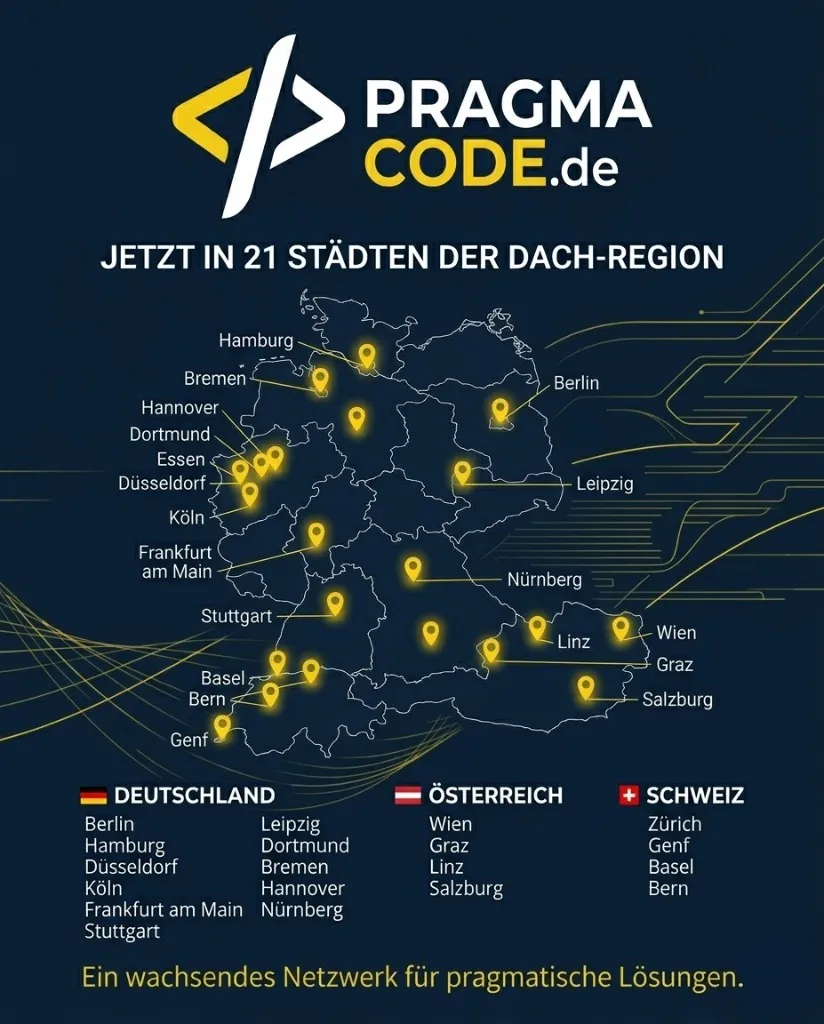
We are your digital partner – regionally anchored and successfully scaling across borders.
Have a vision?
Let's check together how we can make your idea take flight.
Book your free strategy call nowExtended Specialized Glossary
Agentic Procurement
The fully automated, AI-driven B2B procurement workflow. Autonomous purchasing agents evaluate technical specifications, compare supplier quotes, check ERP terms, and execute orders independently via structured APIs.
Universal Commerce Protocol (UCP)
An open industry standard that enables AI agents to communicate machine-readably with merchant systems — from product search through cart population to payment processing.
M2M-Commerce
Machine-to-Machine commerce where digital systems and autonomous AI agents negotiate prices, verify contract compliance, and complete transactions directly via APIs and machine-readable catalogs without human intervention.
Model Context Protocol (MCP)
An open standard protocol introduced by Anthropic. It provides a uniform way for AI models to securely connect to external tools, data repositories, and APIs for seamless integration.
Generative Engine Optimization (GEO)
The process of optimizing content and technical assets so that generative AI engines like Perplexity, SearchGPT, or Google AI Overviews cite and recommend them as primary sources.
Headless Commerce
An e-commerce architecture that decouples the frontend presentation layer from backend business logic and databases, enabling seamless AI agent interactions via structured APIs.