

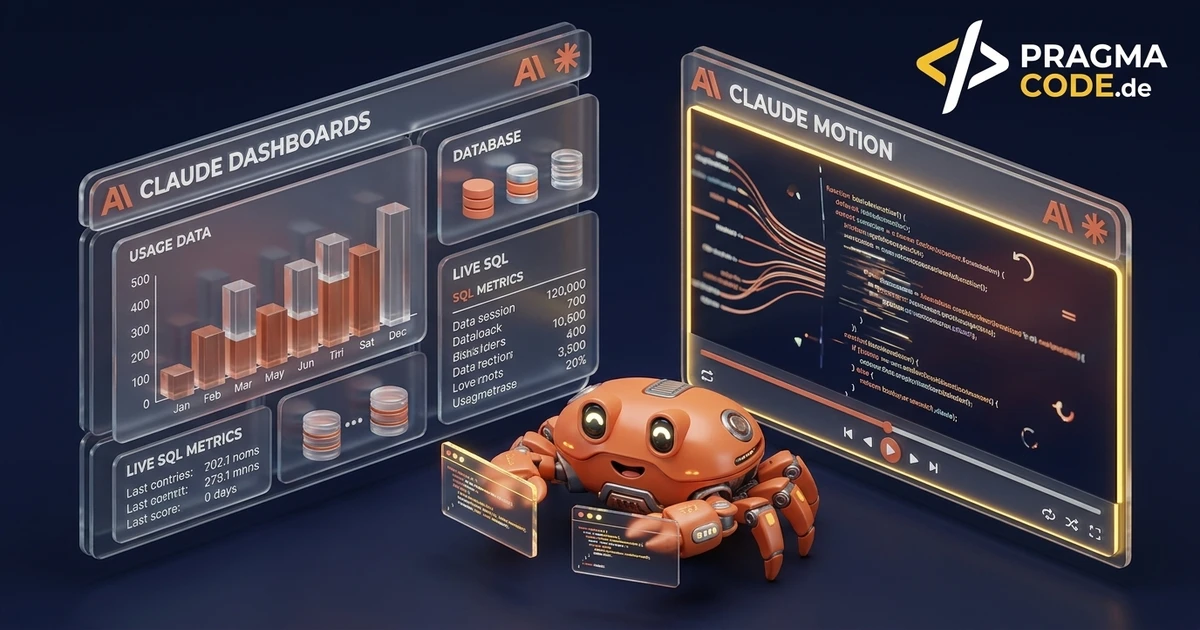
Anthropic expands Claude with two enterprise capabilities: while Claude Dashboards connects enterprise data platforms to build self-updating interactive charts, Claude Motion turns reports and ideas into code-animated explainer videos exported as MP4. What does this mean for businesses – and which tool should teams adopt first?
This article is an in-depth expert contribution from our content cluster. Discover the complete overview on our main page: AI Automation for Enterprises →
- Paradigm shift in business communication: Anthropic's beta launch of Claude Dashboards and Claude Motion disrupts both static spreadsheet presentations and expensive external video production agencies.
- Code precision over video hallucination: Claude Motion renders animated MP4 explainer videos using deterministic code rather than unpredictable video diffusion models. Numbers, typography, and vector layouts remain pixel-perfect and editable.
- Strategic decision path: While Dashboards resolves internal data silos between cloud warehouses and operational teams, Motion turns complex business intelligence into persuasive stakeholder video assets.
- 1. Introduction: The End of Static B2B Reporting
- 2. Claude Dashboards: Live Enterprise Warehouses Without BI Bottlenecks
- 3. Claude Motion: Programmatic Code Animation Over Video Hallucination
- 3.1 Hands-On Showcase: The 6 Official Motion Workflows
- 4. Dashboards vs. Motion: The Strategic B2B Comparison
- 5. The 4 Pillars of Modern AI Data Architecture
- 6. Top 5 B2B Enterprise Use Cases for Businesses
- 7. Cost Traps of Traditional Business Intelligence & Video Production
- 8. Step-by-Step Implementation Roadmap
- 9. Conclusion: Which Tool Belongs at the Top of Your Roadmap?
- 10. Official Sources & Primary Documentation
1. Introduction: The End of Static B2B Reporting
Business decision-making in mid-market and enterprise organizations rarely suffers from a scarcity of raw data. ERP suites, cloud data warehouses, CRM instances, and e-commerce platforms log every transaction, customer interaction, and operational hour with microscopic detail. The existential challenge facing modern organizations is the cognitive translation burden: How does an operational department transform millions of raw database records into clear, actionable insights that executive leadership can evaluate and approve in seconds?
Historically, organizations have been trapped between two unsatisfactory extremes. Data analysts spent days manually stitching together static slide decks that were outdated the moment the executive meeting convened. Alternatively, marketing and strategy teams outsourced animated video explainers to external creative agencies—incurring five-figure production fees, multi-week turnaround times, and grueling revision cycles whenever a single metric changed.
With the October 2026 beta launch of Claude Dashboards and Claude Motion, Anthropic directly targets this communication gap. The foundational model is no longer merely a conversational text generator or software pair programmer; it functions as an integrated visual synthesis engine for enterprise operations. While Dashboards translates connected databases into interactive, self-updating BI visualizations, Motion converts written reports and conceptual briefs into animated explainer videos exported directly as MP4.
Strategic Guidance for CTOs & Managing Directors
The core enterprise challenge is no longer whether generative models can render charts, but how deterministically those artifacts integrate with operational data pipelines. Claude Dashboards delivers operational truth; Claude Motion delivers executive buy-in. Together, they create a unified information loop.
2. Claude Dashboards: Live Enterprise Warehouses Without BI Bottlenecks
Legacy business intelligence suites such as Tableau, Power BI, and Looker demand dedicated semantic data modelers, intricate DAX queries, and rigid ETL scheduling. When business leaders or sales directors require immediate answers to ad-hoc questions ("Which product families experienced the highest return rates alongside contracting margins last month?"), functional departments are forced to submit IT tickets that take days to resolve.
Claude Dashboards eliminates this bottleneck by placing a conversational interface directly on top of modern cloud data warehouse SQL engines. Users on paid Claude tiers (Pro, Team, and Enterprise) can leverage a Zero-Retention BI Connector to link core enterprise infrastructure seamlessly:
Enterprise Data Warehouses
Native read-only connectors for Snowflake, Databricks, Google BigQuery, and Amazon Redshift allow teams to analyze multi-terabyte transactional datasets in milliseconds.
Real-Time & Clickstream Engines
Direct integration with ClickHouse enables low-latency analysis of high-throughput IoT telemetry, server event logs, and live web metrics without pre-aggregation.
CRM & Revenue Platforms
Direct connectivity to Salesforce enables sales executives to visualize pipeline velocities, deal stages, and churn probabilities on demand.
Transparent SQL Synthesis Over Blackbox AI
A fatal flaw in early AI analytics tools was their total lack of auditability: When an AI model stated an ARR or EBITDA metric, users had no visibility into how that number was calculated. Claude Dashboards enforces complete transparency. For every generated visual chart, Claude exposes the underlying SQL query executed against the warehouse. Analysts and IT administrators can inspect query logic, examine join conditions, and verify date filters with a single click, or copy the SQL string directly into established engineering workflows.
Furthermore, generated charts are not inert static screenshots. They are stateful and interactive: Users can dynamically scrub timelines, execute drilldowns into regional subcategories, and zoom into volatile cohorts. Whenever underlying data records update in the warehouse, the dashboard refreshes automatically. For extended collaboration, finished dashboards can be exported seamlessly to dedicated BI platforms including Grafana, Hex, and Sigma.
3. Claude Motion: Programmatic Code Animation Over Video Hallucination
Corporate video production has long been the most expensive, rigid discipline in enterprise communications. While generative diffusion video models (such as Sora or Runway) produce breathtaking cinematic vistas, they routinely fail in enterprise environments. Generative diffusion models synthesize frames probabilistically; they have no underlying concept of vector geometry, mathematical precision, or strict typographic alignment.
The consequence in corporate reporting is catastrophic: blurry fonts, distorted axes, hallucinated percentage values, and mutated company logos. In a quarterly financial briefing or technical customer presentation, visual hallucination destroys executive trust instantly.
The Principle of Programmatic Animation
Anthropic took a fundamentally different engineering path with Claude Motion: Programmatic Animation. Instead of probabilistic video diffusion, Claude generates real, deterministic code—producing vector scripts, SVG nodes, canvas primitives, and programmatic motion timelines. This code is then compiled server-side into a high-definition MP4 video container.
1. Typographic Precision Without Visual Artifacts
Every word, heading, and footnote is rendered as crisp vector typography. No pixel smearing, no illegible glyphs, and zero morphing artifacts across frame transitions.
2. Mathematical and Data Fidelity
Bar heights, trend curves, and numeric counters execute exact mathematical code. If a metric increases by 42 percent, the rendered bar height adheres precisely to that scalar value.
3. Granular Chat-Based Iteration
Adjusting an animation does not require re-rendering from scratch. A simple follow-up prompt ("Change the target revenue at second 12 to 1.8 million euros") updates the underlying code variables and exports a fresh MP4 in seconds.
The feature is triggered inside Claude using the dedicated slash command /motion in the message input box. Teams on Team and Enterprise subscriptions can drag and drop comprehensive whitepapers, markdown reports, or strategic memos into the conversation and prompt: /motion Create a 45-second animated explainer for executive leadership to receive a broadcast-ready MP4 video immediately.
Hands-On Showcase: The 6 Official Motion Workflows in Claude Code
How does working with Claude Motion look in real developer and marketing workflows? With its integration into Claude Code, Anthropic has demonstrated that Motion goes far beyond basic text prompting. By combining filesystem access, automated web inspection, and deterministic code output, teams can execute six highly efficient production workflows directly from the terminal or chat interface:
1. Scenes Are Just Code: The HTML & Headless Browser Architecture
The core architectural breakthrough of Claude Motion: Every scene is pure, deterministic web code. Claude (such as Opus 5.5) generates a self-contained scene.html file that can render any frame at exact timestamp t within a 1920×1080 full-HD viewport. A server-side headless browser captures each frame via precision screenshot—ensuring every render comes out bit-identically reproducible and free from generative diffusion artifacts.
Write one HTML scene that draws any frame at time t. 1920x1080.Technical Execution: Claude constructs a modular
scene.html with a parametric time-stepping function drawFrame(t). The headless browser scrubs discretely across timestamps (e.g., at 00:00:06:12) and compiles frames deterministically into an MP4 stream.
2. Kinetic Titles: Word-by-Word Frame Staggering & Mask Reveals
Instead of static overlays, Claude generates kinetic typography where every word acts as an independent vector element with its own start frame. A slight stagger (e.g., 4 to 6 frames) ensures titles land rhythmically on the musical beat.
Animate "Ship it today" word by word, 6 frame stagger, slide up 40px.Technical Execution: Claude constructs a mask-reveal timeline with staggered keyframes (
+0f, +4f, +8f) and a smooth vertical translation curve.
3. Motion for Your Website: Launch Video Animations Exported as Plain CSS & JS
One of the most powerful advantages of code-based motion: The exact animation driving your launch MP4 can be deployed directly to your production landing page. Claude exports keyframes and timing curves as clean, lightweight CSS and vanilla JavaScript.
Animate my landing page hero. Stagger the headline, CTA and feature cards.Technical Execution: Claude produces a modular
hero.css file with optimized CSS keyframes, enabling the landing page to load instantly without heavy video assets.
4. Automated SaaS Intro: Complete Product Videos Directly from a URL
For product launches or feature releases, Motion eliminates the need for manual storyboarding. Simply provide the URL to your SaaS landing page—Claude analyzes the live page, extracts core value propositions, and constructs the video autonomously.
Make a 20s intro video from lumen.app. Plan the scenes first, then build.Technical Execution: Claude extracts product names, key features, and CTAs, structures a 4-scene storyboard, and renders a 20-second explainer highlighting key revenue metrics.
5. Sync to the Audio: Precise Keyframing to Beats & Word Timestamps
Music and spoken voiceovers provide the emotional backbone of compelling video. Claude Motion accepts beat timestamps in seconds or word-level transcription timestamps (from Whisper or ElevenLabs) and keys every visual transition directly to those markers.
Here are the beat times in seconds. Pop each title on a beat.Technical Execution: Title reveals, scene transitions, and visual accents lock onto transient audio peaks with frame-perfect precision—eliminating tedious timeline trimming in Premiere or After Effects.
6. Animate Your Data: Growing Bar Charts & Dynamic Counters from CSV Files
Traditional business intelligence charts are inert; Claude Motion brings operational data to life. Provide a simple CSV file or table: chart bars expand dynamically and numeric metrics count up from zero to their empirical values.
Animate this CSV as a bar chart. Count each number up as its bar grows.Technical Execution: Vertical or horizontal bars animate proportionally to numeric data (e.g., Reels 74.5k, Shorts 50.3k). For subsequent reporting cycles, simply swap the CSV file—the video updates automatically.
4. Dashboards vs. Motion: The Strategic B2B Comparison
Both capabilities serve distinct phases of enterprise execution. To resolve the central dilemma—"Which capability should you deploy first?"—organizations must weigh the comparative profiles of both tools:
Comparison: Claude Dashboards vs. Claude Motion
- Core Objective: Delivering live, interactive analytics across connected corporate data warehouses.
- Data Foundation: Direct SQL connectors (Snowflake, BigQuery, Databricks, Salesforce, ClickHouse).
- Plan Availability: Active beta access across all paid tiers (Pro, Team, Enterprise).
- Primary Users: Financial controllers, operations managers, business analysts, team leads.
- Output Format: Interactive web widgets, inspectable SQL queries, BI export (Hex, Grafana, Sigma).
- Key ROI Metric: Drastic reduction in internal BI ticket turnaround times and eliminated data silos.
- Core Objective: Converting written reports and strategic ideas into compelling animated video explainers.
- Data Foundation: Documents, narrative briefs, tables, memos via slash command
/motion. - Plan Availability: Exclusive beta access restricted to Team and Enterprise subscriptions.
- Primary Users: C-suite executives, product marketing managers, enterprise sales directors.
- Output Format: Fully compiled MP4 video assets with editable code animation layers.
- Key ROI Metric: Elimination of outsourced agency production costs and faster stakeholder approval cycles.
Decision Framework: Which Tool Belongs at the Top of Your Roadmap?
Prioritization depends entirely on your organization's primary operational bottleneck:
Deploy Claude Dashboards first if: Your company is paralyzed by fragmented data repositories, departments wait days for routine reporting, and software engineers spend hours extracting manual SQL queries for marketing and sales leads. Dashboards provides the unified empirical foundation required for reliable corporate governance.
Deploy Claude Motion first if: Your data and strategy are already well documented, but struggle with executive attention. When 40-page technical memos go unread by board members, complex software value propositions stall during enterprise sales cycles, or your firm routinely spends five-figure agency budgets on basic explainer animations.
5. The 4 Pillars of Modern AI Data Architecture
Integrating Claude Dashboards and Claude Motion into an enterprise software stack requires a rigorous architectural understanding. Anthropic designed both solutions to meet demanding enterprise compliance standards:
1. Zero-Retention Data Connectors
Database connections operate purely ephemerally. Enterprise records are queried for live visual generation but are never stored permanently in model memory or recycled into training corpuses.
2. Deterministic Motion Engine
Natural language prompts compile into parametric vector code. Rendering enforces deterministic keyframe curves, exact corporate hex codes, and standard 60 FPS playback fluidity.
3. Inspectable SQL & Metric Layer
Every generated chart exposes its complete query syntax. Engineers and analysts can audit join logic, window functions, and timestamp filters independently at any time.
4. BI Federation & Media Export
Zero vendor lock-in: Dashboards can be pushed to enterprise BI platforms like Grafana, Hex, or Sigma; Motion produces universally compatible, standalone MP4 assets.
6. Top 5 B2B Enterprise Use Cases for Businesses
In real-world business operations, Claude Dashboards and Claude Motion unlock maximum economic value when applied directly to high-friction corporate workflows:
1. Automated Monthly & Quarterly Briefings
Controlling data in Snowflake is synthesized via Dashboards and converted via Motion into a concise 60-second video update for shareholders and advisory boards.
2. Interactive Sales Pipeline Intelligence
Commercial teams integrate Salesforce to isolate stalled deals in real time, exploring deal velocity curves and win probabilities across territories dynamically.
3. Kinetic B2B Pitch Videos & Proposal Summaries
Enterprise account executives convert dense 50-page RFP tender responses into customized, animated 90-second video summaries for customer procurement committees.
4. Supply Chain & Logistics Early Warning Cockpits
Using ClickHouse and BigQuery connectors, logistics teams monitor safety stock thresholds, container dwell times, and freight bottlenecks on interactive heatmaps.
5. Visual Employee & Partner Onboarding Modules
People operations and compliance teams transform complex security protocols, IT guidelines, and standard operating procedures (SOPs) into clear video explainers.
7. Cost Traps of Traditional Business Intelligence & Video Production
Enterprises clinging to antiquated manual reporting models pay a steep penalty in both operational velocity and recurring consulting budgets:
Trap 1: The PowerPoint Screenshot Graveyard
Senior analysts spend up to eight hours weekly capturing static screenshots from disconnected systems into slide decks. A single revision requires repeating the entire manual assembly chain.
Trap 2: The Five-Figure Creative Agency Tax
External motion design agencies routinely bill between 5,000 and 15,000 euros for a simple two-minute explainer animation with four-week lead times, rendering rapid iteration impossible.
Trap 3: Underutilized Enterprise BI Software Licenses
Organizations invest substantial sums in complex BI software suites that 80 percent of employees never touch because operating them requires specialized data engineering skills.
8. Step-by-Step Implementation Roadmap
Successful enterprise rollout of Claude Dashboards and Claude Motion does not require multi-month IT consulting engagements. A disciplined four-stage roadmap ensures compliance and measurable ROI from day one:
-
Step 1: Warehouse Connectivity & Permission Audit
Provision dedicated, read-only service accounts in your cloud data warehouses (Snowflake, BigQuery, Databricks). Enforce strict IP allowlists and ensure personally identifiable customer information (PII) is masked at the database view level.
-
Step 2: Controlling & Revenue Pilot Dashboards
Begin with recurring operational reports in sales and financial controlling. Audit Claude's generated SQL queries against trusted legacy benchmarks to build stakeholder confidence in query accuracy.
-
Step 3: Standardizing Brand-Compliant Motion Templates
Establish reusable
/motionprompt instructions incorporating your corporate palette, typography standards, logo positioning, and tone. Test internal production by generating short release explainers for marketing campaigns. -
Step 4: Launching the Hybrid Autonomous Reporting Loop
Unify both capabilities into an end-to-end pipeline: Configure Dashboards to aggregate weekly performance variance automatically, and pass that summary directly to Motion to render a Monday morning video brief for executives.
9. Conclusion: Which Tool Belongs at the Top of Your Roadmap?
The introduction of Claude Dashboards and Claude Motion marks a defining turning point in enterprise knowledge management. Anthropic demonstrates that generative artificial intelligence can bridge the gap between empirical database analytics and compelling visual media production.
Returning to the core question—"Should you adopt Dashboards or Motion first?"—the answer depends on organizational maturity:
Begin with Claude Dashboards to establish your empirical baseline. Without verified, connected, and accessible data, visual storytelling remains hollow marketing fluff. But once your operational data is conversationally accessible, Claude Motion becomes your most powerful persuasion multiplier: It converts raw metrics into dynamic, memorable video narratives that align executive boards, empower sales teams, and accelerate business growth.
Quick-Check: Getting Started with Claude Dashboards & Motion
/motion engine
10. Official Sources & Primary Documentation
- Anthropic Newsroom (October 8, 2026): "Introducing Claude Dashboards and Claude Motion in Beta" – Official product release notes detailing new data visualization and programmatic animation capabilities.
- Snowflake Developer Documentation (2026): "SQL API & External LLM Connector Best Practices" – Architectural guidelines for securely linking external foundation models via zero-retention query interfaces.
- Databricks Enterprise Architecture Whitepaper (2026): "Governing AI-Driven Business Intelligence at Scale" – Protocols for read-only credentials, query auditing, and privacy-compliant analytics federation.
Do you want to establish AI dashboards and automated workflows in your organization?
Schedule Free Initial ConsultationOur Regional Expertise
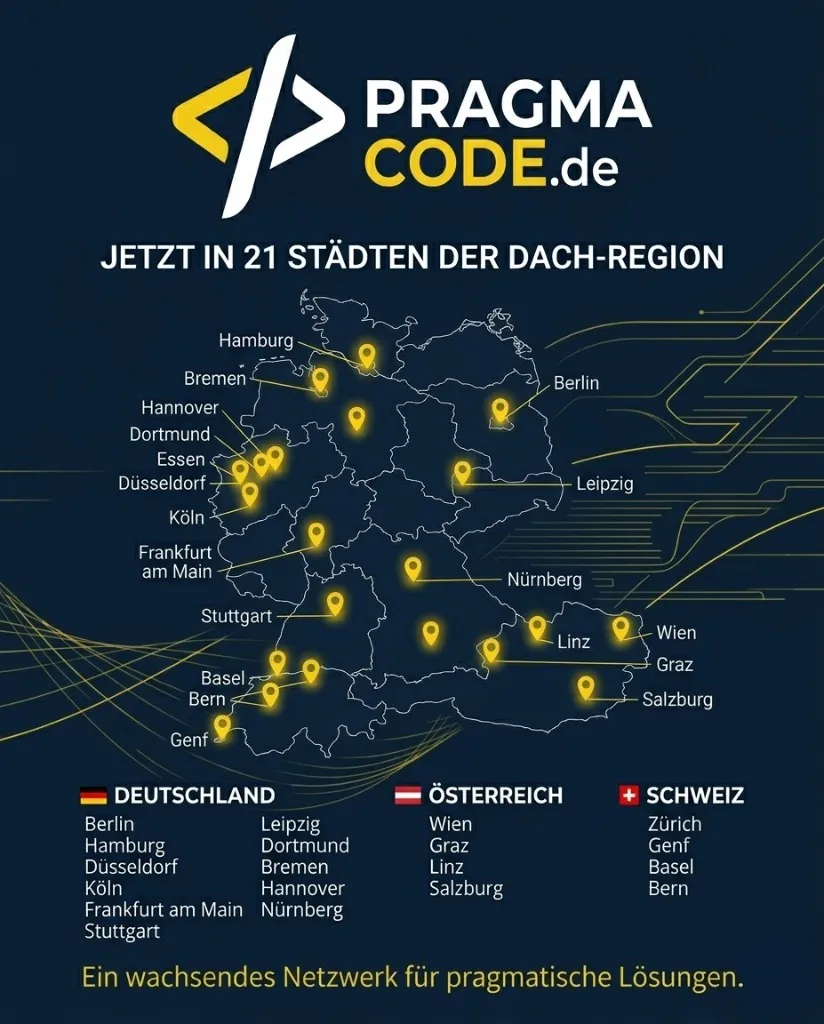
We are your digital partner – regionally anchored and successfully scaling across borders.
Have a vision?
Let's check together how we can make your idea take flight.
Book your free strategy call nowExtended Specialized Glossary
Claude Dashboards
An Anthropic feature that connects enterprise data warehouses and generates interactive, auto-updating BI charts from natural language prompts using transparent SQL queries.
Claude Motion
An Anthropic capability that turns reports or ideas into animated explainer videos via programmatic code generation, exporting editable text, numbers, and assets directly to MP4.
Programmatic Animation
A code-based method of generating motion graphics where typography, metrics, and timeline elements remain fully deterministic and editable unlike diffusion-based AI video models.
Zero-Retention BI Connector
An enterprise integration architecture that queries cloud data warehouses ephemerally for SQL synthesis without storing customer data permanently in the model.