

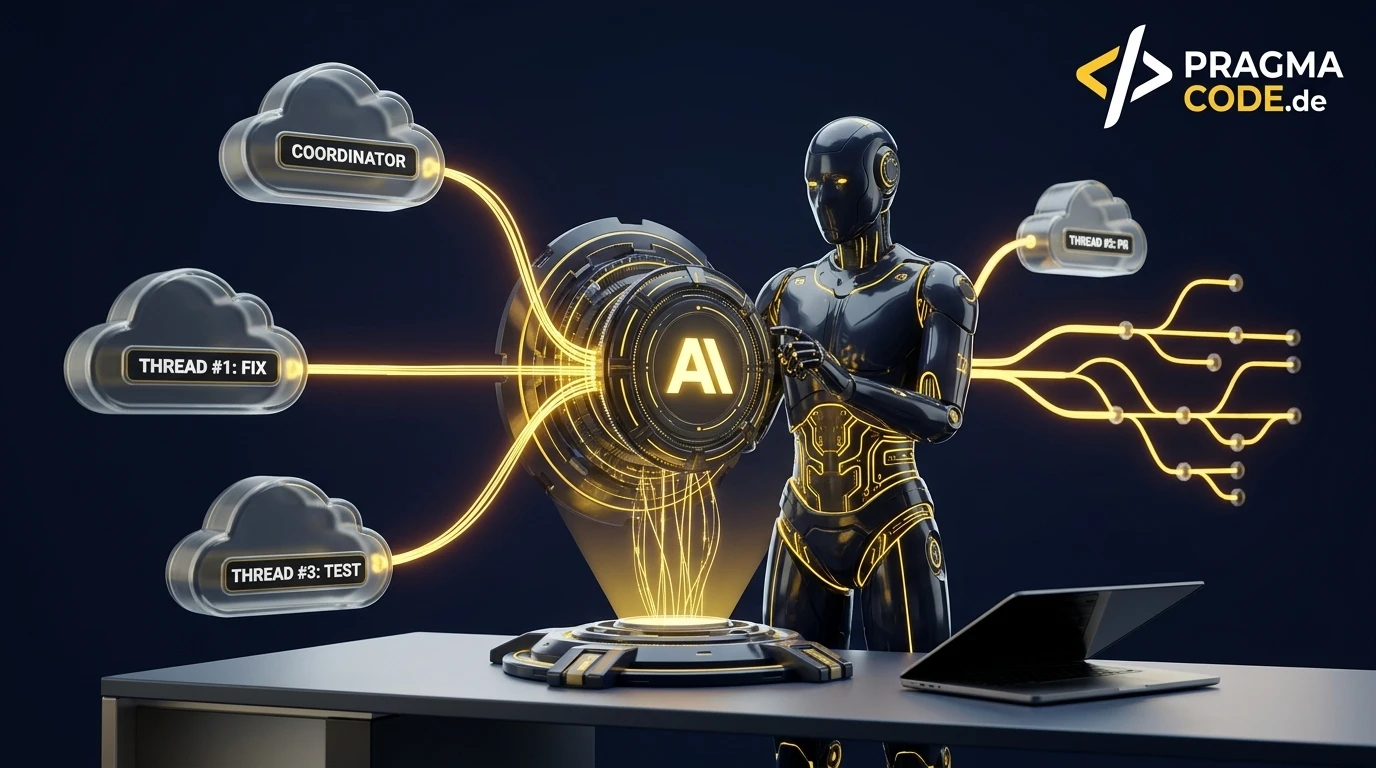
Teams using AI coding agents often write code faster than human reviewers can inspect and merge it. On November 23, 2026, Anthropic introduced Claude Ship—an agent suite designed to eliminate that bottleneck by reviewing pull requests, fixing CI failures, and approving routine changes based on repository policies.
This article is an in-depth expert contribution from our content cluster. Discover the complete overview on our main page: AI Automation for Modern Enterprises →
From Writing Code to Shipping Code
When AI agents like Claude Code generate the majority of a team's source code, the primary bottleneck in software delivery shifts immediately: implementation is no longer the slowest step—waiting for reviews, green CI pipelines, and merge approvals is. That is the exact gap Claude Ship targets.
- Three-Agent Architecture: Claude Ship unites the generally available Code Review agent with two new beta agents: PR Steward for automated fixes and Claude Approvals for policy-driven merge approvals.
- Strict Separation of Duties: PR Steward can fix code and CI failures, but it can never approve or merge a pull request. Merge authority stays anchored in team policies, branch protection, and human sign-off rules.
- Clear Compliance Boundaries: Available on Claude Team and Claude Enterprise for GitHub repositories—but currently excluded for organizations with Zero Data Retention (ZDR), HIPAA configurations, or customer-managed encryption keys (CMEK).
- 1. Why Pull Requests Became the New Bottleneck
- 2. Inside Claude Ship: The Three Agents
- 3. Two Ways to Start: /ship for Developers vs. Admin Governance
- 4. How the Claude Code Team Ships Today
- 5. Safe Enterprise Rollout Roadmap
- 6. Pricing, $10,000 Enterprise Credits & Compliance Limits
- 7. Conclusion, Checklist & Official Sources
1. Why Pull Requests Became the New Bottleneck
Every software engineer knows the friction that follows opening a pull request. You move on to your next task, and then review comments arrive. You stop what you are doing, reload the old context in your head, push a fix, wait for the CI/CD pipeline to run again, and then track down a teammate to give the final approval.
When humans wrote every line of code, review queues and coding speed stayed roughly balanced. However, as engineering teams adopt Agentic AI workflows, that balance breaks. In its November 23, 2026 announcement, Anthropic notes that Claude now writes most of the code on the Claude Code team itself. Once code generation accelerates dramatically, every manual handoff after opening a pull request becomes the primary drag on delivery velocity.
With Claude Ship, Anthropic extends agentic automation across the post-PR lifecycle. Instead of pulling developers back into old branches for routine fixes and status checks, three specialized agents handle review, remediation, and policy-based approval—freeing human reviewers to focus on high-stakes architectural and security decisions.
Strategic Takeaway for Engineering Leaders
Productivity gains from AI coding tools frequently stall in the review queue. Teams already experimenting with Claude Code Projects and autonomous cloud threads experience this firsthand: parallel agents generate pull requests faster than manual review loops can clear them. Claude Ship closes that gap by automating the path from PR creation to merge readiness.
2. Inside Claude Ship: The Three Agents
Rather than deploying a single monolithic bot that rubber-stamps changes, Claude Ship is structured as a modular multi-agent system with distinct responsibilities. Code Review is generally available (GA), while PR Steward and Claude Approvals launched into beta on November 23, 2026.
1. Code Review
Inspects pull requests deeply against the full codebase:
- Analyzes changes through multiple lenses and adversarially verifies candidate findings.
- Categorizes real issues and posts concise, actionable breakdowns directly on the PR.
- Configurable depth per repository: Quick, Standard, or Deep.
2. PR Steward
Keeps pull requests green automatically until they are ready to merge:
- Resolves failing CI checks, merge conflicts, and feedback from review tools or teammates.
- Comments after every push with what changed and clear instructions on how to undo it.
- Interactive control: comment
@claudeto steer work, or@claude stopto pause.
3. Claude Approvals
Evaluates merge readiness against an approval policy stored in the repository:
- Works like a smarter, context-aware evolution of
CODEOWNERS. - Approves routine changes autonomously or escalates sensitive changes to human reviewers.
- Can evaluate Code Review findings or custom natural-language classifiers.
4. Separation of Concerns
Decouples automated remediation from merge authorization by design:
- Fixing (PR Steward) and Approving (Claude Approvals) remain strictly separated.
- No agent can self-certify or merge its own code modifications.
- Existing GitHub branch protection rules and required status checks stay intact.
This separation of duties is what distinguishes Claude Ship from naive auto-merge scripts. An agent allowed to push fixes should never be allowed to certify its own work. Instead, the architecture mirrors proven verification patterns we also highlight in our guide on multi-agent systems in software development: execution and validation are decoupled by design.
Reducing Review Noise Through Adversarial Verification
Many engineering teams disable AI code review bots after a few weeks because noisy, low-value comments overwhelm developers. Anthropic addresses this by having Code Review inspect the repository from multiple angles and then adversarially verify its own candidate findings before posting them. Combined with configurable Quick, Standard, and Deep tiers, teams can match review rigor to each repository's risk profile.
3. Two Ways to Start: /ship for Developers vs. Admin Governance
Anthropic supports two distinct adoption paths: an individual developer workflow initiated from the CLI or desktop app, and a repository-wide configuration managed by engineering admins.
Comparison: Developer /ship Command vs. Repository-Wide Automation
- Trigger: Invoked manually using the new
/shipcommand in Claude Code or the desktop app. - Workflow: Claude pushes the branch, opens the pull request, runs the review, and addresses feedback and failing checks to reach merge readiness.
- Permissions: What can actually merge remains strictly bound to the developer's permissions and repository branch rules.
- Billing: Running
/shipcounts as regular Claude Code usage under the developer's plan.
- Trigger: Runs automatically across a team's pull requests on GitHub without developers manually invoking
/ship. - Granular Settings: Admins enable Code Review and PR Steward per repository, select the review level (Quick, Standard, Deep), and choose when reviews run.
- Budget Guardrails: Monthly spend limits can be configured directly for Code Review and PR Steward.
- Policy Activation: Claude Approvals activates when a connected repository has a policy file on its default branch and can be disabled by an admin at any time.
Crucially for established engineering teams, Claude Ship integrates alongside existing GitHub Actions workflows, required checks, and branch protection rules rather than replacing them.
4. How the Claude Code Team Ships Today
One of the most telling shifts described by Anthropic is how Claude Ship changes who can resolve customer-facing issues. Inside the Claude Code team, a product manager can read customer feedback, explore trade-offs with Claude Tag, ask it to open a pull request, and immediately move on while Claude Ship handles review, fixes, and policy checks.
In a concrete example shared by Anthropic, a customer was confused because the Analytics API documentation implied an Admin key could retrieve Pro and Team usage data. The product manager asked Claude Tag whether a fix was already underway, and it opened a pull request:
PR Opened via Claude Tag
Based on the customer feedback and existing documentation, Claude Tag generated and opened a targeted pull request.
Automated Code Review
Claude Code Review inspected the change against the repository and found no blocking issues.
Human Docs Sign-Off & Policy Approval
A human docs reviewer signed off, Claude Approvals passed the policy check, and the fix merged that very same evening.
Early pilot customers echo this balance between automation and human oversight. Engineering Director Vatsal Bhatt noted that Code Review catches real issues before a human reviewer even reaches the PR, while PR Steward helps contributors resolve them—allowing human reviewers to focus on changes that genuinely require judgment. Senior Vice President Alex Devkar highlighted PR Steward's flexibility in adapting to existing team processes, including how it suggests changes and organizes feedback.
5. Safe Enterprise Rollout Roadmap
Automated approvals require trust built on evidence. Anthropic explicitly recommends enabling Claude Approvals in observe-only mode first before configuring branch protection to require its green light. The following six-step roadmap translates that guidance into an actionable enterprise rollout:
-
Select a Well-Tested Pilot Repository
Begin with a single GitHub repository that already has reliable automated test coverage and clear branch protection rules rather than enabling it org-wide on day one.
-
Enable Code Review & Calibrate Depth
Turn on the generally available Code Review agent first and evaluate whether Quick, Standard, or Deep fits the repository's change volume and risk profile.
-
Configure Monthly Spend Limits
Because reviews and PR Steward remediation loops are billed on tokens, set explicit monthly spend caps for both agents before scaling usage.
-
Turn On PR Steward for CI & Conflict Fixes
Enable PR Steward to handle failing CI checks and merge conflicts. Monitor its post-push summaries and undo instructions to verify code quality in your codebase.
-
Run Claude Approvals in Observe-Only Mode
Add an approval policy file to the default branch and run Claude Approvals in observe-only mode for several weeks, comparing its decisions against senior engineers' actual approvals.
-
Enforce Policy via Branch Protection Selectively
Once observe-mode accuracy is proven, require Claude Approvals in branch protection for clearly scoped routine changes (such as documentation updates), while keeping human sign-off mandatory for sensitive code paths.
For regulated organizations that also need verifiable audit trails across AI-assisted CI/CD pipelines, pairing PR automation with centralized logging is essential—a pattern we examine in detail in our article on GitLab 19.6 AI agents audit logs via MCP.
6. Pricing, $10,000 Enterprise Credits & Compliance Limits
Before rolling out Claude Ship, engineering and procurement teams should factor in both the token-based billing mechanics and the current enterprise compliance exclusions.
Token-Based Usage Billing
Claude Ship is billed on tokens. Total spend depends on pull request volume and size, the selected review level (Quick, Standard, Deep), review frequency, and how much remediation work PR Steward performs.
Observe-Mode Cost Nuance
Claude Approvals has no base fee, but policy classifiers are billed on the tokens they consume. Furthermore, any policy that references Claude's review automatically triggers a billed Code Review—even when Approvals runs in observe-only mode.
$10,000+ Enterprise Credits (Deadline: Jan 15, 2027)
Eligible Claude Enterprise organizations can claim at least $10,000 in Claude Ship credits (subject to Anthropic's terms) by January 15, 2027. Credits must be used within 30 days of claiming, making them well suited for a structured pilot.
Strict Compliance Exclusions
Just as important as pricing are the current availability exclusions stated in Anthropic's November 23, 2026 announcement. Claude Ship is currently not available to organizations using any of the following security configurations:
Zero Data Retention (ZDR)
Organizations with Zero Data Retention enabled cannot currently use Claude Ship. Teams contractually bound to ZDR must continue using standard manual review workflows or isolated pipelines for now.
HIPAA Configuration
Healthcare and medtech organizations operating under a HIPAA-compliant Claude configuration are currently excluded from Claude Ship.
Customer-Managed Encryption Keys (CMEK)
Enterprises that mandate customer-managed encryption keys (CMEK) in their Claude Enterprise setup cannot enable Claude Ship at this stage.
In addition, Claude Ship is currently limited to GitHub repositories on Claude Team and Claude Enterprise plans. Teams hosted on GitLab, Bitbucket, or self-managed Git instances are not yet supported in this beta release.
7. Conclusion, Checklist & Official Sources
Claude Ship tackles the exact bottleneck created by the rise of AI coding agents: when code is written in minutes, pull requests cannot remain a multi-hour waiting room. By combining a proven, adversarially verified Code Review agent with PR Steward and policy-driven Claude Approvals, Anthropic offers a pragmatic blueprint for autonomous PR workflows—provided teams enforce spend limits, validate policies in observe-only mode, and account for the ZDR, HIPAA, and CMEK exclusions.
Quick-Check: Is Your Team Ready for Claude Ship?
Official Sources & Primary Documentation
- Anthropic / Claude (November 23, 2026): "Introducing Claude Ship" – Official product announcement covering Code Review (GA), PR Steward (Beta), Claude Approvals (Beta), the
/shipcommand, Claude Code team metrics (June–September), $10,000+ Enterprise credits, and ZDR/HIPAA/CMEK exclusions.
Looking to adopt Agentic Coding and secure CI/CD workflows in your team?
Schedule a Free Initial ConsultationOur Regional Expertise
We are your digital partner – regionally anchored and successfully scaling across borders.
AI automation for your business?
I deliver this for small and mid-sized businesses: at a fixed price agreed upfront, working directly with the person who builds it. Process, scope and pricing are on the service page.
See service & pricing Or request a free intro callExtended Specialized Glossary
Claude Ship
A suite of three specialized AI agents (Code Review, PR Steward, Claude Approvals) announced by Anthropic on November 23, 2026 to automate the GitHub pull request lifecycle from code inspection and automated fixes to policy-based approvals.
PR Steward
A beta agent within Claude Ship that keeps pull requests green by resolving failing CI checks, merge conflicts, and review feedback, while being intentionally restricted from approving or merging PRs.
Claude Approvals
A policy-based approval agent in Claude Ship (beta) that evaluates pull requests against a repository policy file to approve routine changes automatically or escalate sensitive ones to human reviewers.
Branch Protection
Repository rules in Git platforms like GitHub that enforce required status checks, reviews, and approvals before changes can be merged into protected branches such as main.
Pull Request
A structured change proposal in Git platforms where code modifications from a feature branch are reviewed, tested, and approved before merging into the target branch.
Zero Data Retention (ZDR)
An enterprise privacy configuration where AI providers do not persistently store prompts or outputs after processing. Claude Ship is currently not available to organizations with ZDR enabled.