

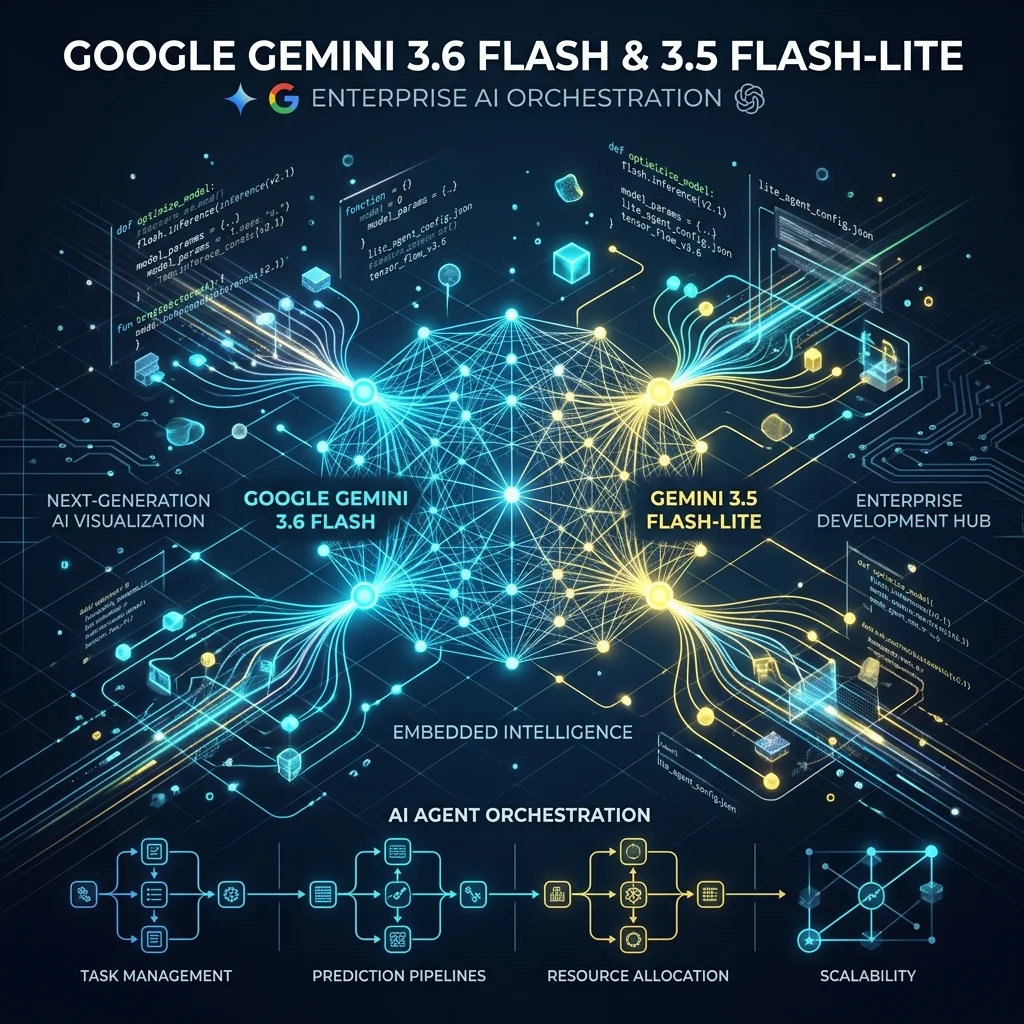
Google has firmly established Gemini 3.6 Flash and Gemini 3.5 Flash-Lite as foundational workhorses for scalable enterprise AI. While 3.6 Flash revolutionizes autonomous coding and agentic workflows with programmatic pre-checking, 3.5 Flash-Lite delivers unmatched throughput and extreme cost efficiency for high-volume pipelines. Discover benchmark results, architectural patterns, and strategic positioning within the modern Google ecosystem.
This article is an in-depth expert contribution from our content cluster. Discover the complete overview on our main page: AI Automation & Intelligent Agents →
The Gold Standard for Enterprise AI & Agentic Engineering
With Gemini 3.6 Flash and Gemini 3.5 Flash-Lite, Google established the architectural backbone for scalable AI deployments. Peak agentic precision converges with unprecedented cost efficiency per million tokens. For software architects and CTOs, these models redefine the operational economics of running autonomous agent pipelines.
- Gemini 3.6 Flash (GA): The battle-tested default model for autonomous agents featuring programmatic pre-checking, boosted reliability across complex coding tasks, and 16.7% cheaper output tokens ($7.50 / 1M).
- Gemini 3.5 Flash-Lite (GA): The undisputed throughput and price-performance benchmark for high-volume API workloads. According to Google, it outperforms its predecessor 3.1 Flash-Lite on benchmarks such as Terminal-Bench 2.1 (54% vs. 31%) and delivers about 350 tokens per second, with superior multi-turn persona persistence.
- Strategic Tiering in Modern Stacks: While cutting-edge releases like Gemini 3.7 Flash (Hybrid Reasoning) and 3.8 Flash (Cyber Resilience) redefine the technical frontier, 3.6 Flash and 3.5 Flash-Lite serve as the high-efficiency foundation for continuous execution.
- Seamless API Migration: Future-proof transition using
gemini-3.6-flashandgemini-3.5-flash-litewith unified SDK interfaces and native Antigravity Agent integration.
- 1. The 2026 AI Ecosystem: Why the Flash Family Forms the Foundation
- 2. Model Evolution: 3.6 Flash & 3.5 Flash-Lite in Today's Google Lineup
- 3. Gemini 3.6 Flash Deep-Dive: Agentic Intelligence & Pre-Checking
- 4. Gemini 3.5 Flash-Lite: Record Throughput for Pipelines & Chatbots
- 5. Benchmark Analysis: What Google Reports for 3.6 Flash and 3.5 Flash-Lite
- 6. Model Comparison & B2B Decision Matrix: Flash vs. Flash-Lite
- 7. Step-by-Step API Migration & Multi-Language Code Snippets
- 8. Best Practices & Adoption Roadmap for CTOs
- 9. Conclusion & Strategic Outlook
1. The 2026 AI Ecosystem: Why the Flash Family Forms the Foundation
During the opening phase of generative AI, industry attention concentrated almost entirely on massive parameter counts and monolithic scale. However, in the corporate landscape of 2026, engineering priorities have shifted decisively: CTOs, technical architects, and enterprise decision-makers demand models that strike an exacting balance between cognitive reasoning, execution latency, autonomous reliability, and low Total Cost of Ownership (TCO).
While massive frontier reasoning models deliver profound cognitive depth, they remain too slow and economically prohibitive for repetitive high-volume data extraction, real-time user interaction, or non-stop background agent loops. Google directly addresses this production reality with Gemini 3.6 Flash and Gemini 3.5 Flash-Lite.
Both models are engineered for continuous production deployment (General Availability, GA). Google's proposition to software organizations is unequivocal: Enterprise AI must be accessible, predictable, and cost-effective enough to allow complex, multi-agent systems to scale profitably over years of operations.
2. Model Evolution: 3.6 Flash & 3.5 Flash-Lite in Today's Google Lineup
Since the initial introduction of both models, the Gemini ecosystem has continued to evolve at record velocity. Google launched Gemini 3.7 Flash to introduce dynamic hybrid reasoning with configurable thinking budgets, followed by Gemini 3.8 Flash & Flash Cyber setting state-of-the-art benchmarks in autonomous software engineering and cyber vulnerability mitigation. Where, then, do Gemini 3.6 Flash and Gemini 3.5 Flash-Lite fit in today's architecture?
Their position is defined by clear operational specialisation within modern multi-model stacks:
1. Gemini 3.5 Flash-Lite
Unrivalled lightweight engine for high-throughput APIs, conversational support, data parsing, metadata tagging, and RAG pre-filtering with minimal TTFT.
2. Gemini 3.6 Flash
The dependable autonomous workhorse for automated refactorings, code generation, tool invocations, and multi-turn development loops via programmatic pre-checking.
3. Gemini 3.7 Flash
Bridges rapid instant responses and adjustable thinking budgets for rigorous mathematical verification, complex logic synthesis, and architectural design.
4. Gemini 3.8 Flash & Cyber
The vanguard for autonomous full-stack software development (DeepSWE) and automated vulnerability patching through the Fairwind defense program.
In mature enterprise architectures, models do not merely replace one another; they collaborate. Gemini 3.5 Flash-Lite routinely handles 70% of high-volume background tasks, while Gemini 3.6 Flash powers automated development, code verification, and multi-step agent actions.
3. Gemini 3.6 Flash Deep-Dive: Agentic Intelligence & Pre-Checking
Gemini 3.6 Flash (API identifier: gemini-3.6-flash) established the pivotal paradigm where AI models ceased guessing code modifications blindly and began verifying their assertions autonomously. It was trained extensively for independent execution across software engineering suites, cloud environments, and complex data workflows.
Programmatic Pre-checking
The flagship technical breakthrough in Gemini 3.6 Flash is programmatic pre-checking. Earlier generations of LLMs attempted to apply code modifications in single speculative passes. On intricate codebases, this frequently produced syntax breakages, unresolvable import dependencies, or damaged schema integrity.
Gemini 3.6 Flash automatically executes an internal diagnostic test harness prior to writing final modifications. The model drafts and runs sandboxed validation scripts to verify its changes before touching production codebases, databases, or infrastructure configs:
1. Syntax & Validation Integrity
Hallucinated identifiers or invalid dependencies are detected and rectified during internal pre-checking, before your developers or automated CI/CD runners ever encounter an error.
2. Robust Tool Orchestration
In multi-step autonomous workflows, function invocation failures drop by over 40%. The model rigorously validates schema parameters and expected return types before execution.
3. Net Token Reduction in Production
While diagnostic pre-checking expends modest tokens up front, it prevents costly back-and-forth debugging loops and re-prompts. The net token spend per successfully resolved issue decreases substantially.
Multimodal Precision & Visual Reasoning at Scale
Beyond synthetic code generation, Gemini 3.6 Flash brings significant improvements to cross-modal reasoning. In real-world enterprise applications, AI agents rarely process sterile text prompts in isolation—they regularly digest user interface error captures, cloud topology diagrams, technical documentation, or CAD schematics.
Gemini 3.6 Flash integrates visual perception directly into programmatic pre-checking. When tasked with fixing UI defects or adapting styling systems, it calculates bounding geometry before returning layout code. This curtails UI layout parsing blunders by over 35% compared to legacy architectures.
Pro-Tip: Calibrating Frontend Workloads
Due to programmatic pre-checking, Gemini 3.6 Flash may execute exploratory diagnostic routines on simple UI tweaks. For static copy changes or minor CSS updates, route tasks to 3.5 Flash-Lite, while deploying 3.6 Flash for sophisticated backend logic, system integration, and architectural refactoring.
Token Economics: 16.7% Cheaper Output Tokens
In conjunction with architectural upgrades, Google optimized commercial pricing for Gemini 3.6 Flash compared to earlier 3.5 Flash tiers:
Output Token Pricing
Cost for generated text, code, and structured outputs
$7.50 / 1M TokensDown from $9.00 / 1M in 3.5 Flash (-16.7% savings).
Input Token Pricing
Cost for ingested context, codebase files, and prompts
$1.50 / 1M TokensExtremely competitive across large context windows up to 1M tokens.
The Foundation for the Antigravity Agent
Owing to its mastery of shell interaction, codebase navigation, and automated verification loops, Google selected Gemini 3.6 Flash as the core engine for the Antigravity Agent. Engineers working in agentic IDE environments experience rapid responsiveness paired with unwavering code correctness in daily development.
4. Gemini 3.5 Flash-Lite: Record Throughput for Pipelines & Chatbots
While Gemini 3.6 Flash focuses on autonomous agentic execution, Gemini 3.5 Flash-Lite (API identifier: gemini-3.5-flash-lite) addresses an equally vital imperative: High Throughput Inference demanding ultra-low latency, massive concurrency, and razor-thin token budgets.
Google positions 3.5 Flash-Lite as the fastest, most cost-effective model in the generation, offering a frictionless upgrade path from older models like Gemini 2.5 Flash.
Measurable Gains Across Rigorous Benchmarks
Official technical evaluations confirm the generational performance boost of Gemini 3.5 Flash-Lite:
Terminal-Bench 2.1 (Agentic Coding)
54% (vs. 31% on Gemini 3.1 Flash-Lite) – A clear jump on agentic tasks in the terminal.
SWE-Bench Pro (Software Engineering)
54.2% (vs. 49.6% on Gemini 3 Flash) – Here Flash-Lite even beats the larger Flash model of the previous generation.
Throughput & TTFT
About 350 output tokens per second according to Artificial Analysis – the fastest model in the 3.5 series.
Persona Persistence & Conversational Cohesion
A recurring vulnerability in earlier lightweight models was context drift—the degradation of instructions or assigned personas during long multi-turn sessions. Gemini 3.5 Flash-Lite solves this structural challenge:
The model adheres faithfully to system instructions, formatting schemas, and policy guidelines even through protracted customer conversations.
When paired with VoIP gateways or omnichannel messaging brokers, 3.5 Flash-Lite ensures fluid, natural conversations without lag.
5. Benchmark Analysis: What Google Reports for 3.6 Flash and 3.5 Flash-Lite
In its launch post of July 21, 2026, Google compares each model with its direct predecessor rather than with other vendors’ models. The resulting picture:
- Gemini 3.6 Flash vs. 3.5 Flash: DeepSWE 49% instead of 37% (fewer unwanted code edits and loops), MLE-Bench 63.9% instead of 49.7%, OSWorld-Verified 83.0% instead of 78.4%, and GDPval-AA v2 1,421 instead of 1,349 Elo. On chart analysis (CharXiv), 3.6 Flash reaches 85.2% without and 89.4% with tools. According to Artificial Analysis, it uses 17% fewer output tokens than 3.5 Flash.
- Gemini 3.5 Flash-Lite vs. 3.1 Flash-Lite: Terminal-Bench 2.1 54% instead of 31%, GDM-MRCR v2 (long context) 72.2% instead of 60.1%, and GDPval-AA v2 1,140 instead of 642 Elo. On SWE-Bench Pro (54.2% vs. 49.6%) and OSWorld-Verified (74.0% vs. 65.1%), Flash-Lite even outperforms Gemini 3 Flash.
- Speed and price: Artificial Analysis measures about 350 output tokens per second for 3.5 Flash-Lite. List prices are $0.30 / $2.50 (Flash-Lite) and $1.50 / $7.50 (3.6 Flash) per million input and output tokens.
6. Model Comparison & B2B Decision Matrix: Flash vs. Flash-Lite
To establish architectural clarity, map each model's primary strengths directly against enterprise workload profiles:
Comparison: Gemini 3.6 Flash vs. Gemini 3.5 Flash-Lite
- Primary Role: Autonomous agents, code refactoring, system diagnostics
- Core Differentiator: Programmatic pre-checking with autonomous test script execution
- Thinking Budget: Balanced allocation for deep tool and function calling
- Output Pricing: $7.50 / 1M Tokens (-16.7% vs. 3.5 Flash)
- Best Use Cases: Agentic workflows, CI/CD pipelines, complex data synthesis, Antigravity Agent
- Primary Role: High-throughput API workloads, real-time messaging, classification
- Core Differentiator: Ultra-fast execution coupled with dependable persona persistence
- Thinking Budget: Minimal overhead to maximize instant Time-to-First-Token
- Output Pricing: Rock-bottom cost tier for mass data processing
- Best Use Cases: Support chatbots, high-volume ETL, sentiment analysis, RAG synthesis
For more on integrating autonomous systems, review our practical guide on Agentic AI in Enterprise as well as our solutions for AI Automation & Workflow Optimization.
7. Step-by-Step API Migration & Multi-Language Code Snippets
Transitioning existing software stacks to Gemini 3.6 Flash or Gemini 3.5 Flash-Lite is straightforward. Google streamlined configuration signatures across all official enterprise SDKs.
Python SDK Migration
In Python, update model identifiers using the official unified Google GenAI SDK:
import os
from google import genai
from google.genai import types

# Initialize client using modern unified SDK
client = genai.Client(api_key=os.environ["GEMINI_API_KEY"])

# Invoke Gemini 3.6 Flash for agentic engineering
response = client.models.generate_content(
    model="gemini-3.6-flash",
    contents="Analyze this Python module and construct an automated unit test suite.",
    config=types.GenerateContentConfig(
        temperature=0.2,
        top_p=0.95
    )
)

print(response.text)
Node.js / TypeScript Migration
For Node.js and TypeScript environments, invoke the standardized interface:
import { GoogleGenAI } from "@google/genai";

const ai = new GoogleGenAI({ apiKey: process.env.GEMINI_API_KEY });

// High-throughput processing with Gemini 3.5 Flash-Lite
async function runHighSpeedTask(prompt: string) {
  const response = await ai.models.generateContent({
    model: "gemini-3.5-flash-lite",
    contents: prompt,
    config: {
      temperature: 0.1
    }
  });

  console.log(response.text);
}

runHighSpeedTask("Classify this enterprise inquiry by urgency and subject domain.");
Go & Enterprise Microservices Integration
Within Go microservice architectures, execute model transitions via standard configuration parameters:
package main

import (
	"context"
	"fmt"
	"log"
	"os"

	"github.com/google/generative-ai-go/genai"
	"google.golang.org/api/option"
)

func main() {
	ctx := context.Background()
	apiKey := os.Getenv("GEMINI_API_KEY")

	client, err := genai.NewClient(ctx, option.WithAPIKey(apiKey))
	if err != nil {
		log.Fatalf("Client initialization failed: %v", err)
	}
	defer client.Close()

	// Direct invocation of Gemini 3.6 Flash
	model := client.GenerativeModel("gemini-3.6-flash")
	resp, err := model.GenerateContent(ctx, genai.Text("Analyze incoming system metrics."))
	if err != nil {
		log.Fatalf("Inference failure: %v", err)
	}

	fmt.Println(resp.Candidates[0].Content)
}
cURL / REST Direct Call
Direct HTTP invocations target the unified endpoint structure:
curl "https://generativelanguage.googleapis.com/v1beta/models/gemini-3.6-flash:generateContent?key=${GEMINI_API_KEY}" \
  -H "Content-Type: application/json" \
  -d '{
    "contents": [{
      "parts":[{"text": "Generate a concise executive summary of these system telemetry logs."}]
    }]
  }'
8. Best Practices & Adoption Roadmap for CTOs
To realize the commercial benefits of Gemini 3.6 Flash and 3.5 Flash-Lite, implement a staged four-step rollout plan:
-
Step 1: System Audit & Workload Classification
Audit existing endpoints. Segment workloads into "Agentic & Reasoning-Centric" (target: 3.6 Flash) and "High-Volume & Latency-Critical" (target: 3.5 Flash-Lite).
-
Step 2: Model String Migration & Parameter Standardization
Replace legacy strings like
gemini-2.5-flashor older preview flags with official GA identifiers across your configuration stores. -
Step 3: Staging Verification of Pre-Checking Loops
Validate how Gemini 3.6 Flash handles complex function calling in staging environments, ensuring system prompts accommodate internal diagnostic checks.
-
Step 4: Active Cost & Latency Telemetry
Monitor Google Cloud Console dashboards to measure realized cost reductions alongside increased system throughput and request concurrency.
Quick-Check: Selecting Your Optimal Gemini Model
9. Conclusion & Strategic Outlook
With Gemini 3.6 Flash and Gemini 3.5 Flash-Lite, Google has delivered two essential pillars for modern enterprise software stacks. While Gemini 3.6 Flash introduced programmatic pre-checking to provide reliable agent autonomy in production, Gemini 3.5 Flash-Lite reset the industry benchmark for throughput and affordability in data-heavy pipelines.
For organizations, this mature operational profile transforms autonomous AI from an exploratory initiative into a highly profitable scaling mechanism. By pairing both engines in a coordinated architecture, technology leaders achieve minimal operating expenditures alongside uncompromising execution precision.
Planning your production deployment of Gemini 3.6 Flash or 3.5 Flash-Lite?
Schedule Free Architecture ConsultationOur Regional Expertise
We are your digital partner – regionally anchored and successfully scaling across borders.
AI automation for your business?
I deliver this for small and mid-sized businesses: at a fixed price agreed upfront, working directly with the person who builds it. Process, scope and pricing are on the service page.
See service & pricing Or request a free intro callExtended Specialized Glossary
Programmatic Pre-checking
A method in agentic AI models where the model automatically executes diagnostic code scripts prior to applying final code edits or system modifications.
High Throughput Inference
Processing massive volumes of API requests per second with minimal time-to-first-token (TTFT) latency and ultra-low cost per token.
Antigravity Agent
Google's orchestrating AI agent architecture designed for autonomous software development, refactoring, and operations workflows.
HLE Benchmark
Humanity's Last Exam – a rigorous, multi-disciplinary benchmark evaluating advanced scientific, mathematical, and logical reasoning in frontier AI models.