


Revolut is gradually phasing out complex menu hierarchies: With AIR, the FinTech rolls out an embedded AI assistant to over 13 million users. A comprehensive hands-on evaluation balancing genuine excitement, time savings, and current architectural limits.
This article is an in-depth expert contribution from our content cluster. Discover the complete overview on our main page:AI Automation for Enterprise Applications →
- FinTech Paradigm Shift: Revolut AIR (AI by Revolut) marks a fundamental transition from static dashboards to an agentic dialogue interface with native operational execution.
- High-Impact Feature Discovery vs. Habitual Speed: While complex tasks like travel eSIM purchases and emergency card freezing benefit from dramatic friction reduction, habitual routine clicks in the classic interface remain faster.
- Enterprise Privacy & Biometrics: Third-party LLM providers retain zero customer data. All financially binding actions remain locked behind non-negotiable biometric checkpoints (FaceID/Fingerprint).
From Menu Overload to Autonomous Execution
Revolut's rollout signals the departure from passive FAQ chatbots in the financial sector: AIR operates as a true Execution Engine (AI), orchestrating real core-banking capabilities with persistent context retention and strict zero-data-retention governance.
- 1. Introduction: The Conversational Banking Revolution
- 2. Under the Hood: Architecture, Privacy & Biometrics
- 3. Hands-On Test: 5 Core Capability Domains
- 4. Efficiency Benchmark: AIR in Numbers – Typing vs. Tapping
- 5. Strategic B2B Takeaways: What Enterprises Can Learn from AIR
- 6. Conclusion & Checklist for AI Product Leaders
- 7. Official Sources & Revolut Referral Link
1. Introduction: The Conversational Banking Revolution
Anyone following digital banking over the past decade knows the inevitable trade-off of rapid expansion: With every new platform feature – from multi-currency accounts to stock trading, spending categorization, insurance policies, and travel eSIMs – menu hierarchies expanded exponentially. Even experienced users frequently find themselves scrolling through deeply nested submenus just to generate a disposable virtual card or download a monthly statement. This friction is known as feature overload, and it constitutes the single largest usability challenge in contemporary fintech products.
As a long-standing Revolut customer, I have watched the platform evolve from an innovative foreign exchange card into an expansive financial super-app (with over 80 million active users globally – you can sign up with my personal referral link here). When Revolut officially announced the rollout of its new AI assistant AIR (short for AI by Revolut) on April 9, 2026 – initially for 13 million UK customers and progressively across the European Economic Area – I was eager to put it through rigorous testing. Having evaluated the assistant extensively on day one, the verdict is evident: AIR is not another trivial support widget, but one of the first credible implementations of enterprise-grade Conversational Banking.
Julia Ponomareva, Partner and General Manager of CX and AI Products at Revolut, underscored the strategic rationale during the product debut:
“We believe the era of navigating through endless tabs and menus is over. With AIR, we’re delivering a new level of money intelligence that’s both powerful and effortless. It’s not just an assistant; it’s a co-pilot that elevates everyday life, making financial management as easy and natural as sending a text. Crucially, Revolut customers also remain firmly in the driver’s seat, ensuring that money intelligence never comes at the cost of privacy.”
Yet how does the system perform when exposed to unscripted daily inquiries beyond polished corporate demonstrations? Where does AIR generate demonstrable time savings, and where does the traditional graphic interface remain superior? This comprehensive review provides an objective technical and operational breakdown.

2. Under the Hood: Architecture, Privacy & Biometrics
Financial transaction records represent one of the most sensitive classes of personal data. When a machine learning assistant is granted access to spending habits, merchant records, account balances, and security configurations, European privacy officers and compliance teams demand rigorous technical guarantees. Direct integration with unvetted commercial LLM endpoints without strict safeguards would immediately violate GDPR regulations.
To address this challenge, Revolut designed AIR upon a four-pillar security and integration architecture that serves as an exemplary case study for enterprise software engineers:
1. Zero Data Retention
User queries, conversation history, and transaction data are processed through a dedicated security proxy. Revolut enforces a strict zero-retention mandate: Third-party AI partners never store user information, nor are conversations permitted to train external foundation models.
2. Biometric Guardrails
AIR operates without autonomous permission to disburse funds or unilaterally modify critical account settings. Any action with financial implications – such as freezing physical cards, purchasing data plans, or transferring capital – requires explicit biometric validation via FaceID or fingerprint.
3. Security Context Retention
The assistant maintains a persistent conversation memory. If a customer reports a potentially stolen payment card, AIR treats this incident as an active hazard and proactively prompts the user to freeze the card, even after the user redirects the dialogue to unrelated lifestyle topics.
4. Sandboxed API Endpoints
AIR does not execute unvalidated database statements. An intent parser maps conversational prompts onto strictly typed microservice calls inside Revolut's banking infrastructure, matching the exact access controls applied to native UI controls.
Accessing the assistant is seamless: Users either swipe down from the middle of the home dashboard or navigate to Profile, Chats, and AIR. This embeds the conversational agent directly inside Revolut's existing messaging hub rather than obstructing regular user flows with invasive overlay modals.
3. Hands-On Test: 5 Core Capability Domains
To evaluate AIR's real-world efficacy, I tested five functional domains reflecting typical workflows for small business owners, freelancers, and private account holders. Empirical observations from usability evaluations conducted by European fintech research agencies further corroborate these findings.
3.1 Spending Transparency & Coffee Breakdown: Deep Transaction Discovery
AIR's standout capability lies in contextual spending analysis that far exceeds standard static monthly bar graphs. During testing, an early inquiry was straightforward: “How much did I spend on coffee last month?”
AIR demonstrated commendable traceability. Rather than returning a bare summary total, it transparently cited the underlying merchants identified in the audit (including Starbucks, Pret a Manger, and Costa) and offered an itemized breakdown. When prompted with the subsequent question “What percentage of my total food budget did I spend on coffee?”, AIR combined two disparate data sets (the broader food and dining category against coffee purchases) to calculate an accurate 0.9% share out of £272.40 total food expenditure.
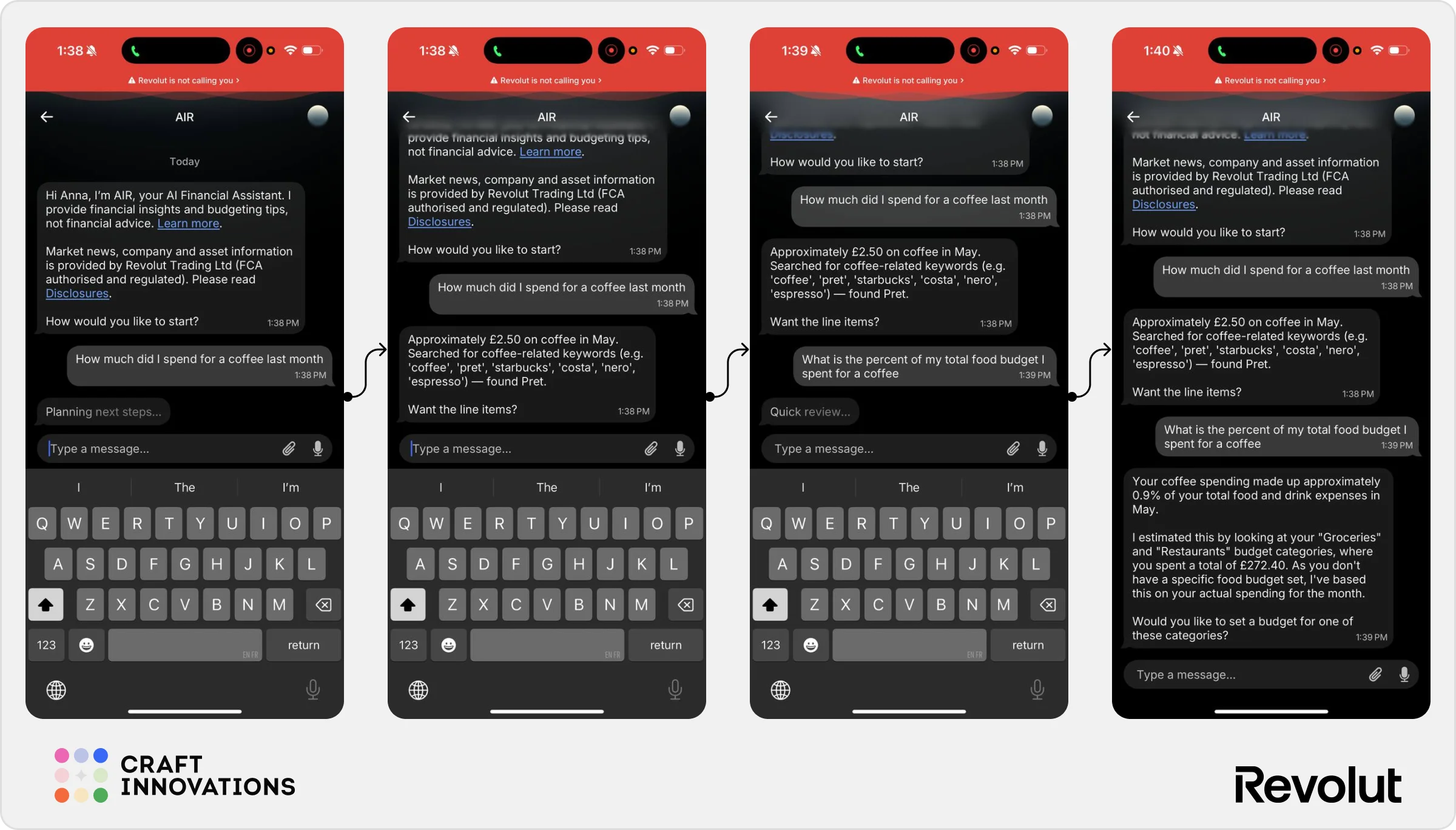
This interactive drill-down capability transforms personal finance into an intuitive search experience. Customers no longer need to configure manual date filters or export spreadsheet exports; natural conversational queries suffice.
3.2 Card Controls & Incident Handling: Explicit Execution with Confirmation
The second scenario evaluated operational account controls. A frequent real-world incident occurs when a user suspects their card has been misplaced and seeks immediate protection. Instead of hunting for the card management tab, the command is simple: “Help me freeze my card.”
AIR promptly identified the primary active card (displaying its last four digits) and responded with a clear confirmation check: “I've found your Standard card ending in 1706. Since it's currently active, would you like me to proceed with freezing it for you?” The card is locked only after affirmative input. When subsequently prompted with “I want to open a new virtual card”, AIR not only explained the underlying mechanics of disposable tokens but surfaced immediate interactive shortcuts to instantiate both Visa and Mastercard virtual cards.
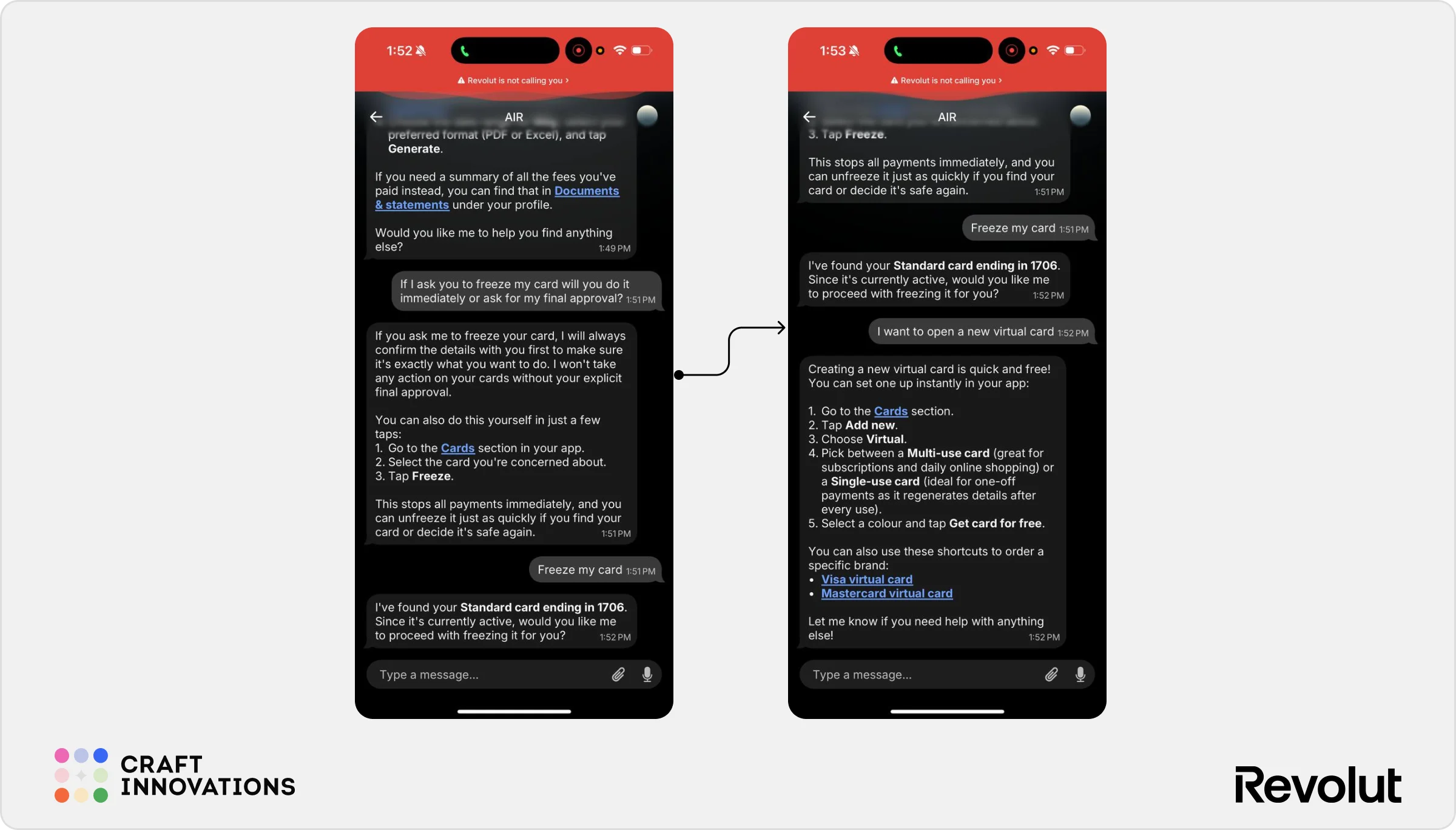
3.3 Travel & Connectivity: The Most Mature Autonomous Flow
The travel and international connectivity workflow currently represents AIR's most sophisticated agentic achievement. When asked “Can you buy me a 3GB SIM for my next trip?”, AIR responded intelligently by first requesting the travel destination.
Upon specifying Budapest, the assistant retrieved corresponding data plans through Revolut's partnership with 1GLOBAL, itemized suitable packages for Hungary, and detailed the terms (£3.49 for 1 GB valid across 7 days). Following purchase confirmation, the fee was debited from the primary account and the eSIM provisioned in the user profile – a seamless end-to-end transaction without navigating external portals.
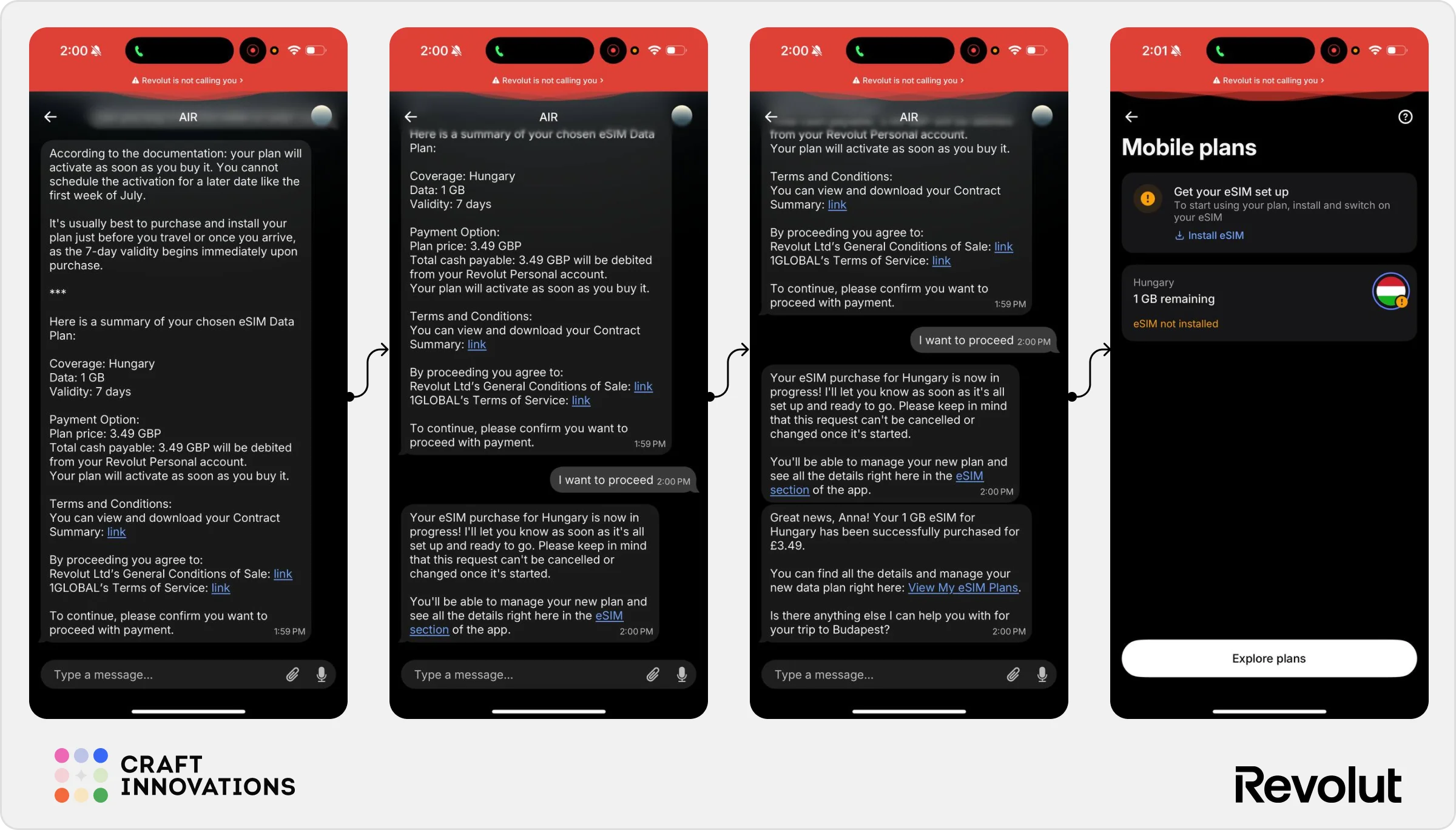
The subsequent cancellation inquiry was equally impressive: When asked “Can we cancel a purchase?”, AIR verified policy conditions, confirmed that cellular roaming had not yet commenced, calculated the refundable total, and completed the refund autonomously within seconds. Here, AIR transitions from a passive guide to a legitimate execution engine.
3.4 Top 5 High-Impact Use Cases for Daily Banking
Across our testing cycles, five distinct scenarios emerged where AIR delivers immediate operational value:
1. Merchant & Transaction Retrieval
Instantly surfacing isolated historical expenses (airline bookings, software subscriptions, hospitality receipts) without scrolling through multi-month statements.
2. Emergency Card Freezing & Limits
Temporarily disabling lost payment cards or establishing monthly budget ceilings through conversational single-line instructions.
3. Travel eSIM Provisioning
Browsing, purchasing, and refunding international cellular data plans natively inside the conversational window.
4. Live Market Quotes & Performance
Checking real-time valuation for major equities (Nvidia, Apple) and account portfolio statistics within strict regulatory boundaries.
5. Disposable Virtual Card Creation
Generating single-use virtual debit cards on demand for protected checkout at unfamiliar ecommerce merchants.
3.5 Current Friction Points: Where AIR Still Struggles
A balanced evaluation must account for existing limitations. Testing revealed three notable bottlenecks:
-
Incomplete Historical Result Sets
When instructed to “Find all my Wizz Air transactions”, AIR initially surfaced only a single transaction, despite multiple distinct airline bookings residing in the database. Only upon explicit follow-up prompting did the assistant retrieve the remaining records. Manual verification remains advisable for compliance-relevant audits.
-
Friction in Recipient & Contact Matching
While merchant recognition is reliable, AIR repeatedly failed to identify frequently used personal bank recipients (such as a customer's external domestic bank account) or smartphone contacts for P2P transfers, falling back to manual instructional text.
-
Indexing Delays for Newly Created Sub-Accounts
When a new sub-account (Pocket or Vault) was created, AIR failed to detect its existence even after a 24-hour window, reporting that the target pocket did not exist. This reveals caching lags across microservice synchronization layers.
4. Efficiency Benchmark: AIR in Numbers – Typing vs. Tapping
Does conversational interaction consistently outperform conventional graphical navigation? In benchmark trials, users performed identical standardized tasks across both modalities under controlled timing conditions.
Comparison: Traditional App Navigation vs. AIR Conversational Banking
- eSIM Purchase: ~45 seconds (6 taps: Home → Lifestyle → eSIM → Country → Buy).
- Transaction Search: ~10 seconds (Tap search icon → Enter keyword → Instant results).
- Card Freezing: ~8 seconds (Cards tab → Swipe to target card → Tap Freeze button).
- Strengths: Unmatched speed for routine, known workflows with instant visual validation.
- Weaknesses: High cognitive load when locating seldom-used features buried in deep menus.
- eSIM Purchase: ~50 seconds (6 interactions including text entry and model response latency).
- Transaction Search: ~20 seconds (Open chat → Formulate prompt → Process answer).
- Card Freezing: ~15 seconds (Enter prompt → Await confirmation card → Confirm).
- Strengths: Superior for aggregated multi-variable calculations, unfamiliar paths, and discoverability.
- Weaknesses: LLM generation latency (~2–4 seconds) slows down simple one-click operations.
These empirical findings demonstrate that conversational AI does not automatically accelerate every interaction. When a user knows exactly where a button resides, direct physical taps remain roughly twice as fast as composing a text prompt and waiting for natural language generation.
Expert Tip: The 80/20 Rule for AI User Interfaces
Deploy conversational agents primarily for aggregation, analytical discovery, and exception handling (e.g. “What were my aggregate SaaS expenses this quarter?”). For routine, frequent operational tasks, dedicated hardware buttons and dashboard shortcuts remain ergonomically superior.
5. Strategic B2B Takeaways: What Enterprises Can Learn from AIR
Revolut's implementation provides valuable architectural blueprints for software architects, digital leaders, and enterprise product managers architecting Agentic AI Workflows or client portals:
Solve the Feature Discovery Bottleneck
As enterprise software (ERP, CRM, financial suites) expands, feature utilization stagnates. A conversational interface dramatically lowers friction by enabling natural language discovery rather than manual navigation through documentation.
Build Execution Engines, Not Passive Chatbots
Users require actionable outcomes rather than restatements of help center articles. An AI assistant delivers tangible ROI only when it can trigger background jobs, configure permissions, or settle transactions directly – as proven by Revolut's eSIM workflow.
Enforce Traceability Over Hallucination
AIR itemizes its mathematical reasoning by displaying individual merchant line items. In enterprise environments – particularly in automated accounting pipelines – auditability and mathematical explainability are critical for compliance.
Decouple Intelligence from Authorization
LLMs should analyze parameters and prepare workflows, while actual operational commits must route through deterministic endpoints with mandatory human approval (Biometric Guardrails or multi-party approval).
6. Conclusion & Checklist for AI Product Leaders
Revolut AIR demonstrates that conversational assistants have outgrown novelty status to become functional components of enterprise product architecture. While occasional edge-case indexing delays exist, the paradigm shift is unmistakable. Financial institutions and SaaS vendors that rely strictly on static form fields risk losing engagement to platforms offering natural dialogue execution.
For organizations looking to orchestrate enterprise data pipelines, adopting proven integration paradigms like autonomous API integrations provides the technical foundation to support conversational agents over internal infrastructure.
Quick-Check: Essentials for Enterprise AI Assistants
7. Official Sources & Revolut Referral Link
As a long-time Revolut customer, I experience firsthand how smart automation, multi-currency flexibility, and robust security simplify daily finances. With AIR, Revolut elevates conversational banking into an operational execution engine – from rapid expense audits to frictionless global eSIM data plans.
Personal Recommendation: Experience Revolut & AIR
Join me and over 80 million users who love Revolut: Sign up with my link below to get started and test Revolut along with its new AIR conversational assistant directly on your mobile device:
Official Sources & Primary Documentation
- Revolut Newsroom (April 9, 2026): "Revolut launches AI assistant, AIR, for 13m UK customers" – Official press release on the AIR release, Zero Data Retention privacy, and UK rollout.
- Revolut Feature Blog (April 2026): "How to use AIR, your new AI assistant" – Practical walkthrough for natural language spending queries, card freezing, and setup.
- Revolut Global Rollout (2026): Revolut Newsroom & Media Center – Official repository documenting EEA expansion across 31 countries and the Revolut Research initiative.
Planning conversational AI assistants or autonomous workflows for your organization?
Schedule a free initial consultationOur Regional Expertise
We are your digital partner – regionally anchored and successfully scaling across borders.
Have a vision?
Let's check together how we can make your idea take flight.
Book your free strategy call nowExtended Specialized Glossary
Conversational Banking
Interacting with banking services through natural language (chat or voice) rather than traditional multi-step menu and tab navigation.
Zero Data Retention
A privacy framework in AI integrations ensuring that personal user data is neither permanently stored by third-party model providers nor used for model training.
Execution Engine (AI)
An AI system designed not merely to deliver informational answers, but to directly trigger and complete operational tasks (such as card freezing, purchases, or refunds).
Biometric Guardrails
Safety controls in AI-enabled financial applications requiring mandatory biometric verification (e.g. FaceID or fingerprint) before executing sensitive actions.