

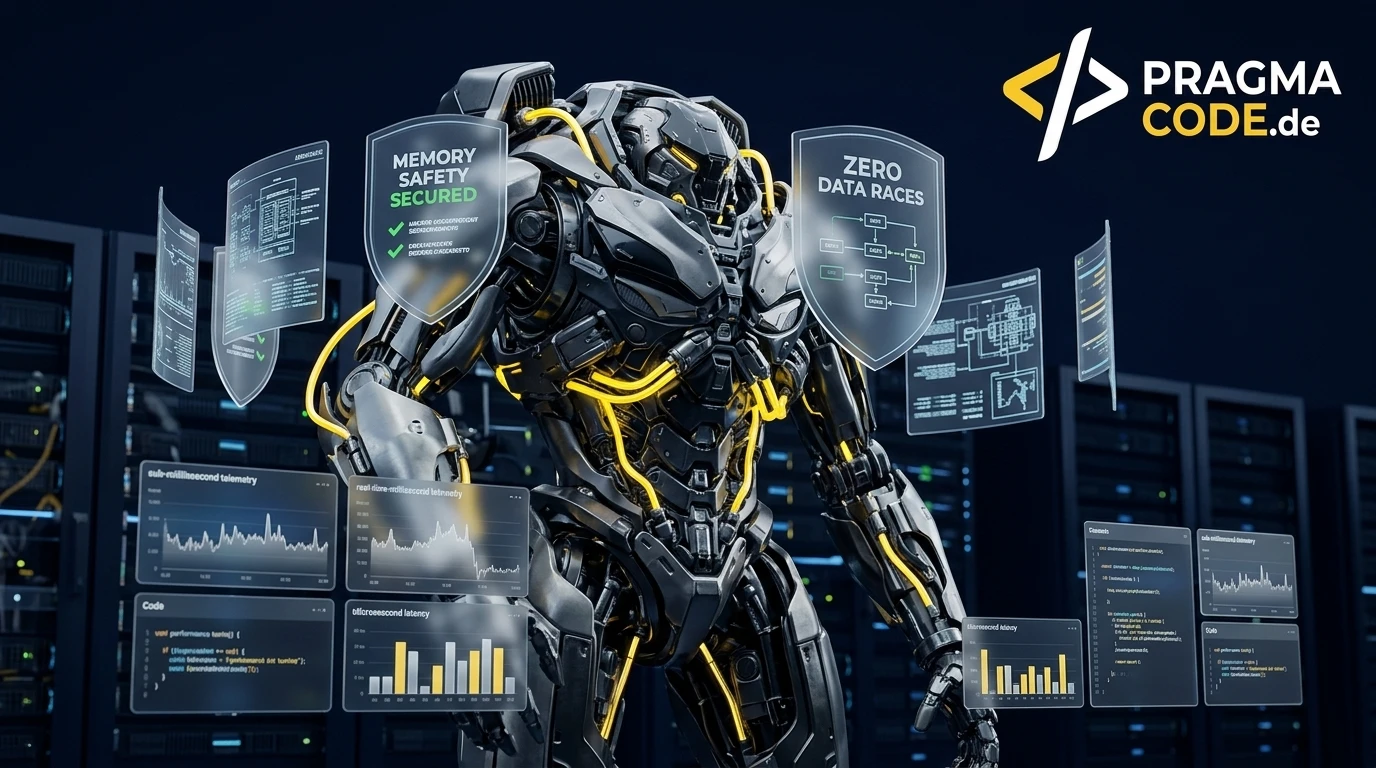
In 2026, enterprise software architecture is undergoing a fundamental transformation. Driven by stringent regulatory frameworks such as the EU Cyber Resilience Act (CRA), escalating cloud infrastructure expenditures, and the heavy compute requirements of generative AI workloads, the Rust programming language has graduated from specialized systems programming into the core of enterprise technology strategy. Discover why leading enterprises and mid-market innovators are systematically migrating mission-critical workloads to Rust—and how to achieve unprecedented speed, resilience, and cloud ROI without incurring unpredictable project risks.
This article is an in-depth expert contribution from our content cluster. Discover the complete overview on our main page: Web Development & Progressive Web Apps →
- Guaranteed Memory Safety Without Garbage Collection: Rust statically prevents buffer overflows, dangling pointers, and data races at compile time through its ownership model. This neutralizes more than 70% of known cyber-attack vectors and satisfies compliance standards under the EU Cyber Resilience Act (CRA).
- Drastic Cloud Cost Reduction: By operating without a heavyweight runtime or garbage collection cycles, Rust microservices consume up to 85% less memory and cold-start in under 5 milliseconds in serverless architectures, significantly decreasing infrastructure spend and digital carbon emissions.
- Pragmatic Hybrid Modernization: Organizations do not need to rewrite legacy platforms from scratch. Through WebAssembly, high-speed Python extensions (PyO3), and isolated microservices, Rust can be strategically deployed to solve distinct latency and security bottlenecks.
- 1. The 2026 Paradigm Shift: Regulatory Pressure and Runtime Limits
- 2. Core Architectural Pillars: Ownership, Borrowing, and Zero-Cost Abstractions
- 3. Economic Impact & FinOps: How Rust Halves Cloud Infrastructure Costs
- 4. WebAssembly & Edge Computing: Blistering Performance in the Browser
- 5. Rust in the AI Era: The High-Throughput Backbone of Machine Learning
- 6. Top 5 Enterprise Use Cases for Mid-Market IT
- 7. Avoiding Common Cost Traps and Adoption Pitfalls
- 8. A Pragmatic 4-Phase Migration Roadmap
- 9. Quick-Check for CTOs and Engineering Leaders
- 10. Conclusion: Securing Long-Term Resiliency and Performance
1. The 2026 Paradigm Shift: Regulatory Pressure and Runtime Limits
For more than three decades, architectural decisions in software engineering were constrained by an apparently insoluble trade-off: development teams had to choose between bare-metal execution speed at the expense of memory safety and developer velocity (C, C++) or developer ergonomics and automatic memory safety at the cost of massive runtime overhead and unpredictable latency jitter (Java, C#, Node.js, Python).
In 2026, this compromise has become obsolete. In its place stands the Rust (Programming Language). Originally developed within Mozilla for high-performance browser engines and operating systems, Rust has rapidly transformed into one of the most strategically significant programming languages in enterprise IT.
The transition toward memory-safe languages is no longer an academic preference; it has become an enforceable regulatory mandate. Under the EU Cyber Resilience Act (CRA) and enhanced operator responsibilities mandated by the NIS2 Directive, corporate executives and engineering leaders face strict legal liability for preventable vulnerabilities within deployed digital products and software supply chains. Security organizations including the German Federal Office for Information Security (BSI), the US Cybersecurity and Infrastructure Security Agency (CISA), and the White House Office of the National Cyber Director explicitly advise organizations to systematically deprecate memory-unsafe languages.
Simultaneously, enterprise platforms relying on traditional runtime environments with automatic Garbage Collection are hitting financial and physical barriers. Within containerized Kubernetes clusters and serverless environments such as AWS Lambda or Google Cloud Run, cloud providers bill not for lines of code, but for allocated RAM volume and CPU execution duration. When a Java or Node.js microservice requires 512 megabytes of base memory simply to parse 20 megabytes of payload data, organizations pay continuous operational tax for idle runtime overhead.
Rust resolves both challenges simultaneously: it provides the raw machine performance and resource frugality of C++, while mathematically enforcing absolute Memory Safety at compile time without requiring pause-inducing garbage collection routines. The next chapter explores the foundational mechanisms that make this possible.
2. Core Architectural Pillars: Ownership, Borrowing, and Zero-Cost Abstractions
The architectural foundation of Rust is its revolutionary Ownership and Borrowing system. Rather than forcing software engineers to manually allocate and free pointers (as in C) or relying on a resource-heavy background runtime that continuously traverses memory graphs, Rust enforces lifetime invariants during compilation.
The core engine executing this validation is the Borrow Checker. During every build cycle, this static analysis pass scrutinizes every variable, pointer, and reference against three non-negotiable rules:
Exclusive Owner (Single Ownership): Every allocated value in memory has exactly one owner variable at any given moment. When ownership is transferred (move semantics), previous access is immediately revoked at compile time.
Deterministic Scoping (RAII): As soon as the owner variable leaves its scope, associated memory is deterministically and instantaneously released—without latency-inducing garbage collection pauses.
Aliasing XOR Mutation (Exclusive Borrowing): A memory location may have either any number of immutable references (&T) OR exactly one mutable reference (&mut T)—never both simultaneously.
1. Ownership & RAII
Variables manage their own memory lifecycle. As soon as a struct drops out of scope, its destructor triggers deterministically. Zero memory leaks, zero dangling pointers, zero manual free() calls.
2. The Borrow Checker
Strict static analysis eliminates null-pointer exceptions and iterator invalidation. Defects are resolved during the build phase—never during production peak traffic at 3:00 AM.
3. Zero-Cost Abstractions
Ergonomic constructs like functional iterators, closures, and pattern matching compile down into machine instructions identical to or faster than handcrafted assembly loops.
4. Fearless Concurrency
Compiler traits Send and Sync ensure data is only shared across threads when guaranteed to be free of data races. Multithreaded systems scale smoothly across CPU cores.
This design not only eliminates classic memory corruption bugs, but also banishes data races in multithreaded software. In languages like C++, Java, or Go, uncoordinated concurrent reads and writes to shared memory result in race conditions that are notoriously difficult to reproduce in automated test suites, yet trigger critical crashes and data corruption under high production concurrency. Rust's architectural promise of Fearless Concurrency guarantees that any program passing compilation is inherently protected against data races.
Furthermore, Rust strictly adheres to Bjarne Stroustrup's concept of Zero-Cost Abstractions: features you don't use impose no performance penalty, and features you do use compile down into code as optimal as hand-written assembly. The following code snippet demonstrates how Rust combines safety, functional expressiveness, and deterministic memory handling:
// Rust: Fully verifiable memory safety and error management at compile time
pub struct CustomerRecord {
    pub id: u64,
    pub name: String,
    pub active: bool,
}

impl CustomerRecord {
    // Borrows a slice: the compiler guarantees 'name' cannot be modified
    // or deallocated while this reference is held by another caller.
    pub fn display_name(&self) -> &str {
        &self.name
    }
}

// Predictable error handling without unexpected runtime nulls
pub fn process_order(customer: Option<CustomerRecord>) -> Result<u64, &'static str> {
    // Pattern matching statically forces the developer to handle missing values
    match customer {
        Some(record) if record.active => {
            // Memory is automatically and deterministically cleaned up when exiting scope (RAII)
            Ok(record.id)
        }
        Some(_) => Err("Customer account is currently suspended"),
        None => Err("Customer record does not exist"),
    }
}
Notice that the concept of a null pointer does not exist in this snippet. In ecosystems like Java, C#, or TypeScript, unexpected NullPointerException or TypeError: Cannot read properties of undefined crashes remain among the most frequent causes of unplanned service downtime. Rust replaces raw null references with the algebraic Option<T> enum. If a value can be absent, the compiler forces the developer to explicitly handle both Some(T) and None cases. Failing to do so causes compilation to fail immediately.

3. Economic Impact & FinOps: How Rust Halves Cloud Infrastructure Costs
In an era of cloud-first architecture and expanding cloud infrastructure budgets, language selection is no longer a localized technical choice—it has become an impactful FinOps lever. In many organizations, ballooning cloud bills across AWS, Google Cloud, and Azure are accepted as an inevitable consequence of business growth, leading teams to continuously over-provision CPU and RAM rather than addressing software runtime inefficiencies.
Examining real-world production resource profiles highlights the stark financial advantage of native Rust microservices:
Comparison: Managed Runtimes vs. Rust Enterprise Microservices
- Base Memory Footprint: Standard baseline memory consumption of 250 MB to 800 MB per container instance (JVM overhead, V8 Engine).
- Latency Characteristics: Unpredictable P99 latency spikes caused by periodic garbage collection pauses (Stop-the-World sweeps).
- Cold-Start Delays: Serverless initialization delays ranging from 800 ms to 3,500 ms in AWS Lambda or Google Cloud Run.
- Security Vulnerabilities: Susceptible to memory leaks, unbounded heap growth, and third-party remote code execution (RCE) flaws.
- Digital Carbon Footprint: Substantial energy drain in cloud data centers driven by continuous JIT interpretation and GC cycles.
- Base Memory Footprint: Ultra-lean 8 MB to 25 MB RAM consumption per microservice under sustained high-load conditions.
- Latency Characteristics: Virtually flat, jitter-free sub-millisecond response profiles with zero garbage collector interruptions.
- Cold-Start Delays: Instantaneous serverless invocation in 2 ms to 8 ms—delivering true near-instant response times.
- Security Vulnerabilities: Provable compile-time memory safety; self-contained static binaries without external shared libraries.
- Digital Carbon Footprint: Up to 80% reduction in compute energy demand, measurably lowering Scope 3 enterprise emissions.
For a typical mid-sized enterprise operating 30 to 50 backend microservices, this architectural difference produces substantial cost savings. A backend service built with modern Rust frameworks like Axum or Actix-Web and powered by the asynchronous Tokio runtime can comfortably manage over 100,000 concurrent WebSocket connections or thousands of REST requests per second on minimal cloud hardware, such as an AWS t4g.small or GCP e2-micro instance.
In serverless and auto-scaling container environments, the combination of sub-5-millisecond cold starts and tiny RAM allocations cuts invocation costs by 50% to 75%. Because cloud providers price serverless workloads by multiplying execution time by allocated memory in Gigabyte-seconds (GB-s), replacing a service that requires 512 MB and 200 ms with a Rust function consuming 64 MB and responding in 15 ms reduces invocation spend by more than a factor of 20.
Furthermore, this architectural efficiency directly supports enterprise sustainability goals (Green IT). Under expanding European reporting obligations like the Corporate Sustainability Reporting Directive (CSRD), organizations must systematically document and reduce their IT carbon emissions. Eliminating wasteful CPU compute cycles and idle RAM reservations across corporate cloud infrastructure is one of the most direct and measurable mechanisms to curtail Scope 3 data center emissions.
4. WebAssembly & Edge Computing: Blistering Performance in the Browser
Another major technological frontier where Rust excels is the intersection of browser engineering and edge architecture via WebAssembly (Wasm). Historically, client-side web applications were restricted entirely to JavaScript. While modern JIT compilers have improved JavaScript execution significantly, browsers frequently falter when executing heavy mathematical models, cryptographic handshakes, multi-threaded CAD modeling, or continuous audio/video manipulation.
Rust provides the most mature and production-ready toolchain for compiling directly to WebAssembly. Leveraging tools like wasm-pack and wasm-bindgen, software architects can compile Rust libraries into compact binary Wasm artifacts that execute within browser sandboxes at near-native CPU speeds.
Pro-Tip: Privacy-First Client-Side Computing
Deploy Rust and WebAssembly to run compute-heavy, data-sensitive algorithms directly on the user's local device, eliminating the need to transmit private customer data to centralized cloud servers. Whether performing local document encryption, client-side PDF rendering, automated image processing, or running lightweight embedded vector models: WebAssembly protects customer privacy, reduces centralized server overhead, and provides instantaneous UI feedback with zero network latency.
Industry leaders have demonstrated the power of this architecture: Figma relies on WebAssembly compiled from systems languages for its entire collaborative vector engine. Adobe has brought the full desktop capabilities of Photoshop to the web using WebAssembly. In mid-market enterprise applications, this opens powerful competitive avenues: a 3D machinery configurator, an interactive architectural statics calculator, or client-side biometric verification tools can run entirely inside the browser across any device without provisioning massive backend compute clusters.
Simultaneously, WebAssembly is redefining Edge Computing. Modern distributed serverless platforms like Cloudflare Workers, Fastly Compute, and Vercel Edge execute lightweight Wasm modules inside isolated V8 runtime environments. These modules initialize in under a single millisecond, performing authorization checks, dynamic A/B routing, and regional security sanitization at edge nodes closest to the requesting user.

5. Rust in the AI Era: The High-Throughput Backbone of Machine Learning
In public discourse surrounding artificial intelligence, Python is widely perceived as the standard language for machine learning, data exploration, and generative AI prototypes. However, in production-grade AI infrastructure and real-time inference pipelines, 2026 has witnessed a major architectural shift: mission-critical operational layers are increasingly being rebuilt in Rust.
While Python remains unmatched for formulating experimental training workflows in Jupyter notebooks, its interpreter creates severe bottlenecks in production. The Global Interpreter Lock (GIL), substantial memory overhead, and uncoordinated garbage collection sweeps frequently cause expensive server and GPU resources to sit idle while waiting for CPU pipelines to parse data.
Consequently, premier AI research labs and open-source infrastructure teams have established Rust as the foundational substrate for machine learning:
Hugging Face Tokenizers & Candle
The world's most widely adopted tokenizer libraries for Large Language Models (LLMs) are built entirely in Rust to parse massive text corpuses in fractions of a second. The Candle framework offers a minimalist, lightning-fast inference engine in pure Rust without Python runtime overhead.
Vector Databases (Qdrant & LanceDB)
Next-generation semantic search and enterprise RAG (Retrieval-Augmented Generation) systems rely heavily on vector engines like Qdrant, built in Rust to query hundreds of millions of high-dimensional embeddings with deterministic millisecond latencies.
Polars (The Modern Pandas Upgrade)
Polars is a blazingly fast DataFrame library written in Rust that outperforms traditional Python Pandas by 10x to 100x. Utilizing the Apache Arrow format and automated multithreaded query optimization, Polars effortlessly processes gigabytes of tabular data in memory on standard laptops.
Turbopack & Biome Toolchains
Modern frontend development toolchains (bundlers, linters, formatters) have migrated from JavaScript to Rust, yielding up to 20x faster build and deployment speeds in continuous integration (CI) pipelines.
For mid-market enterprises deploying AI agents or autonomous API pipelines (Autonomous API Integration), Rust provides vital reliability. When a Python inference proxy stumbles under sudden traffic surges, an equivalent Rust-based gateway streams output tokens smoothly to hundreds of concurrent users without memory ballooning.
6. Top 5 Enterprise Use Cases for Mid-Market IT
Rust is not an all-or-nothing requirement for every single application. For simple CRUD interfaces with low query volumes or short-lived marketing campaigns, modern frameworks such as Astro, Next.js, or standard full-stack web technologies deliver faster initial turnaround. However, in specific mission-critical domains, Rust is unparalleled:
1. High-Throughput APIs & Microservices
Core transaction gateways, financial payment pipelines, and ERP connectors required to process hundreds of thousands of requests per minute with rock-solid sub-millisecond latencies.
2. High-Performance WebAssembly Frontends
Interactive web applications executing heavy computation directly in the browser: 3D product visualizers, CAD viewers, client-side data analytics engines, and cryptographic signature verification.
3. Cloud Optimization & Serverless Scaling
High-volume cloud microservices and AWS Lambda functions where replacing legacy Java or Node.js runtimes reduces monthly hosting and computing invoices by more than 60%.
4. Streaming Data & AI Pipelines
Real-time event brokers (Apache Kafka, RabbitMQ), high-speed vector search indexing, RAG token streaming proxies, and high-throughput data transformations utilizing Polars.
5. Industrial IoT & Smart Manufacturing
Edge gateways interfacing directly with industrial machinery, sensor telemetry acquisition systems, and embedded Linux controllers governed by stringent CRA and NIS2 security mandates.
7. Avoiding Common Cost Traps and Adoption Pitfalls
Despite its remarkable capabilities, adopting Rust into an established engineering organization requires a clear architectural vision. Teams introducing Rust without proper technical onboarding often face timeline slippage and developer frustration. Organizations must proactively avoid these three common pitfalls:
Trap 1: The "Rewrite Everything in Rust" Fallacy
Attempting a monolithic "Big Bang" rewrite of an entire functioning enterprise system in Rust almost always results in budget overruns, delayed deliverables, and immense team fatigue.
Trap 2: Underestimating the Initial Learning Curve
Rust requires a fundamentally different mental model of memory lifecycles. Engineers transitioning from garbage-collected languages often spend their initial 3 to 6 weeks fighting the Borrow Checker.
Trap 3: Overuse of the unsafe Escape Hatch
Inexperienced teams often resort to wrapping code in unsafe blocks to bypass strict compiler errors. Doing so strips away Rust's core safety guarantees and silently introduces critical vulnerabilities.
The solution to economical Rust adoption is an incremental, hybrid modernization strategy: keep core stable systems intact, and leverage Rust specifically for isolated performance bottlenecks, high-risk security modules, or newly architected cloud-native services.
8. A Pragmatic 4-Phase Migration Roadmap
To capture the benefits of Rust while mitigating delivery risk, software engineering leadership should adopt a phased rollout methodology:
-
Phase 1: Profiling & Bottleneck Identification
Conduct a thorough architectural audit of your existing infrastructure. Which services are generating the highest cloud compute bills? Which API endpoints exhibit severe P99 latency jitter? Where do persistent memory leaks occur?
-
Phase 2: Hybrid Proof of Concept (PoC)
Isolate a single high-impact bottleneck and build a localized proof of concept. Use interoperability tooling such as PyO3 (for Python architectures), napi-rs (for Node.js services), or WebAssembly to accelerate hotpaths without modifying the surrounding application ecosystem.
-
Phase 3: Team Enablement & Architectural Standards
Upskill your core engineering personnel in idiomatic Rust design patterns (traits, structured error handling via
thiserror/anyhow, asynchronous concurrency with Tokio). Establish code review standards that strictly govern and restrict any usage ofunsafe. -
Phase 4: Greenfield Microservices & CI/CD Hardening
Construct new mission-critical backend components natively in Rust (leveraging Axum, SQLx, and Tokio). Embed automated security verifications (
cargo audit,cargo clippy,cargo deny) directly into CI/CD pipelines to guarantee software supply chain integrity.
9. Quick-Check for CTOs and Engineering Leaders
Evaluate your upcoming software initiatives against this checklist to determine if Rust is the optimal strategic and financial fit for your architecture:
Quick-Check: Is Rust the Right Choice for Your Next Project?
10. Conclusion: Securing Long-Term Resiliency and Performance
In 2026, the Rust programming language has evolved far beyond a niche developer trend. It represents the modern foundation for resilient, cost-effective, and high-performance digital systems. By investing in memory-safe, resource-efficient architectures, enterprises not only insulate themselves against catastrophic cyber attacks and regulatory penalties under the EU Cyber Resilience Act, but also secure concrete financial advantages through drastically lowered cloud computing costs.
Adoption does not require a disruptive overhaul. Through smart, hybrid modernization roadmaps, engineering teams can incrementally harness the speed and stability of Rust—safeguarding ongoing business operations while building for the future. Explore our guide to Best Practices in Modern Software Development to discover how resilient code architectures are engineered in production.
Are you planning a high-performance or mission-critical software project?
Schedule a Free Architecture ConsultationOur Regional Expertise
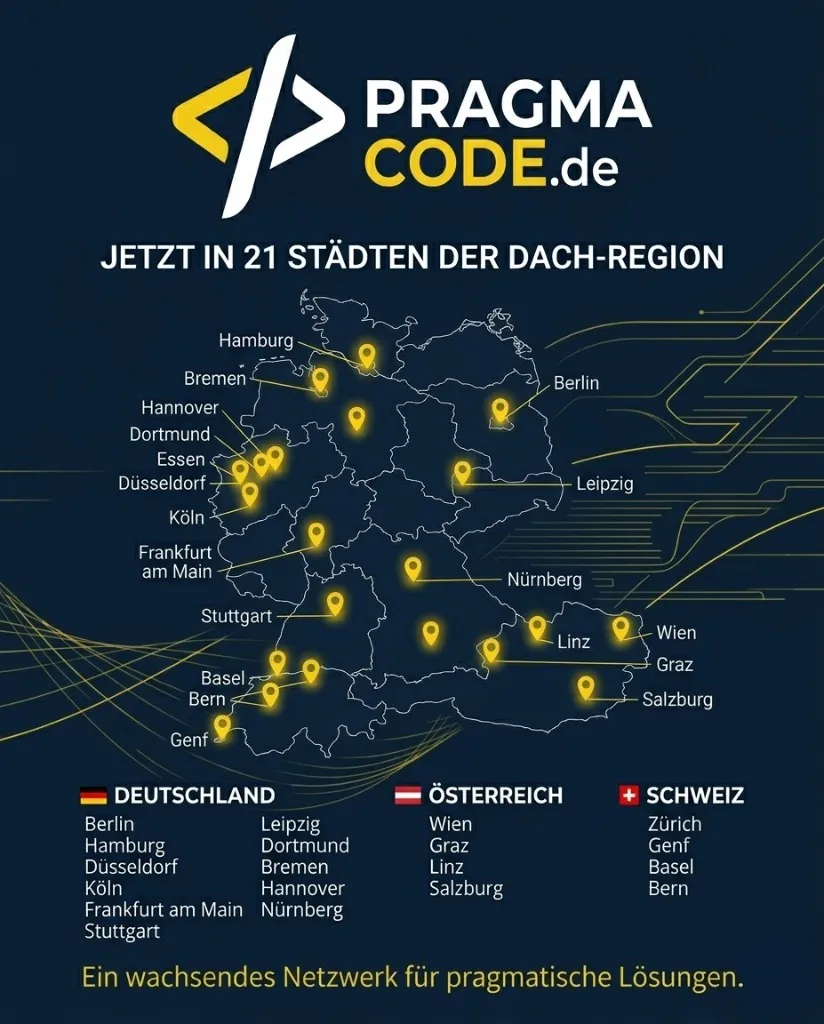
We are your digital partner – regionally anchored and successfully scaling across borders.
Web development for your business?
I deliver this for small and mid-sized businesses: at a fixed price agreed upfront, working directly with the person who builds it. Process, scope and pricing are on the service page.
See service & pricing Or request a free intro callExtended Specialized Glossary
Rust (Programming Language)
A modern systems programming language focusing on blistering execution speed, strict type safety, and compile-time guaranteed memory safety without requiring a garbage collector.
Borrow Checker
A core component of the Rust compiler that enforces strict static ownership and lifetime rules during compilation, guaranteeing that memory references remain valid without runtime overhead.
Memory Safety
Protection from memory corruption bugs such as buffer overflows, dangling pointers, and use-after-free flaws, which historically account for over 70% of critical security vulnerabilities.
Zero-Cost Abstractions
An engineering design philosophy ensuring that high-level abstractions—including generics, iterators, and pattern matching—compile down directly into optimal, uncompromised machine code.
Fearless Concurrency
Rust's compile-time guarantee that multithreaded and concurrent code is provably protected against data races and unpredictable thread corruption via the Send and Sync traits.
RAII (Resource Acquisition Is Initialization)
A software design pattern where resource allocation is tied directly to object lifetime, triggering automatic and deterministic deallocation as soon as variables exit their scope.
Tokio
The industry-standard asynchronous, event-driven I/O runtime for Rust, engineered to effortlessly handle tens of thousands of concurrent network connections with minimal RAM.
WebAssembly (Wasm)
A high-performance binary instruction format enabling code compiled from languages like Rust to execute directly in web browsers or edge worker environments at near-native speeds.