

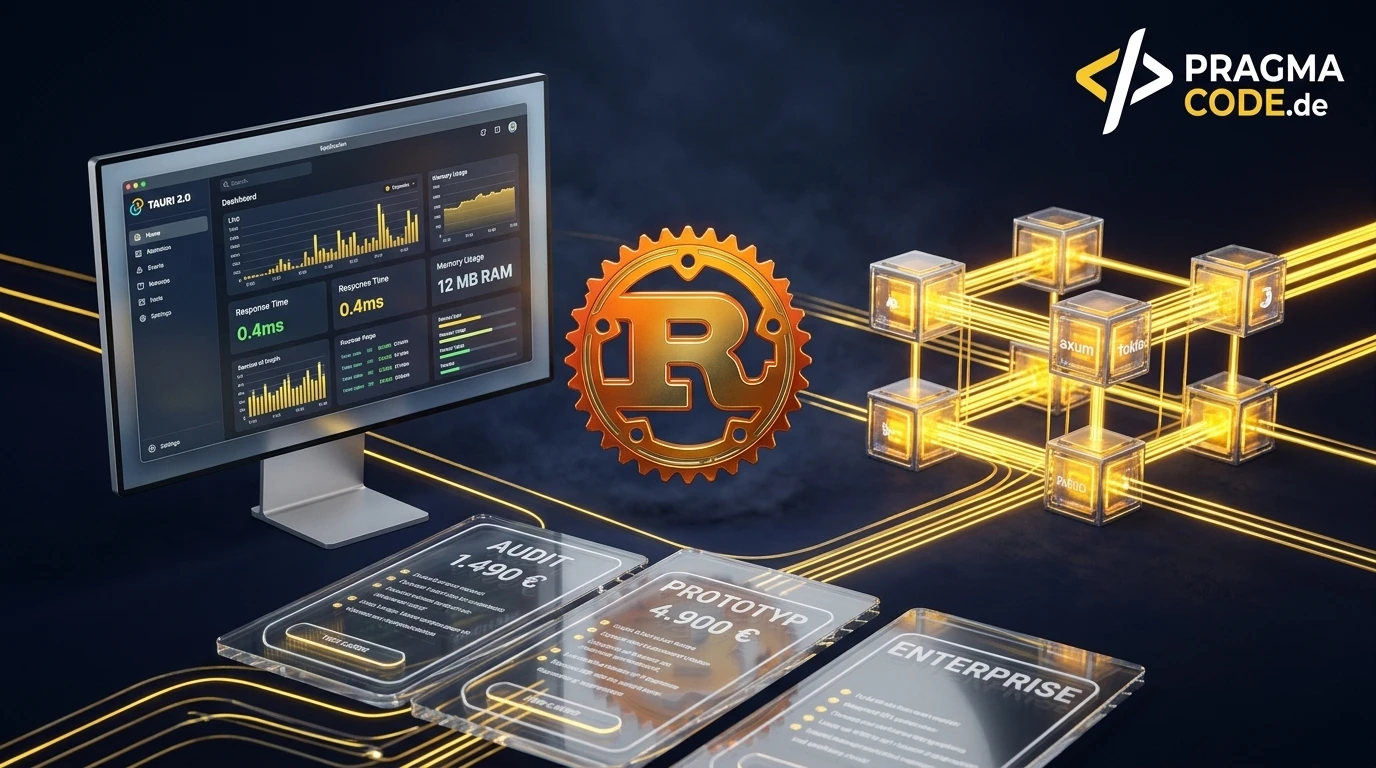
By 2026, the Rust programming language has transcended its origins as a systems language to become a core strategic pillar for medium-sized industrial and software enterprises. It effectively resolves the long-standing dilemma between uncompromising execution speed and rigorous cybersecurity. From resource-efficient internal desktop business applications using Tauri 2.0 as a lightweight Electron alternative, to hyper-scalable backend APIs powered by Axum, to data-sovereign on-premise AI inference – Rust delivers quantifiable business value. In this practical guide, discover how modern businesses adopt Rust without project risk, backed by transparent, modular fixed-price engineering packages.
This article is an in-depth expert contribution from our content cluster. Discover the complete overview on our main page: Rust Development & High-Performance Engineering →
- Paradigm shift in application architecture: By uniting bare-metal compilation with mathematically proven memory safety, Rust prevents runtime crashes and critical vulnerabilities by design. Enterprises eliminate expensive production bug-hunting cycles and fulfill EU Cyber Resilience Act (CRA) compliance obligations automatically.
- Radical desktop resource efficiency with Tauri 2.0: Replacing bloated Electron stacks with Tauri 2.0 slashes the memory footprint of internal desktop tools from 250 MB to under 25 MB and compresses installer sizes down to 10 to 15 MB. This significantly extends the operational lifecycle of existing workstation hardware across manufacturing, logistics, and administration.
- Risk-free adoption with fixed-price transparency: Instead of burning open-ended time-and-material consulting budgets, Pragma Code provides a modular 3-tier model: an in-depth Architecture Audit (€1,490), a working Focus Prototype (€4,900), and full-scale Enterprise Engineering with clearly scoped milestones and complete commercial predictability.
- Introduction: Software Engineering as a Strategic Competitive Advantage
- 1. The Architectural Turning Point: Legacy Stack Limitations & Regulatory Pressure
- 2. The 4 Proven B2B Use Cases for Rust in Medium-Sized Enterprises
- 3. Business Case & ROI: Why Rust Makes Financial Sense
- 4. The 5 Strategic Levers for Successful Rust Adoption
- 5. Transparent Fixed-Price Packages for Rust Engineering at Pragma Code
- 6. The Structured 4-Phase Implementation Roadmap
- 7. Decision-Maker Quick Check & Conclusion
Introduction: Software Engineering as a Strategic Competitive Advantage
In mid-sized industrial and software organizations, IT environments often struggle with identical symptoms: monolithic backend systems groaning under increasing event volumes; internal line-of-business desktop tools built on Electron consuming hundreds of megabytes of RAM per workstation; and cloud infrastructure invoices from hyperscalers like AWS, Azure, and Google Cloud steadily climbing month after month. Simultaneously, regulatory frameworks such as the European Cyber Resilience Act (CRA) and NIS-2 directives impose strict product liability standards on digital solutions and embedded software.
For decades, IT decision-makers faced an uncomfortable compromise: choose interpreted or garbage-collected runtimes like Python, Node.js, PHP, or Java for rapid feature delivery at the expense of latency spikes, unpredictable garbage collection pauses, and heavy memory overhead – or invest in C and C++, unlocking bare-metal speed while continuously risking buffer overflows, memory leaks, and severe concurrency race conditions.
The Rust programming language definitively eliminates this architectural dilemma. Through an innovative compile-time ownership and borrowing model enforced by the Borrow Checker, Rust guarantees complete Memory Safety without runtime overhead and without any garbage collector. At Pragma Code, we deploy Rust precisely where enterprises demand absolute operational resilience, deterministic response times, and maximum efficiency. On our dedicated service page for Rust Development & High-Performance Engineering, we offer modular, risk-controlled project packages tailored to enterprise requirements.
1. The Architectural Turning Point: Legacy Stack Limitations & Regulatory Pressure
Why has Rust reached critical momentum for mid-sized enterprises in 2026? The answer lies in the intersection of architectural exhaustion in conventional tech stacks and rising regulatory liabilities.
Widespread programming ecosystems such as Python and Node.js encounter physical boundaries when handling data-intensive operations. Python excels as an interactive orchestration and glue layer for machine learning pipelines, yet struggles with multi-core parallelism and high-throughput concurrent I/O due to its Global Interpreter Lock (GIL). Node.js, while capable of handling lightweight asynchronous web requests, suffers steep performance degradation whenever CPU-heavy data transformations or cryptographic tasks block the single-threaded event loop.
Escalating Cloud & Server Overhead
To compensate for memory leaks and garbage collection thrashing in dynamic languages, companies over-provision virtual instances. 60% to 80% of server billing pays for unused runtime overhead.
Unpredictable Production Outages
Null pointer exceptions and out-of-memory crashes routinely trigger under peak user load. Emergency firefighting diverts top engineering talent and damages client trust.
Workstation Hardware Bottlenecks
Electron-based desktop tools launch a dedicated Chromium browser process per window. On factory floor terminals and warehouse devices, this causes severe UI lag.
Concurrently, the European Cyber Resilience Act (CRA) enforces legally binding Secure-by-Design mandates across digital products. Independent security audits by Microsoft, Google, and the German BSI consistently confirm that upwards of 70% of all critical software vulnerabilities originate from memory management defects (e.g., buffer overflows, use-after-free). Adopting memory-safe languages like Rust is rapidly becoming the de-facto requirement to pass stringent compliance audits and mitigate executive liability.
2. The 4 Proven B2B Use Cases for Rust in Medium-Sized Enterprises
Contrary to the misconception that Rust is strictly reserved for operating system kernels, browser engines, or embedded microcontrollers, the language delivers its highest commercial return in mid-sized B2B settings across four core operational domains.
Use Case 1: Lean Desktop Business Applications with Tauri 2.0 vs. Electron
Industrial enterprises, logistics hubs, diagnostic laboratories, and retail networks rely on hundreds of specialized internal desktop tools: barcode inventory scanners, machine telemetry monitors, quality assurance consoles, and ERP terminals. Over the past decade, these tools were predominantly developed with Electron to leverage modern web frameworks like React, Vue, or Svelte. The operational penalty has been severe: every Electron application packages an entire Chromium browser and Node.js runtime, idling at 150 to 350 MB of RAM and requiring multi-megabyte installers.
This is where Tauri 2.0 fundamentally disrupts enterprise desktop software. Tauri utilizes the existing native operating system webview (WebKitGTK on Linux, WebKit on macOS, and WebView2 on Windows) and marries it to an ultra-fast, memory-safe native Rust backend. The real-world difference is striking:
Enterprise Architecture Comparison: Electron vs. Tauri 2.0
- Idle RAM Footprint: 180 to 350 MB per active application window
- Installer Size: 85 to 150 MB (bundled Chromium binary engine)
- Cold Start Latency: 2.5 to 5.0 seconds until initial user readiness
- Attack Surface: Expansive Node.js ecosystem with thousands of transitive dependencies
- Mobile Support: No native cross-platform build target; requires separate codebase
- Idle RAM Footprint: 15 to 35 MB (over 85% memory savings)
- Installer Size: 8 to 18 MB compact, native executable binary
- Cold Start Latency: Under 300 milliseconds (instant user responsiveness)
- Attack Surface: Minimal, strictly auditable Rust core with secure IPC channels
- Mobile Support: Native multi-platform deployment across Desktop, iOS, and Android
For our clients, this translates directly into tangible productivity gains: older warehouse terminals and office workstations run smoothly without freezing, even when multiple custom tools operate concurrently. Internal frontend teams maintain their preferred UI toolsets (TypeScript, Tailwind CSS, modern components) while mission-critical business logic, hardware integrations, and local filesystem access reside safely in an uncrashable Rust core.
Use Case 2: High-Throughput API Gateways & Microservices with Axum & Tokio
When distributed microservices must process tens of thousands of concurrent requests – such as IoT telemetry streaming from manufacturing plant sensors, logistics parcel tracking, or high-frequency pricing queries in B2B commerce –, traditional Node.js or Java Spring Boot services struggle with thread pool saturation and latency jitter. By leveraging Axum on top of the asynchronous runtime Tokio, engineering teams construct REST and gRPC gateways that achieve deterministic, sub-millisecond response times.
Axum harnesses Rust's type system to validate routes, request headers, authentication tokens, and request payloads at compile time. Runtime bugs caused by malformed payloads are eliminated before code reaches production. Simultaneously, a single lightweight server core can handle tens of thousands of concurrent TCP sockets while keeping CPU utilization and power consumption at fractional levels.
Use Case 3: Data-Sovereign On-Premise AI Inference & RAG with Candle
Industrial enterprises and engineering firms understandably hesitate to upload proprietary CAD drawings, customer records, or confidential manufacturing formulas to third-party public AI APIs hosted in overseas cloud environments. However, running open-weights models (such as Mistral, Llama, or Qwen) locally previously demanded cumbersome, fragile Python environments burdened by massive PyTorch dependencies and complex container setups.
With Candle (Rust ML), Hugging Face's minimalist machine learning framework written purely in Rust, we embed state-of-the-art language models and vector embedding pipelines directly into the application process. Devoid of heavy Python runtime baggage, custom RAG pipelines execute on standard customer hardware or edge devices – fully air-gapped, GDPR-compliant, and operating with maximum hardware efficiency.
Use Case 4: WebAssembly (WASM) & Incremental Legacy Modernization
Very few enterprises have the luxury of discarding mature monolithic systems to conduct greenfield rewrites. Thanks to superior WebAssembly (Wasm) compilation targets and transparent C-compatible FFI (Foreign Function Interface) layers, Rust enables a safe, evolutionary modernization strategy. Bottleneck routines are isolated, rewritten in Rust, and seamlessly imported into existing web frontends via WebAssembly or into existing C#, Java, or C++ services as native dynamic libraries.
1. Tauri 2.0 Business Applications
Replace bloated Electron apps with streamlined native binaries. Combine modern web frontends with memory-safe Rust cores for instant workstation responsiveness.
2. Axum & Tokio High-Throughput APIs
Microservices and API gateways delivering deterministic sub-millisecond latencies. Boundless concurrency without garbage collection jitter on IoT streams.
3. Local AI Inference with Candle
Embed open SLMs and RAG vector search pipelines directly into native Rust binaries. 100% confidential on-premise execution without external cloud exposure.
4. WebAssembly & Legacy Modernization
Progressively renew legacy systems without destructive rewrites. High-performance modules run inside browsers or link via FFI into enterprise monoliths.
3. Business Case & ROI: Why Rust Makes Financial Sense
Adopting modern technology must deliver a defensible commercial return to CFOs and executive boards. Migrating to Rust is not an academic exercise in language aesthetics; it is a calculated business optimization driven by three measurable financial levers:
Lever A: Substantial Reduction in Cloud and Server Hosting Expenditures
A typical enterprise microservice running on Node.js or Java Spring Boot demands between 512 MB and 2 GB of RAM per instance to absorb peak traffic surges without trigger-happy Out-of-Memory (OOM) kills. An equivalent Axum microservice in Rust easily processes identical transaction volume within 15 to 40 MB of RAM. In serverless cloud setups like AWS Lambda or Google Cloud Run, compiled Rust binaries cold-start in under 5 milliseconds, while JVM-based containers take several seconds of billed spin-up time. Across microservice fleets spanning 20 to 50 workloads, infrastructure invoices regularly decline by 50% to 75%.
Lever B: Eliminating Costly Outage Response and Firefighting
Dynamically typed or manually managed codebases conceal significant operational liabilities: unhandled null pointers and subtle memory leaks often trigger only under extreme production conditions on weekends. Resolving these emergencies consumes expensive senior developer hours and causes business disruption. Rust enforces explicit handling of every potential failure through Option<T> and Result<T, E> at compile time. If code passes the compiler, it runs reliably in production with unprecedented stability.
Expert Recommendation: Targeted Bottleneck Profiling
Never attempt a wholesale rewrite of mature enterprise monoliths. Employ Application Performance Monitoring (APM) tools to pinpoint the critical top 5% of endpoints responsible for 80% of server compute or latency bottlenecks. Rewrite only those performance-critical hotspots as modular Rust services or Tauri desktop tools. This surgical approach regularly achieves a complete return on investment within 6 to 8 weeks.
Lever C: Workstation Capital Expense Avoidance and Hardware Longevity
Because Rust and Tauri 2.0 operate with near-zero runtime overhead, legacy warehouse computers, shop-floor terminals, and field tablets do not require premature hardware upgrades. An internal tool that previously stuttered on 4 GB RAM machines runs fluidly under Tauri 2.0. This prevents five-figure hardware renewal costs while adhering to sustainable Green IT principles.
4. The 5 Strategic Levers for Successful Rust Adoption
To determine whether and where Rust provides the fastest commercial payback for your organization, assess your current software landscape against these five battle-tested criteria:
1. Latency & Scale Bottlenecks
Existing APIs, event pipelines, or integrations struggle under peak traffic spikes or fail to meet strict client SLA requirements.
2. Lagging Desktop Business Tools
Internal Electron-based applications overwhelm workstation hardware, causing slow startup times and frustrating user delays.
3. Regulatory Compliance Demands
Directives like the EU Cyber Resilience Act (CRA) or client enterprise security audits mandate provable memory safety by design.
4. Sovereign On-Premise AI Ambitions
Proprietary enterprise data must be processed using private local language models and vector search without external cloud dependency.
5. Growing Cloud Infrastructure Costs
Hyperscaler hosting expenses on AWS, Azure, or Hetzner expand faster than revenue due to runtime memory and container bloat.
5. Transparent Fixed-Price Packages for Rust Engineering at Pragma Code
Decades of enterprise software experience have shown us that mid-sized businesses rightfully avoid open-ended time-and-material billing models when testing new technologies. At Pragma Code, we remove project risk upfront. As outlined on our central Packages & Pricing page and detailed on our Rust Development & High-Performance Engineering hub, we provide transparent, fixed-price engineering engagements:
Package 1: Rust Performance & Architecture Audit (€1,490 Fixed Price)
Timeline: 1 week. We inspect your existing codebase (Node.js, Python, Electron, C++) to isolate latency drivers, memory leaks, and architectural bottlenecks. You receive an executive report detailing concrete ROI calculations, an actionable Rust/Tauri architecture blueprint, and an objective feasibility assessment before committing any project capital.
Package 2: Rust Focus Prototype (€4,900 Fixed Price)
Timeline: 2 to 3 weeks. Working software over endless documentation: We build a fully functional, production-ready prototype addressing your highest-priority bottleneck – such as a lightweight Tauri 2.0 desktop tool or a high-throughput Axum microservice. Includes comprehensive benchmark validation against your legacy system and complete source code handover.
Package 3: Enterprise Rust Engineering (From €8,500 Fixed Price)
Timeline: 4 to 8 weeks. Full-scale implementation of robust, mission-critical systems: High-performance backend architectures, automated CI/CD pipelines with cargo audit and clippy, on-premise container deployment, compliance audit support, and structured mentoring for your internal engineering team.
Our packages are designed to build upon each other seamlessly: findings from the Audit feed directly into the Focus Prototype, and the verified Prototype forms the architectural bedrock for the full-scale Enterprise rollout. You maintain total budget oversight and milestone control at every phase.
6. The Structured 4-Phase Implementation Roadmap
Adopting Rust in enterprise environments succeeds through structured, disciplined delivery. Pragma Code applies a proven 4-phase implementation model designed to minimize operational disruption and prove business value early:
-
Phase 1: Discovery, Profiling & Architectural Design
Together with your technical leadership, we identify high-friction bottlenecks and critical interfaces. We establish strict contract specifications (OpenAPI, gRPC, Protobuf) and draft the security and data architecture.
-
Phase 2: Isolated PoC & Benchmark Verification
Rapid development of an operational Focus Prototype. We benchmark the prototype under realistic load conditions directly against your legacy implementation, providing empirical proof of latency reduction and RAM savings.
-
Phase 3: Production Hardening & CI/CD Integration
Scaling the prototype into a production-grade release. We establish automated security gates in GitHub Actions or GitLab CI (memory-safety checks, linters, unit and integration tests) and finalize complete technical documentation.
-
Phase 4: Rollout, Knowledge Transfer & Ongoing Support
Controlled deployment via canary releases or side-by-side staging runs. Through paired programming sessions and architectural workshops, we empower your internal development team to manage and evolve the system autonomously.
7. Decision-Maker Quick Check & Conclusion
In 2026, software engineering tolerates neither inefficiency nor complacency. Enterprises running mission-critical workloads on fragile, resource-hungry stacks bleed cloud capital every month and carry needless security exposure. Rust equips forward-thinking medium-sized businesses with the precise toolset required to unite world-class technical execution with fiscal prudence.
Quick-Check: Is Your Organization Ready for Rust?
If you answered "Yes" to two or more of these questions, an exploratory strategy consultation will immediately clarify your options. Together, we evaluate your system landscape and outline how a targeted Performance Audit or Focus Prototype delivers high-performance software without commercial risk.
Ready for high-performance, memory-safe software with Rust?
Schedule your free initial consultation nowOur Regional Expertise
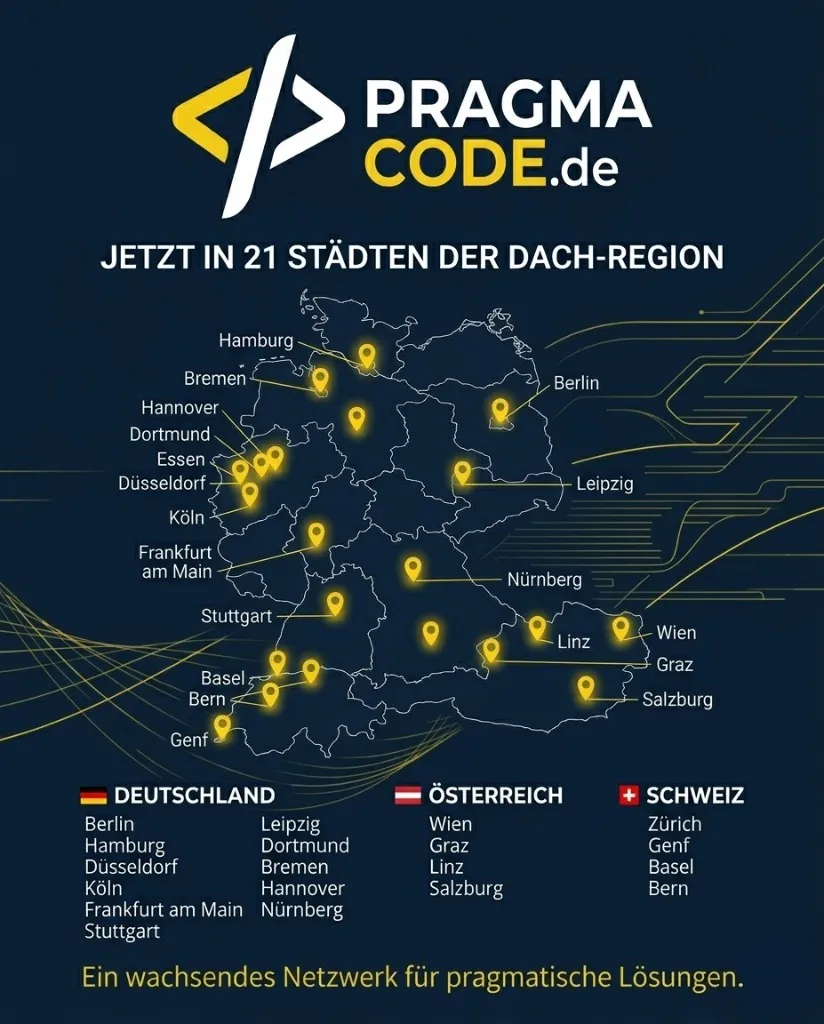
We are your digital partner – regionally anchored and successfully scaling across borders.
Rust development for your business?
I deliver this for small and mid-sized businesses: at a fixed price agreed upfront, working directly with the person who builds it. Process, scope and pricing are on the service page.
See service & pricing Or request a free intro callExtended Specialized Glossary
Tauri 2.0
A modern application framework for building resource-efficient desktop and mobile apps using web frontends and a native, memory-safe Rust backend. Compared to Electron, Tauri reduces RAM consumption by up to 90% and produces extremely compact binary sizes (10–15 MB).
Axum
An ergonomic, high-performance, and modular web application framework for the Rust programming language built on Tokio, Tower, and Hyper. It enables building microservices and APIs with sub-millisecond latencies and minimal CPU overhead.
Candle (Rust ML)
A minimalist and high-performance machine learning framework for Rust developed by Hugging Face, enabling lean, local AI model inference without heavy Python runtimes or PyTorch dependencies on enterprise servers and edge hardware.
Borrow Checker
A core component of the Rust compiler that enforces static ownership and lifetime rules during compilation, mathematically guaranteeing that no invalid memory accesses occur.
Memory Safety
Protection against memory-related software vulnerabilities such as buffer overflows, dangling pointers, or use-after-free conditions, which account for over 70% of all critical CVEs.