

Artificial intelligence in mid-sized enterprises has grown far beyond the experimentation phase. But how can decision-makers evaluate the actual Return on Investment (ROI) of AI initiatives when traditional accounting methods fail at complex system boundaries? This guide provides concrete business cases, mathematical models, and metrics for measurable value creation.
This article is an in-depth expert contribution from our content cluster. Discover the complete overview on our main page:AI Automation & Autonomous Agents →
The Paradigm Shift in the CFO Office
Why evaluating AI initiatives in 2026 no longer works with traditional software depreciation rules, but requires dynamic Agentic ROI models, prompt caching economics, and risk-adjusted performance indicators.
- Traditional accounting falls short: Legacy CAPEX/OPEX views capture neither prevented employee turnover nor quality enhancements or accelerated product development cycles.
- Holistic ROI formula: Realistic ROI (Return on Investment) is calculated from direct hours saved, strategic opportunity value, and mitigated error costs minus true TCO (Total Cost of Ownership).
- Scaling via Agentic AI: Autonomous multi-agent systems achieve an exponential Time-to-Value (TTV) compared to simple copilots by taking over end-to-end process workflows.
- 1. Introduction: The ROI Illusion in SMEs
- 2. Why Traditional Accounting Models Fail for AI
- 3. The Four Dimensions of AI Value Creation
- 4. The Holistic AI ROI Formula & Mathematical Model
- 5. Concrete B2B Business Cases from the Field
- 6. Hidden Cost Traps & 36-Month TCO Calculation
- 7. Governance, KPIs & Live Telemetry in Enterprise Environments
- 8. Roadmap: 4-Phase Framework for Measuring ROI
- 9. Conclusion & Actionable Next Steps
1. Introduction: The ROI Illusion in SMEs
In corporate boardrooms across Europe and North America, the executive conversation around artificial intelligence has fundamentally transformed. While earlier years were characterized by exploratory pilot projects, proof-of-concept tests, and playful experimentation, board members, CFOs, and finance directors now demand hard facts, audit-proof numbers, and defensible returns. The urgent question at board meetings is no longer: “What can AI do?”, but rather: “When and how does our AI investment tangibly pay off in hard currency?”
Here, many established companies hit an unexpected roadblock. Evaluating AI initiatives using the same rigid framework applied to purchasing a new CNC milling machine or renewing Microsoft 365 licenses almost inevitably leads to disappointment or severe misjudgments. Traditional financial accounting methods focus exclusively on primary, linear savings — such as reducing administrative labor through automated invoice processing. However, they remain blind to the far more powerful secondary and tertiary multiplier effects created by agile, autonomous AI architectures:
Accelerated Sales Velocity
When a B2B enterprise responds to major tenders (RFP Automation) within minutes instead of weeks thanks to automated specification extraction, win rates increase dramatically.
Mitigation of Penalties & Liability
Predictive quality assurance and automated legal reviews prevent costly compliance fines, contractual penalties, and warranty claims.
Retention of Key Talent
Relieving senior engineers or legal specialists from monotonous manual data entry reduces turnover and saves massive recruitment costs.
Increased Innovation Speed
Accelerated time-to-market for new digital products captures valuable market share before competitors can react.
To reveal the true net value of AI initiatives, executive leaders require a modern, dynamic evaluation framework. In this article, we construct an audit-ready model that satisfies both strict financial controlling standards and the operational reality of enterprise AI transformations.
2. Why Traditional Accounting Models Fail for AI
Classic capital budgeting relies heavily on static metrics like Payback Period, Net Present Value (NPV), and Internal Rate of Return (IRR). These tools were engineered for deterministic capital assets: a physical machine costs X dollars, produces Y units per hour, and depreciates linearly over Z years. AI systems, however, behave in fundamentally distinct ways.
Comparison: Traditional IT Controlling vs. Modern AI ROI Controlling
- Focus: Pure CAPEX/OPEX cost reduction in headcount
- Metric: Static Payback Period (amortization time in years)
- Measurement: Linear time tracking before/after software rollout
- Operating Costs: Fixed annual software license and maintenance fees
- Risk Model: Downtime risk is categorized as strictly binary (running / not running)
- Focus: Dynamic value creation, output quality & business scaling
- Metric: Risk-Adjusted ROI & Time-to-Value (TTV)
- Measurement: Throughput, quality score, precision & opportunity yields
- Operating Costs: Usage-based token consumption with prompt caching, MLOps, vector re-indexing
- Risk Model: Hallucination probabilities, data drift & EU AI Act governance costs
Three core structural drivers explain why legacy financial accounting falls short when evaluating artificial intelligence:
Non-Linear Learning Curves
Unlike legacy software packages whose business utility peaks on deployment day and depreciates thereafter, well-engineered AI agent architectures gain accuracy, context, and operational efficiency over time through vector database expansions and continuous feedback loops.
Usage-Based Cost Dynamics
While SaaS tools charge rigid fees per seat per month, modern frontier models charge per million tokens processed. With architectural optimizations like prompt caching and semantic routing, input token costs decrease by up to 80%.
Qualitative Multiplier Effects
An AI copilot in customer support does not merely save 5 minutes per ticket; it increases First-Contact-Resolution rates. This drives customer retention and directly boosts Customer Lifetime Value (CLV).
3. The Four Dimensions of AI Value Creation
To present an audit-proof business case to executive leadership and investors, enterprise leaders should segment total project returns into four distinct value dimensions. This taxonomy ensures complete capture of both direct operational savings and transformative strategic yields.
1. Direct Cost Reduction
Direct reductions in operating expenditures, overtime, and external contractors.
Savings: 30%–60%Eliminating manual data entry, automated invoice verification, and tier-1 helpdesk inquiry resolution.
2. Velocity & Scale Impact
Expanding organizational throughput without linear headcount expansion.
Throughput: +300%Multiplying order volumes processed across sales, fulfillment, and development teams with existing staffing levels.
3. Quality & Risk Mitigation
Eliminating human clerical errors, guaranteeing regulatory compliance (e.g., GDPR, EU AI Act), and elevating overall procedural precision. Preventing a single compliance failure or breach easily recoups an entire project budget.
4. Strategic Opportunity Value
Unlocking net-new revenue streams via AI-native business capabilities (AI Business Models 2026), such as 24/7 autonomous sales agents, personalized eCommerce experiences, and data monetization.
4. The Holistic AI ROI Formula & Mathematical Model
To satisfy the rigorous standards of corporate finance, we have synthesized a mathematical formula that maps aggregate yield directly against full lifecycle expenditure (TCO).
The Advanced AI ROI Formula for Decision Makers
ROI (%) = [ (S_h + E_o + R_m) - TCO ] / TCO × 100
- S_h: Direct Savings (Labor Hours Saved): Total labor hours automated multiplied by fully loaded hourly internal labor rates.
- E_o: Opportunity Earnings (Velocity Profit): Contribution margin gained from net-new business captured via reduced response times and higher quotation capacity.
- R_m: Risk Mitigation (Error & Penalty Avoidance): Expected statistical value of avoided compliance sanctions, contract SLA penalties, and customer return costs.
- TCO: Total Cost of Ownership: Sum of initial architecture engineering, software licenses, token expenses (with prompt caching), infrastructure, and ongoing MLOps over 36 months. For comprehensive pricing details, see our AI Cost & Budget Guide.
Concrete Business Case: Mid-Sized B2B Distributor (250 Employees)
Consider the enterprise implementation of an autonomous AI agent system for automated supplier catalog processing and product master data harmonization over a 36-month time horizon:
Initial Expenditure (CAPEX)
System architecture, API integration & core build
65,000 €One-time custom development before production launch.
Operating Expenditure (OPEX)
Token costs with caching, hosting & MLOps support
36,000 €1,000 € / month over 3 years.
Change Management
Team workshops, workflow adaptation & enablement
14,000 €Staff enablement and ongoing training coaching.
Total TCO (36 Months)
Cumulative investment and operational expenditure
115,000 €Comprehensive cost projection including safety contingency.
Against this total investment, the enterprise realizes the following aggregate returns over 36 months:
S_h (Direct Labor Savings)
2 full-time equivalents liberated from manual entry
594,000 €3,600 hrs/year × 55 €/hr over 3 years.
E_o (Opportunity Earnings)
New SKU launches in 4 hours rather than 14 days
105,000 €35,000 € incremental gross margin annually.
R_m (Risk Mitigation)
Preventing catalog order mismatches and return freight
45,000 €15,000 € saved per year in avoided returns.
Total Gross Return (36 Months)
Cumulative financial value creation over 3 years
744,000 €Total validated economic value generated.
Feeding these audited metrics directly into our ROI formula:
ROI = ( 744,000 € - 115,000 € ) / 115,000 € × 100 = 546.95%
The enterprise achieves its Time-to-Value (TTV) — the milestone where cumulative operational savings fully offset the initial 115,000 € outlay — in the 7th month post go-live.
5. Concrete B2B Business Cases from the Field
To illustrate the versatile economic impact of applied enterprise AI, we analyze three battle-tested implementations across diverse European commercial sectors.
Case 1: Autonomous Voice AI Agent in Freight & Logistics
Baseline Situation: A mid-market logistics provider handles approximately 450 daily inbound driver and dispatcher calls regarding shipment tracking, slot booking changes, and address revisions. Average cost per call center interaction: 6.80 €.
AI Solution: Deployment of a real-time conversational voice AI agent connected directly into the enterprise ERP and TMS via secure APIs.
Business Outcome: 72% of inbound inquiries are resolved completely autonomously without human operator escalation. Cost per automated interaction plunges to 0.45 €. At 80,000 annual calls, this generates over 360,000 € in net annual operational savings against engineering costs of roughly 48,000 €.
Case 2: RFP & Tender Automation in Precision Machinery
Baseline Situation: Reviewing and completing complex multi-hundred-page technical tender documents (RFPs) demands an average of 18 senior engineering hours per bid.
AI Solution: Multi-agent system extracting mechanical specifications, cross-referencing internal technical standards libraries, and generating pre-drafted response packages.
Business Outcome: Total turnaround time drops to 3.5 hours. The sales engineering team submits 4x more tender responses with existing headcount. Faster turnaround boosts tender win rates by 14%, generating 520,000 € in annual gross margin expansion.
Case 3: Automated Quality & Security Reviews in Software Engineering
Baseline Situation: A B2B software vendor with 40 developers commits roughly 20% of engineering bandwidth to manual code reviews, pull request verifications, and compliance audits.
AI Solution: Autonomous code-auditing agents embedded directly into the continuous integration pipeline (GitHub Actions Pipeline).
Business Outcome: Manual review load cut by 50%, recapturing 4,000+ developer hours annually (equivalent to ~320,000 € in engineering capacity) and decreasing critical production vulnerabilities by 80% prior to release.
6. Hidden Cost Traps & 36-Month TCO Calculation
The primary pitfall in enterprise AI projects is underestimating downstream operational expenses. While traditional off-the-shelf software incurs largely predictable annual maintenance, modern AI architectures exhibit dynamic operational cost profiles.
Uncontrolled Token Creep & Lack of Prompt Caching
Unoptimized multi-turn prompts, excessive context window stuffing, and unconstrained RAG retrieval quickly lead to budget overruns. Antidote: Systematic implementation of prompt caching (saving up to 80% on recurring system prompt tokens), context compression, and semantic routing to smaller distilled models.
Model Drift, Re-Indexing & Continuous Evaluation Harnesses
AI models do not remain static. Upstream model updates, internal document updates, or subtle accuracy drift demand automated eval frameworks (AI Evals & Quality Assurance), recurring vector database re-indexing, and disciplined MLOps governance.
EU AI Act Compliance & Audit Governance
Enterprises implementing high-risk workflows categorized under Annex III of the EU AI Act must provide technical documentation, risk management logs, and human-in-the-loop oversight mechanisms. Neglecting compliance incurs costly retrofits or severe fines that demolish project returns.
7. Governance, KPIs & Live Telemetry in Enterprise Environments
Sustaining long-term return on investment requires real-time telemetry. Rather than waiting for year-end accounting reconciliations, corporate leaders monitor agent performance continuously via an operational dashboard.
The following five performance indicators (KPIs) form the bedrock of disciplined AI financial management:
Deflection Rate (Resolution Rate)
Percentage of workflows and customer queries successfully resolved end-to-end without requiring human operator escalation.
Accuracy & Hallucination Rate
MLOps accuracy benchmark measuring semantic precision and factual grounding against verified enterprise source data.
Cost per Task / Cost per Resolution
Direct infrastructure expenditure (tokens consumed + compute fraction) per completed process step to control marginal unit economics.
Time-to-Value (TTV)
Elapsed timeframe from initial project outlay to the point of cumulative break-even and positive net cash flow contribution.
User Adoption & Feedback Score
Daily active usage depth among targeted knowledge workers and recurring satisfaction ratings in real-world workflows.
8. Roadmap: 4-Phase Framework for Measuring ROI
To guarantee complete transparency and measurable outcomes from concept to enterprise scale, we execute projects following our proven 4-phase implementation roadmap:
-
Phase 1: Baseline Audit & KPI Definition (Weeks 1–3)
Comprehensive audit of current process costs, cycle times, and error frequencies. Establishing hard target KPIs (e.g., "reducing support ticket cycle time from 45 to 8 minutes").
-
Phase 2: MVP & Controlled Pilot Validation (Weeks 4–8)
Deployment of a functional Minimum Viable Product for a controlled user cohort. Empirically measuring token expenditure, accuracy rates, and early user feedback under real operational conditions.
-
Phase 3: System Rollout & Telemetry Integration (Weeks 9–16)
Full integration into core enterprise infrastructure (ERP, CRM, databases) and establishing automated telemetry dashboards for real-time TCO and hours-saved tracking.
-
Phase 4: Continuous Optimization & Scaled Expansion (Ongoing)
Monthly financial audits comparing actual performance against initial business case projections. Systemic prompt optimization, model fine-tuning, and expanding successful agent patterns across additional departments.
9. Conclusion & Actionable Next Steps
Calculating the Return on Investment of AI projects in 2026 is no longer a speculative exercise, but a precise, audit-proof financial discipline. Crucially, business leaders must look beyond basic headcount reduction. By treating AI as a strategic growth multiplier and measuring metrics like Time-to-Value (TTV), opportunity gains, and risk mitigation, enterprise leaders turn AI investments into their strongest competitive advantage.
Quick-Check: Your Path to Measurable AI ROI
Ready to Calculate the Exact ROI of Your AI Initiatives?
Our experts help you build audit-proof business cases, select optimal agent architectures, and implement measurable AI automations.
Schedule Free ConsultationOur Regional Expertise
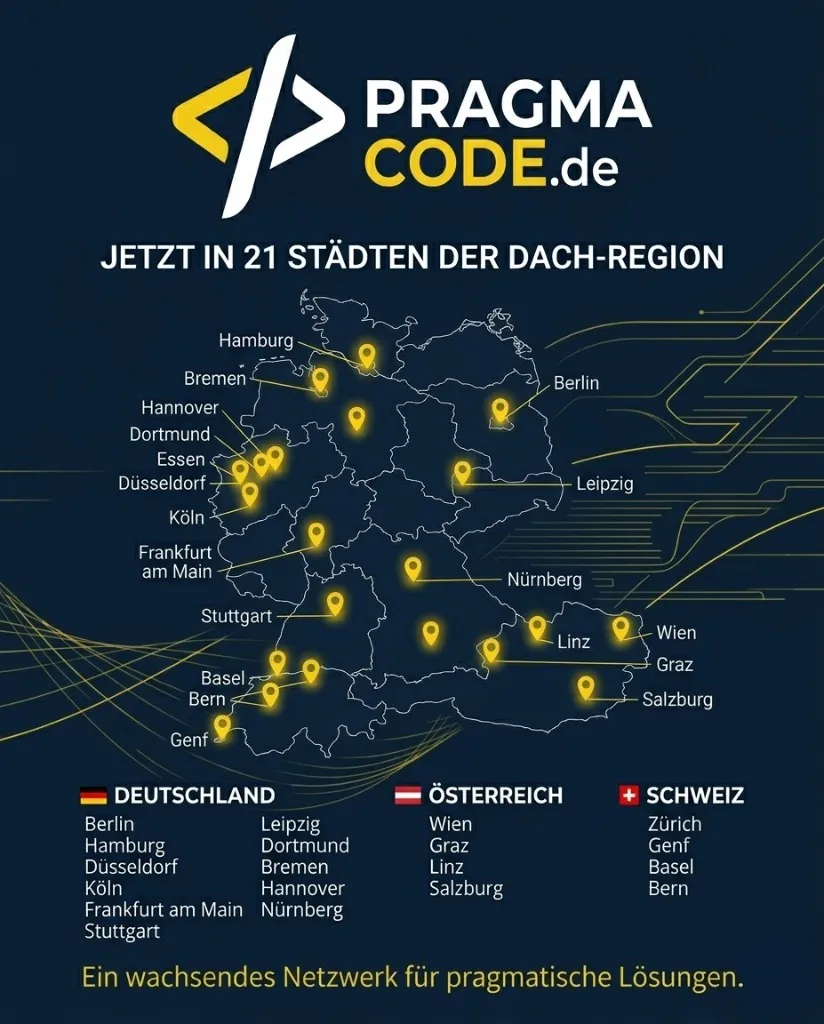
We are your digital partner – regionally anchored and successfully scaling across borders.
Have a vision?
Let's check together how we can make your idea take flight.
Book your free strategy call nowExtended Specialized Glossary
Time-to-Value (TTV)
The elapsed time from initial investment in an AI initiative until the realization of measurable business value.
Risk-Adjusted ROI
A return on investment metric incorporating operational risks, error rates, and governance costs into the net yield calculation.
Agentic ROI
The dedicated value contribution of autonomous AI agent systems, measured by shortened cycle times and scaling without linear headcount additions.
TCO (Total Cost of Ownership)
The aggregate sum of all direct and indirect costs of an AI system over its entire lifecycle.