

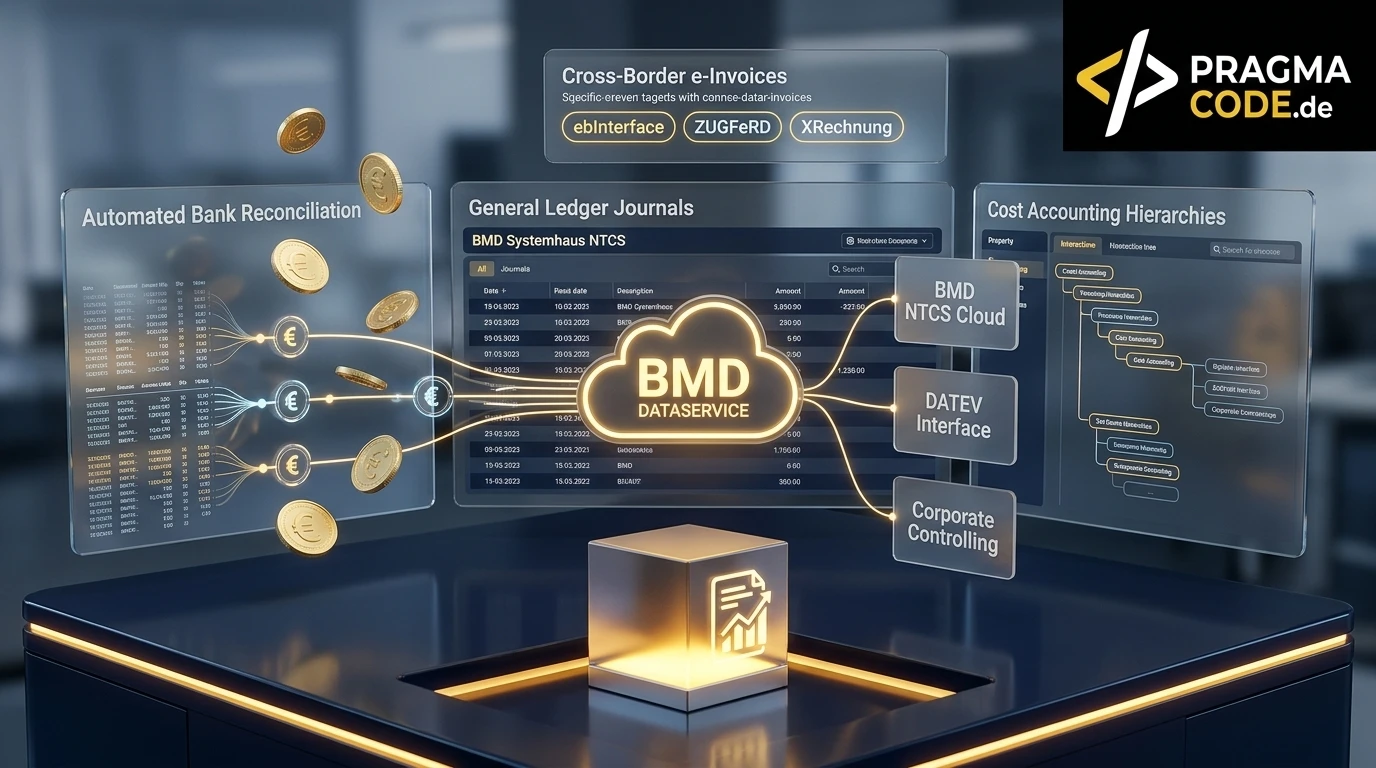
BMD Systemhaus from Steyr is the undisputed market leader for ERP, financial accounting, and tax advisory management in Austria, rapidly expanding across the DACH territory. How can mid-market enterprises achieve seamless integration via BMD DataService and automated e-invoicing pipelines in 2026?
This article is an in-depth expert contribution from our content cluster. Discover the complete overview on our main page: AI & Workflow Automation →
- Market Leader in Austria, Growing Across DACH: Over 30,000 corporate clients and 2,500 advisory practices rely on BMD NTCS for accounting, payroll, and ERP.
- BMD DataService Integration Hub: Unified interface architecture for fully automated exchange of booking journals, master records, and digital voucher images.
- Cross-Border E-Invoicing Mastery: Native compliance with ebInterface (Austria), XRechnung and ZUGFeRD (Germany), alongside international Peppol routing.
- 1. BMD Systemhaus: DACH Market Positioning & Architecture in 2026
- 2. BMD DataService: The Universal Interface Platform in Detail
- 3. Integration Technologies: REST, SOAP, ASCII & DATEV Interoperability
- 4. Comparative Analysis: BMD Advisory vs. BMD Business ERP for Trade & Industry
- 5. The 5 Core Modules for Automated Financial & ERP Workflows
- 6. GoBD, BAO, E-Invoicing 2026 & ISO 27001 Data Security Standards
- 7. Integration Roadmap: 4 Phases to a Live Production API Pipeline
- 8. Avoiding Common Cost Traps & Technical Implementation Pitfalls
- 9. Conclusion & Actionable Executive Checklist
1. BMD Systemhaus: DACH Market Positioning & Architecture in 2026
Headquartered in Steyr, Upper Austria, with international branches across Germany, Switzerland, Hungary, the Czech Republic, and Slovakia, BMD Systemhaus GesmbH is one of Central Europe's most accomplished enterprise software houses. Its core platform, BMD NTCS (New Technology Client Server), has established an undisputed benchmark in Austria, deployed by over 80 percent of all certified tax advisors and auditors. Concurrently, BMD experiences rapid adoption among German mid-market enterprises in 2026, especially those operating multi-entity entities across Germany, Austria, and Switzerland seeking a unified financial platform.
Architecturally, BMD NTCS is engineered on a high-capacity relational SQL database engine. All corporate disciplines—general ledger, fixed asset valuation, cost center controlling, multi-country payroll, inventory management, CRM, and time capture—operate on a single, perfectly unified data repository. This consolidated data schema eliminates friction-prone internal interfaces between isolated departments. Through the BMD Cloud and modern web extensions, team members and external accounting partners access receipts, reports, and approvals securely from anywhere.
Expert Tip: Native Multi-Jurisdiction Compliance
For mid-sized corporations operating in both Germany and Austria, BMD NTCS provides unmatched legal compliance: The application adheres natively to German statutory accounting rules (GoBD, SKR03/SKR04, ELSTER submissions) as well as Austrian fiscal legislation (BAO, U30, FinanzOnline, Einheitskontenrahmen).
2. BMD DataService: The Universal Interface Platform in Detail
To connect upstream commerce and CRM platforms like Salesforce, Odoo, Shopware, Magento, or bespoke vertical applications to BMD, the company developed the BMD DataService. This interface engine acts as an intelligent gatekeeper, verifying external transaction files, payment data, customer updates, and digitized invoice images before posting them cleanly into NTCS ledgers without manual user intervention.
1. Automated Document & Voucher Image Ingestion
Accounts payable and receivable documents are ingested via PDF, TIFF, or structured XML, mapped to transactional journal lines, and stored immutably within the native BMD DMS.
2. Electronic Bank Statement Processing & Reconciliation
Automated collection of CAMT.053, MT940, and EBICS statement streams. Intelligent pattern matching evaluates invoice numbers and account identifiers, automatically clearing open AR/AP balances.
3. Bidirectional Master Data Synchronization
Real-time synchronization of customer and vendor ledger accounts between CRM/commerce suites and BMD. Address modifications, credit limits, and banking coordinates reflect immediately.
4. Cost Accounting & Project Milestone Ingestion
Instant allocation of cost centers, cost units, and project codes from operational systems into BMD for granular real-time contribution margin reporting.
3. Integration Technologies: REST, SOAP, ASCII & DATEV Interoperability
The interface ecosystem of BMD NTCS supports contemporary web standards alongside established data exchange formats, fitting cleanly into any corporate IT landscape.
1. BMD DataService REST & SOAP APIs
Programmatic endpoints enabling live synchronization of master accounts, voucher lookups, inventory levels, and automated journal postings via JSON/XML.
2. DATEV & BMD Standard Batch Filters
Certified file exchange converters supporting standard DATEV Postversand formats alongside BMD-5/NTCS ASCII file structures.
3. Folder Watchers & Secure SFTP Gateways
Background daemons monitoring designated directories, parsing freshly deposited invoice and transaction files automatically into validation queues.
4. ebInterface, XRechnung & ZUGFeRD
Comprehensive invoice parser for the Austrian ebInterface standard as well as German XRechnung and ZUGFeRD profiles compliant with EN 16931.
For modern development teams and enterprise integration architects, deploying open-source automation platforms like n8n represents the gold standard. Rather than developing rigid point-to-point connectors, the middleware captures webhook events dispatched from storefronts, ERP platforms, or payment providers (Stripe, PayPal, Adyen). It validates tax rules, reconciles accounts, and dispatches structured batches through the BMD DataService into the general ledger.
A key capability of the BMD DataService is its granular pre-validation engine: Inbound transactional records are checked against company-specific master data rules before final ledger commitment. If VAT identification numbers are missing for intra-community transactions or required semantic fields of EN 16931 are invalid, the workflow isolates problematic entries into a quarantine table and alerts administrators via automated webhooks, while the valid batch posts immediately.
A standard use case is automated e-commerce daily settlement: Thousands of online customer payments are aggregated via n8n, payment gateway transaction fees are allocated automatically to dedicated expense accounts, and the final reconciled batches—complete with archived PDF receipts—stream into BMD without manual human touchpoints.
4. Comparative Analysis: BMD Advisory vs. BMD Business ERP for Trade & Industry
BMD addresses two foundational commercial user groups through specialized module configurations sharing the identical NTCS engine.
Comparison: Advisory Practice vs. Business ERP
- Core Objective: Practice management, statutory deadline tracking, fee calculations, and staff billable time management.
- Client Scale: Administration of hundreds of distinct client financial ledgers across diverse legal entities and tax codes.
- Collaboration: BMD Com portal providing clients with paperless receipt submission and real-time dashboard analytics.
- Regulatory Interfaces: Direct submission engines for Austrian FinanzOnline and German ELSTER authorities.
- Core Objective: Inventory management, procurement, warehouse logistics, sales order billing, and in-house finance.
- Operational Continuity: Unbroken digital process chains from quotation to delivery note, final billing, and ledger posting.
- Controlling: Granular multi-dimensional cost accounting (KORE), cost unit tracking, and corporate consolidation.
- Organization-Wide Suite: Integrated CRM, ticketing helpdesk, workforce scheduling, and central DMS.
5. The 5 Core Modules for Automated Financial & ERP Workflows
The modular framework of BMD NTCS empowers organizations to deploy precisely the capabilities required for their commercial business model.
1. Financial Accounting (FiBu)
General ledger, AR/AP ledgers, automated SEPA credit transfers, multi-level dunning management, and algorithmic bank reconciliation.
2. Cost Accounting (KORE)
Cost categories, cost centers, internal cost allocations, and multi-tier contribution margin reporting for maximum corporate operational clarity.
3. Payroll Accounting
Multi-country payroll processing conforming with Austrian and German statutory rules, submitting automated declarations to social security funds.
4. Inventory & Logistics
Procurement, warehouse bin management, serial number tracking, multi-warehouse replenishment, order fulfillment, and point-of-sale checkout.
5. Document Management (DMS)
GoBD- and BAO-compliant immutable long-term document archiving equipped with neural OCR search and instant bidirectional transaction links.
6. GoBD, BAO, E-Invoicing 2026 & ISO 27001 Data Security Standards
As a leading Central European software developer, BMD maintains uncompromising standards for regulatory compliance, data protection, and audit governance.
GoBD & BAO Certified Immutability
Uncompromising tamper-proof locking of all committed accounting journals, maintaining comprehensive audit trails for tax authority examinations.
ISO 27001 & ISAE 3402 Hosting
The BMD Cloud is deployed within certified Austrian Tier-3 data centers, ensuring full European GDPR compliance, disaster recovery, and high availability.
Multi-Standard E-Invoicing (EN 16931)
Full support for European e-invoicing standards including ebInterface, XRechnung, and ZUGFeRD, connected with Peppol international exchange networks.
Granular Role Access & 2FA Protection
Field-level authorization models fortified by multi-factor authentication, preventing unauthorized access across corporate accounting domains.
7. Integration Roadmap: 4 Phases to a Live Production API Pipeline
Implementing an automated integration pipeline connecting third-party systems to BMD NTCS requires a disciplined four-phase approach.
-
Phase 1: Chart of Accounts & Tax Code Harmonization
Define standard charts of accounts, harmonize tax keys, and align customer and vendor numbering conventions across all operational systems.
-
Phase 2: BMD DataService Configuration & Field Mappings
Configure mapping profiles inside the BMD DataService interface module, enforce required field rules, and enable secure API credentials.
-
Phase 3: Middleware Construction & Staging Validation
Build automation workflows using n8n or custom connectors. Conduct test batch imports with live production samples in an isolated test client.
-
Phase 4: Live Rollout & Automated Monitoring
Promote the integration pipeline into production, train finance operations teams, and activate automated alerts for rejected transaction batches.
8. Avoiding Common Cost Traps & Technical Implementation Pitfalls
During the deployment of interfaces to BMD NTCS, organizations should proactively address typical operational pitfalls to prevent delays and cost overruns.
1. Interface Module Licensing Requirements
Access to BMD DataService and programmatic web service features requires appropriate module licenses. Verify licensing parameters before kickoff.
2. Cross-Border Tax Key Discrepancies
When routing cross-border transactions between Austria and Germany, verify that intra-community supply and reverse-charge codes align precisely.
3. Unlinked Document Vouchers
Importing accounting batches without attached PDF voucher links forces accounting personnel to match files manually. Ensure simultaneous transmission.
4. Silent Batch Ingestion Failures
If scheduled file imports encounter format errors without alerting administrators, accounting gaps accumulate. Configure automated error notifications.
9. Conclusion & Actionable Executive Checklist
In 2026, BMD Systemhaus NTCS stands as one of the most capable, adaptable, and dependable ERP and accounting platforms in Central Europe. By integrating modern automation pipelines via the BMD DataService, organizations eliminate repetitive manual booking routines entirely. Companies gain frictionless financial operations, unmatched DACH regulatory security, and future-ready enterprise scalability.
Quick-Check: Your BMD Automation Action Plan
Ready to Automate Your BMD NTCS Interface Pipelines?
Schedule a Free ConsultationOfficial Sources & Primary Documentation
- BMD Systemhaus GesmbH (2026): "BMD NTCS: Business Software for Practices and Enterprises" – Platform overview and module specifications.
- BMD DataService Documentation (2026): "Interfaces and Automated Data Exchange with BMD" – Web service endpoints and technical connectors.
- Austrian Economic Chamber (WKO): "ebInterface: The Austrian Standard for Electronic Invoicing" – XML schemas and validation rules.
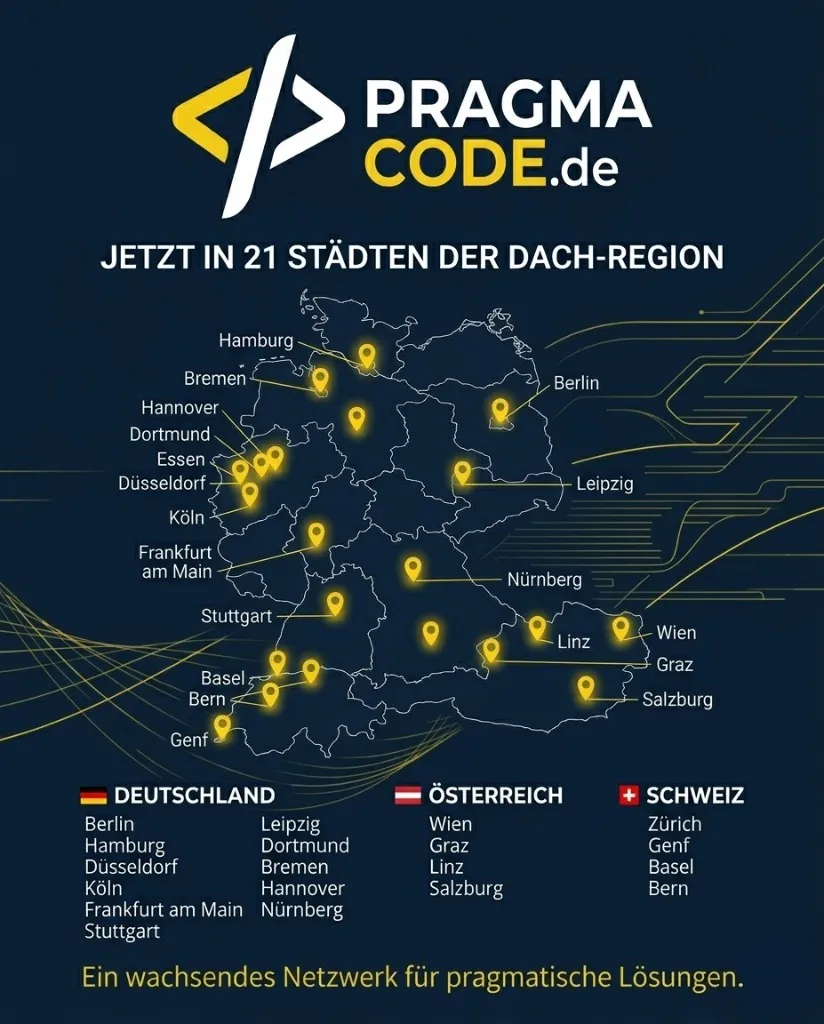
Our Regional Expertise
We are your digital partner – regionally anchored and successfully scaling across borders.
Have a vision?
Let's check together how we can make your idea take flight.
Book your free strategy call nowExtended Specialized Glossary
BMD NTCS
The modular enterprise business software by BMD Systemhaus GesmbH covering financial accounting, payroll, ERP, and tax practice administration.
BMD DataService
The highly configurable interface platform by BMD Systemhaus for automated bidirectional batch and web service exchange of ledger records and vouchers.
ebInterface
The official Austrian XML standard for structured electronic invoicing in B2B and B2G transactions.