

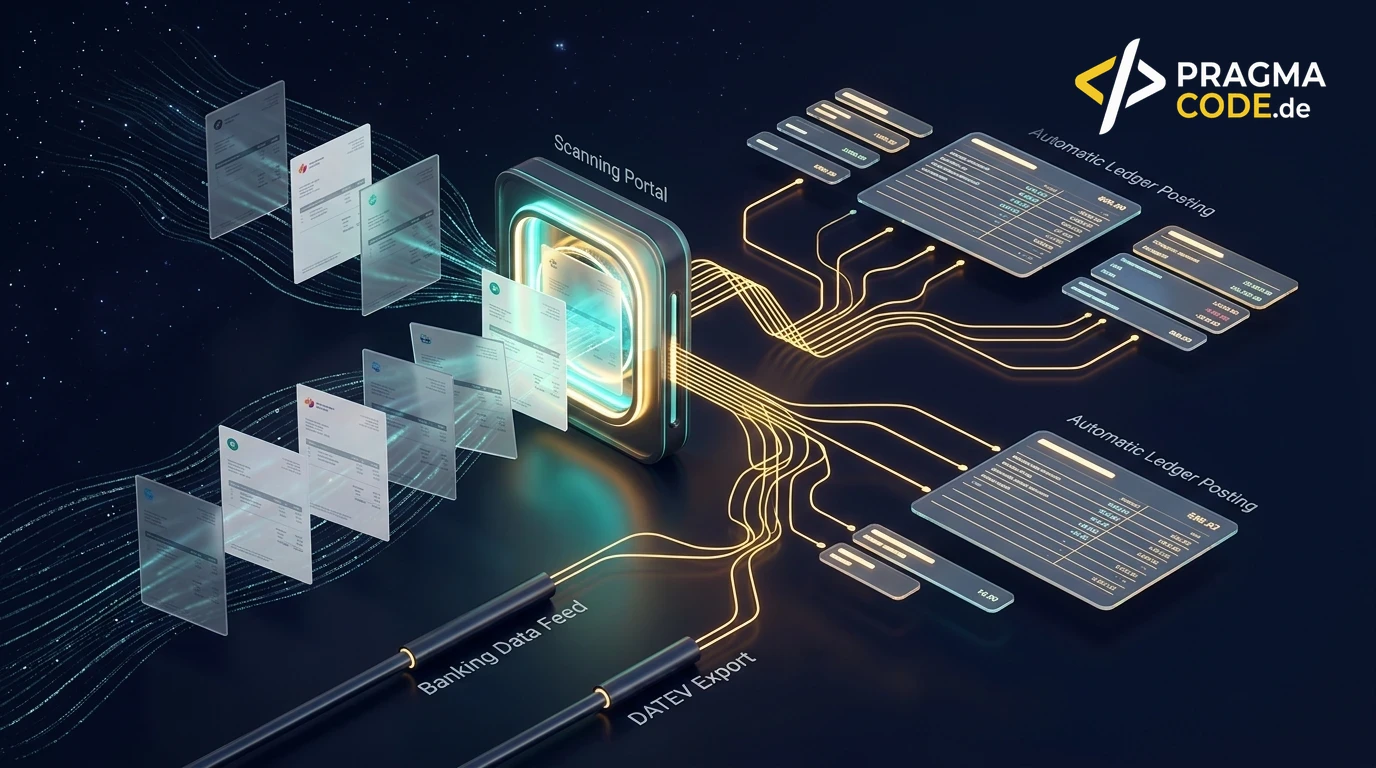
While legacy accounting software forces staff to manually enter booking records and configure rigid rule matrices, BuchhaltungsButler achieves an automated pre-accounting quote of over 90% via self-learning algorithms. How does AI-driven document assignment work in practice, and how can growing businesses seamlessly integrate the platform via REST APIs?
This article is an in-depth expert contribution from our content cluster. Discover the complete overview on our main page: AI & Workflow Automation →
- Self-Learning Pre-Accounting: Through adaptive machine learning, the system achieves an automated classification rate exceeding 90% for recurring vendors and transaction streams.
- Automated 3-Way Bank Reconciliation: Live feeds from checking accounts, credit cards, PayPal, Stripe, and Amazon Pay match against open payables and invoices in real time.
- Developer-Friendly REST API: Clean JSON endpoints empower technical teams to upload receipts, query transaction states, and synchronize financial master data within n8n workflows or custom ERPs.
- The Challenge: Manual Pre-Accounting Bottlenecks
- The AI Architecture: How BuchhaltungsButler Understands Invoices
- Automated Bank Reconciliation & Payment Gateways
- E-Invoicing Mandates & The DATEV Ecosystem
- REST API in Practice: Syncing Receipts & Transactions
- Hands-On n8n Workflow for Automated Invoice Delivery
- Market Comparison: BuchhaltungsButler vs. DATEV, sevDesk & Lexware
- Strategic Verdict & Implementation Roadmap for Growing Businesses
The Challenge: Manual Pre-Accounting Bottlenecks
For mid-sized companies, high-volume e-commerce retailers, and growing digital agencies, the month-end closing routine frequently turns into an exhausting ordeal: dozens of invoices must be retrieved from disparate customer portals, inbox threads, and cloud drives. Accounting personnel and executive leadership spend countless hours inspecting line items to determine correct expense accounts according to German charts of accounts (SKR03 or SKR04), applicable input tax brackets, and project cost allocations.
Even inside modern software-as-a-service accounting tools, automation is frequently handcuffed to rigid, deterministic rulesets. If a SaaS provider alters its PDF typography by a few millimeters or a bank statement description truncates vendor metadata, conventional optical character recognition (OCR) setups fail. The invoice is thrown into an exception queue, demanding tedious human troubleshooting.
The Paradigm Shift: Probabilistic AI Over Brittle Coordinate Templates
BuchhaltungsButler takes a fundamentally different engineering path compared to legacy data entry screens: instead of relying on fixed pixel coordinates on a PDF document, the platform's machine learning engine analyzes semantic context. Supplier names, tax identifiers, IBANs, invoice numbers, line items, and tax percentages are extracted dynamically and cross-referenced against historical booking habits across the organization.
The operational payoff is immediate: as organizations feed documents into the system over several billing cycles, the autonomous classification rate steadily climbs. Standard operational expenses such as cloud hosting subscriptions, logistics fees, telecommunications bills, and office essentials are completely pre-classified and paired with bank disbursements without requiring manual human clicks.
The AI Architecture: How BuchhaltungsButler Understands Invoices
The core technological asset behind BuchhaltungsButler is its multi-stage document ingestion and classification pipeline. Whether a supplier invoice is ingested via drag-and-drop, email forwarding, or an automated REST API call, the artifact passes through four highly tuned processing layers:
| Processing Phase | Underlying Technology | System Output |
|---|---|---|
| 1. Multimodal OCR & Normalization | Neural text extraction, LayoutLM visual tokens & deskewing | Normalized textual layer with precise coordinates and bounding boxes |
| 2. Named Entity Recognition (NER) | Contextual transformers specialized in financial documents | Validated metadata (net amounts, tax brackets, invoice dates, payment terms) |
| 3. Historical Pattern Matching | Collaborative filtering on tenant-specific journal entry history | Recommended general ledger accounts (e.g., 4930 office supplies / 6815 IT expenses) |
| 4. Confidence Scoring & Auto-Approval | Heuristic plausibility models and mathematical balance validation | Green status if confidence > 95%; quarantine flag on calculation anomalies |
A particularly impressive engineering capability is the platform's handling of mixed-tax vouchers. When a hotel invoice lists overnight lodging at 7% VAT alongside breakfast amenities at 19% VAT, standard tools break down and require manual ledger line splits. BuchhaltungsButler parses the underlying item descriptions and automatically creates distinct ledger rows mapped to their respective tax codes.
Adaptive Learning: Human-in-the-Loop Feedback Mechanisms
Whenever a financial controller overrides an automated booking suggestion—for example, reallocating a cloud software subscription from generic administrative IT expenses to a capitalized research and development project—the engine absorbs that correction as a tenant-level weight adjustment.
Unlike generalized large language models prone to statistical hallucinations, BuchhaltungsButler's classification algorithm operates under strict accounting constraints:
Debit-Credit Equilibrium
The aggregate sum of debit allocations must mathematically balance credit postings down to the exact cent before booking approval.
Tax Logic Consistency
Automated algorithmic validation between tax ledger codes and invoice percentages safeguards against flawed input tax deduction claims.
IBAN-Vendor Verification
Cross-referencing payment disbursement accounts against verified supplier master records actively protects against billing manipulation and fraud.
Automated Bank Reconciliation & Payment Gateways
Extracting metadata from an invoice is only half the battle—until an invoice is verified against a verified cash outflow, the accounting ledger remains unresolved. BuchhaltungsButler integrates bank accounts through standard PSD2 and FinTS protocols, pulling real-time statement lines several times daily.
FinTS & EBICS Multibank
Direct synchronization with German commercial banks, savings banks, and modern neobanks including Qonto, Finom, Revolut, and N26 without manual CSV exports.
Corporate & Virtual Cards
Comprehensive reconciliation support for American Express, corporate credit cards, and spend management suites like Pleo, Moss, and Spendesk.
E-Commerce Settlement Hub
Autonomous disaggregation of bulk payouts from Stripe, PayPal, Klarna, and Amazon Pay into individual order lines and associated processing fees.
Processing Fee Splits
Disagio and payment transaction fees are automatically posted to monetary transaction expense accounts, ensuring net revenues balance cent for cent.
In high-volume e-commerce and subscription business models, traditional software routinely collapses under payout batching: a payment gateway transfers a net lump sum of €10,000, representing 240 distinct customer orders minus €210 in payment handling deductions. BuchhaltungsButler matches these payout reports with individual orders, allocating fees to monetary processing expense lines automatically.
E-Invoicing Mandates & The DATEV Ecosystem
With Germany and the European Union mandating structured B2B electronic invoices, simple visual PDFs are rapidly becoming obsolete. Enterprises must maintain technical infrastructure capable of ingesting, validating, rendering, and archiving structured XML documents conforming to European standard EN 16931.
Native Support for XRechnung & ZUGFeRD 2.x
BuchhaltungsButler supports both core electronic billing formats out of the box:
- XRechnung (Pure XML Structure): The application parses the underlying XML schema tree, validates Schematron business rules, and renders a clean, human-readable HTML interface. Staff no longer need to inspect raw code tags manually.
- ZUGFeRD 2.2 / Factur-X (Hybrid Container): Machine-readable XML records are extracted straight from the PDF container. Totals, tax registration numbers, and buyer reference IDs are ingested with zero OCR error rates.
GoBD Compliance & Immutable Audit Trails
Every document stored inside BuchhaltungsButler is archived in ISO 27001-certified German server facilities with complete cryptographic version history. If an account code or approval note is adjusted, the unalterable original document remains forensically auditable in accordance with statutory compliance frameworks.
Bridging the Gap to Tax Advisors: DATEV Connect online
A recurring roadblock when implementing modern SaaS accounting tools is resistance from external tax accounting firms. Kanzleien rely extensively on DATEV software suites and frequently reject non-standardized export files. BuchhaltungsButler overcomes this bottleneck through formal technical certification for DATEV Connect online and DATEV Data Services.
At month-end, financial teams export complete DATEV-compliant booking batches complete with pre-assigned chart-of-accounts rules, tax flags, and hyperlinked document image tokens directly into DATEV Unternehmen online. External tax advisors simply verify and post the batches, slashing unbillable correspondence over missing receipts to virtually zero.
REST API in Practice: Syncing Receipts & Transactions
For engineering-driven startups, digital platforms, and automation agencies, BuchhaltungsButler functions not merely as a browser UI, but as a fully programmatic financial hub. Through its clean RESTful API, developers can upload vouchers, poll account balances, and trigger automated reconciliation routines.
API Architecture & Authentication
The API utilizes standard Bearer tokens passed via HTTP authorization headers. All requests and responses communicate using structured JSON over encrypted TLS 1.3 connections.
Sample cURL request to dispatch an incoming invoice to the platform:
curl -X POST https://api.buchhaltungsbutler.de/v1/documents \
  -H "Authorization: Bearer sec_live_99a8b7c6d5e4f3a2b1" \
  -H "Content-Type: multipart/form-data" \
  -F "file=@/invoices/2026/AWS-Cloud-Hosting-INV-9821.pdf" \
  -F "document_type=incoming_invoice" \
  -F "payment_status=paid" \
  -F "currency=EUR" \
  -F "note=Monthly infrastructure expense Frankfurt region"
The API immediately responds with a unique document identifier and the initialization state:
{
  "id": "doc_9841284a-7182-4f32",
  "filename": "AWS-Cloud-Hosting-INV-9821.pdf",
  "status": "processing",
  "ocr_status": "queued",
  "created_at": "2026-10-13T10:15:30Z",
  "auto_matching": true,
  "confidence_score": null
}
Event-Driven Integration with Webhooks
Rather than maintaining inefficient API polling scripts, engineering teams configure BuchhaltungsButler webhooks that trigger instantaneously upon key lifecycle events:
document.matched: Emitted as soon as an invoice is successfully linked to a corresponding bank ledger transaction.document.needs_review: Alerts administrators when a receipt falls below confidence thresholds or exhibits balance discrepancies.transaction.created: Pushes incoming financial disbursements directly into internal ERP or data warehouse systems.
Hands-On n8n Workflow for Automated Invoice Delivery
Pairing BuchhaltungsButler with self-hosted workflow automation engines like n8n provides organizations with a robust, end-to-end receipt pipeline: incoming billing PDFs sent to inboxes, supplier portal scrapers, or chat tools are ingested, verified, and uploaded automatically.
The core workflow pipeline operates across four logical tiers:
-
1. Multi-Channel Document Trigger
New incoming billing document received in
invoices@company.comor instant webhook notification from Stripe or Shopify starts the workflow. -
2. Format Validation & Security Check
Automated verification of PDF/ZUGFeRD payload integrity alongside antivirus checks inside isolated sandboxed containers.
-
3. REST API Dispatch & Tagging
Multipart payload upload directed to BuchhaltungsButler with pre-populated cost centers, project codes, and metadata.
-
4. Channel Notification & Verification
Real-time Slack or Microsoft Teams operational update featuring a deep-link directly to the voucher for accounting approval.
A tested n8n production JSON workflow blueprint for autonomous document dispatch:
{
  "name": "BuchhaltungsButler Invoice Dispatcher",
  "nodes": [
    {
      "parameters": {
        "pollTimes": {
          "item": [
            {
              "mode": "everyMinute"
            }
          ]
        },
        "mailbox": "INBOX",
        "format": "resolved"
      },
      "name": "IMAP Email Trigger",
      "type": "n8n-nodes-base.emailReadImap",
      "typeVersion": 2,
      "position": [240, 300]
    },
    {
      "parameters": {
        "conditions": {
          "string": [
            {
              "value1": "={{ $json.attachmentExtension }}",
              "value2": "pdf"
            }
          ]
        }
      },
      "name": "Filter Only PDF",
      "type": "n8n-nodes-base.if",
      "typeVersion": 1,
      "position": [460, 300]
    },
    {
      "parameters": {
        "requestMethod": "POST",
        "url": "https://api.buchhaltungsbutler.de/v1/documents",
        "options": {},
        "bodyParametersUi": {
          "parameter": [
            {
              "name": "document_type",
              "value": "incoming_invoice"
            }
          ]
        },
        "headerParametersUi": {
          "parameter": [
            {
              "name": "Authorization",
              "value": "Bearer sec_live_99a8b7c6d5e4f3a2b1"
            }
          ]
        },
        "sendBinaryData": true,
        "binaryPropertyName": "data"
      },
      "name": "Upload to BuchhaltungsButler",
      "type": "n8n-nodes-base.httpRequest",
      "typeVersion": 4.1,
      "position": [680, 300]
    }
  ],
  "connections": {
    "IMAP Email Trigger": {
      "main": [
        [
          {
            "node": "Filter Only PDF",
            "type": "main",
            "index": 0
          }
        ]
      ]
    },
    "Filter Only PDF": {
      "main": [
        [
          {
            "node": "Upload to BuchhaltungsButler",
            "type": "main",
            "index": 0
          }
        ]
      ]
    }
  }
}
Market Comparison: BuchhaltungsButler vs. DATEV, sevDesk & Lexware
Which types of organizations benefit most from BuchhaltungsButler? The matrix below outlines how the platform compares against established legacy and micro-business competitors:
| Evaluation Metric | BuchhaltungsButler | DATEV Unternehmen online | sevDesk / Lexware Office |
|---|---|---|---|
| Target Audience | Growing SMBs, e-commerce, digital agencies (10–100 FTEs) | Tax accounting firms & traditional enterprise mittelstand | Freelancers, solopreneurs & small trade shops |
| Pre-Accounting Ratio | Extremely high (> 90%) via self-learning AI | Low to moderate (heavily rule-based) | Moderate (OCR with manual approval clicks) |
| Bank & Payment Reconciliation | Superb (PSD2, FinTS, Stripe, PayPal, Amazon Pay fee disaggregation) | Robust (FinTS/EBICS, batch settlements often manual) | Standard (Checking accounts & basic PayPal feeds) |
| API Flexibility | Modern REST API & event webhooks for developers | Proprietary (DATEV Connect, high barrier to entry) | Open REST APIs, strong Zapier/Make modules |
| E-Invoicing (EN 16931) | Fully native (XRechnung & ZUGFeRD 2.x) | Fully native | Fully native |
| Advisor Collaboration | Seamless via DATEV Connect online data services | Native (the standard firm platform) | Exportable as DATEV files through accountant portal |
Strategic Verdict & Implementation Roadmap for Growing Businesses
BuchhaltungsButler represents a compelling sweet spot for growing organizations that have outgrown the lightweight limitations of solopreneur invoicing tools, yet refuse to shoulder the immense budgetary and procedural weight of complex enterprise ERP finance suites.
Its combination of accurate AI-driven document assignment, automated unbundling of high-volume payment processing feeds, and frictionless handoff to tax practitioners via DATEV Connect online permanently removes the friction of month-end closing cycles.
Quick-Check: 4-Step Roadmap to Autonomous Bookkeeping
Are you planning to automate your financial accounting workflows, ensure full compliance with mandatory B2B e-invoicing standards, or build custom API bridges between your ecommerce platforms and BuchhaltungsButler? The engineering team at Pragma Code designs, builds, and maintains resilient, GoBD-compliant automation pipelines tailored to your operations.
Ready to Automate Your Financial Accounting?
Let's evaluate how much time and operational expense your team can reclaim through intelligent accounting workflows, custom API integrations, and self-learning pre-accounting.
Schedule a Free Strategy ConsultationOur Regional Expertise
We are your digital partner – regionally anchored and successfully scaling across borders.
Have a vision?
Let's check together how we can make your idea take flight.
Book your free strategy call nowExtended Specialized Glossary
BuchhaltungsButler
A cloud-based German accounting platform designed for SMBs, e-commerce brands, and tax advisors, centered on self-learning AI pre-accounting, automated bank reconciliation, and open APIs.
Pre-Accounting
The preliminary accounting step where invoices and receipts are mapped to specific general ledger accounts, cost centers, and VAT codes prior to final ledger posting.
DATEV
Germany's primary software cooperative for tax consultants and auditors, providing standard charts of accounts such as SKR03 and SKR04 alongside secure data exchange protocols.