


Despite full order books and profitable P&L reports, growing companies frequently stumble not from a lack of margin, but from sudden cash crunches. Why manual spreadsheets have become an operational liability in 2026 and how Commitly provides predictive stability via real-time banking, scenario modeling, and developer APIs is explored in this guide.
This article is an in-depth expert contribution from our content cluster. Discover the complete overview on our main page: AI & Workflow Automation →
- Real-Time Financial Clarity: Automated multibank feeds via PSD2 & EBICS consolidate real-time commercial balances across multiple financial institutions.
- Rolling 13-Week & 12-Month Projections: Blends historical statement patterns with live accounts receivable and accounts payable synchronized from DATEV, sevDesk, or Lexware.
- Predictive Scenario Stress-Testing: Instant modeling of Best-Case, Base-Case, and Worst-Case cash trajectories for Capex evaluations and statutory German StaRUG early-warning compliance.
- The Blind Flight Paradox: Why Spreadsheets Risk Corporate Solvency
- System Architecture: Banking Feeds, Open Items & Recurring Baselines
- The Rolling 13-Week Forecast & German StaRUG Compliance
- Early-Warning KPIs: Quick Ratio, Burn Rate & Runway Monitoring
- Scenario Planning: Stress-Testing Capital Expenditures & Down turns
- ERP & Accounting Connectors: DATEV, sevDesk & Beyond
- Direct vs. Indirect Cash Flow Methodology (DRS 21 Standards)
- Multi-Currency Treasury Management & Exchange Rate Hedging
- The Commitly REST API: Automating Liquidity Data Streams
- Hands-On n8n Workflow for Automated Cash Flow Early Warning
- Market Comparison: Commitly vs. Agicap, Excel & Enterprise ERPs
- Strategic Verdict & Implementation Roadmap for Resilient Enterprises
The Blind Flight Paradox: Why Spreadsheets Risk Corporate Solvency
Executive leadership across growing mid-market enterprises (KMU) and venture-backed scale-ups routinely experiences a perplexing fiscal disconnect: the accounting department confirms robust accounting profits for the preceding quarter, yet the primary commercial bank accounts sit uncomfortably near zero. Payroll dates, supplier liabilities, and quarterly corporate tax prepayments arrive concurrently, while major enterprise clients unilaterally stretch contract payment terms by an extra 30 days.
The operational reality of financial planning in over 70 percent of mid-sized organizations continues to depend on static spreadsheet files in Microsoft Excel or Google Sheets. This approach introduces existential operational hazards:
- Stale Data Foundations: Financial workbooks are typically updated only once weekly or monthly by an overloaded controller. Intraday account movements remain invisible.
- Severe Vulnerability to Human Error: A single formula reference error or unintentionally deleted row can distort projected liquidity balances by hundreds of thousands of euros.
- Absence of Dynamic Scenario Modeling: Answering critical questions like "Can we afford to onboard two senior engineers next month if Client X delays payment until November?" requires hours of manual formula rebuilding.
Accounting Profit Is an Opinion – Cash Flow Is a Fact
A standard income statement illustrates revenues on an accrual basis. It provides zero visibility into whether sufficient cleared cash will reside in the treasury account next Tuesday to settle statutory payroll taxes. Corporate insolvencies in the mid-market stem almost exclusively from acute illiquidity, not accounting unprofitability.
Commitly transforms this dynamic: the application replaces static spreadsheet workbooks with an event-driven cloud treasury command center that merges historical cleared transactions with future commitments in real time.
System Architecture: Banking Feeds, Open Items & Recurring Baselines
The core engineering strength of Commitly is its continuous synchronization across three complementary data pillars:
PSD2 & EBICS Bank Feeds
Autonomous daily collection of cleared balances and transaction lines from commercial banks and payment providers (Deutsche Bank, Sparkassen, N26, Stripe, PayPal).
Open Ledger Invoices
Continuous synchronization of outstanding client invoices (accounts receivable) and unpaid vendor bills (accounts payable) alongside due dates.
Recurring Operational Costs
Automated forward scheduling of fixed commitments (rent, payroll, equipment leases, insurance, debt amortization) with custom payment cycles.
AI Cash Flow Engine
Adaptive categorization of statement lines into standard financial cash flow buckets (operating, investing, and financing cash flows).
When an enterprise client clears an outstanding invoice, Commitly matches the cleared wire transfer against the open accounts receivable line and updates the forward forecast immediately, eliminating manual reconciliation checklists.
The Rolling 13-Week Forecast & German StaRUG Compliance
In corporate treasury management, the rolling 13-week cash flow model represents the global benchmark for operational liquidity control. Covering exactly one calendar quarter, it captures the operational horizon across which cash movements can be forecasted and controlled with high mathematical reliability.
| Planning Horizon | Core Operational Purpose | Predictive Confidence & Data Inputs |
|---|---|---|
| Immediate (1–14 Days) | Cash discount optimization & payment release queues | 98% accuracy (cleared statement balances & verified due bills) |
| Quarterly (13 Weeks) | Tax prepayments, quarterly payroll, bonus cycles | 90% accuracy (pipeline contracts, recurring baselines & terms) |
| Annual (12 Months) | Budgeting, runway assessment, capital expenditures (Capex) | Strategic trajectory modeling based on seasonal cycles |
Statutory Early-Warning Mandates: German StaRUG Compliance
Under the German Corporate Stabilization and Restructuring Framework Act (StaRUG), company directors bear statutory liability for maintaining a continuous crisis early-warning mechanism (§ 1 StaRUG).
Managing directors who fail to project and document impending insolvency risks across a rolling 12- to 24-month horizon risk personal liability with private assets. Commitly fulfills these legal compliance standards out of the box, producing verifiable, audit-proof cash flow documentation for supervisory boards and credit institutions.
Early-Warning KPIs: Quick Ratio, Burn Rate & Runway Monitoring
Commitly continuously tracks the vital solvency ratios prioritized by commercial lenders and private equity investors:
- Cash Ratio (Liquidity 1st Degree): Ratio of immediately available cleared funds to short-term liabilities. Projected shortfalls trigger automated warnings.
- Quick Ratio (Liquidity 2nd Degree): Cleared cash plus short-term accounts receivable divided by short-term liabilities. Readings below 100% indicate an urgent need for liquidity intervention.
- Monthly Net Burn Rate & Runway: For technology startups and fast-scaling organizations, the engine calculates the exact number of months remaining at current net operating outflow rates.
Scenario Planning: Stress-Testing Capital Expenditures & Downturns
Strategic business decisions require calculated risk-taking—but that risk must be mathematically modeled. Commitly's scenario module enables financial controllers to evaluate multiple hypothetical futures simultaneously:
Scenario A: Worst Case
Key enterprise account delays payment by 60 days; quarterly retail revenue drops by 25%. Question: Exactly when is the bank credit line breached?
Scenario B: Capex & Growth
Onboard three senior engineers next month; purchase €100,000 in specialized machinery. Question: How low does the minimum cash buffer drop?
Scenario C: Price Adjustment
Implement an 8% price increase against a 12% rise in energy and supplier costs. Question: What is the net impact on 12-month operational cash flow?
Alternative scenarios can be mapped alongside the operational baseline and evaluated on a unified dashboard, revealing the exact "point of insolvency" well in advance to negotiate factoring lines or adjust capital timing.
ERP & Accounting Connectors: DATEV, sevDesk & Beyond
Rather than operating as a disconnected silo, Commitly connects directly with established accounting infrastructures:
- DATEV Data Services: Direct synchronization of journal batches, open receivables/payables (OPOS lists), and trial balances straight from the accountant environment.
- sevDesk & Lexware Office: Automated ingestion of outgoing customer invoices and incoming supplier bills via REST API.
- BuchhaltungsButler: Real-time import of AI-categorized vouchers and verified bank reconciliations.
- Shopify & Stripe: Direct ingestion of e-commerce checkout queues to project payout batches.
Direct vs. Indirect Cash Flow Methodology (DRS 21 Standards)
While statutory annual financial statements calculate cash flows indirectly from net profit by reversing non-cash expenses like depreciation, Commitly operates primarily on the direct method:
Gross client cash inflows and gross supplier, payroll, and tax cash outflows are contrasted directly. This provides controllers with day-to-day operational control. For bank reviews and investor presentations, figures can be converted into standard cash flow statements conforming to German Accounting Standard No. 21 (DRS 21 / GAS 21) with a single click.
Multi-Currency Treasury Management & Exchange Rate Hedging
For internationally active companies billing clients in US dollars or sourcing components in foreign currencies (USD, GBP, CHF), managing multiple currencies inside manual spreadsheets is fraught with currency exposure risks.
Commitly consolidates foreign accounts using real-time European Central Bank (ECB) benchmark exchange rates into a unified reporting currency. Concurrently, treasury managers can isolate specific currency pools to identify foreign exchange (FX) exposure and structure forward hedging contracts effectively.
The Commitly REST API: Automating Liquidity Data Streams
For tech-driven scale-ups, systems integrators, and software teams, Commitly provides a RESTful API enabling programmatic queries of cash trajectories, automated injection of custom forecast lines, and event monitoring.
API Architecture & Sample Query
Authentication relies on standard Bearer tokens passed via HTTP request headers.
Sample cURL request to retrieve the current 13-week liquidity trajectory:
curl -X GET "https://api.commitly.com/v1/companies/comp_49102/forecast?weeks=13" \
  -H "Authorization: Bearer sec_tok_9918273645abcdef" \
  -H "Accept: application/json"
Commitly responds with weekly cash flow breakdowns detailing opening funds, projected inflows, projected outflows, and ending balances:
{
  "company_id": "comp_49102",
  "currency": "EUR",
  "forecast_start": "2026-10-13",
  "weeks": [
    {
      "week_number": 42,
      "opening_balance": 142500.00,
      "projected_inflows": 38400.00,
      "projected_outflows": 29100.00,
      "net_cash_flow": 9300.00,
      "closing_balance": 151800.00,
      "minimum_reserve_breached": false
    },
    {
      "week_number": 43,
      "opening_balance": 151800.00,
      "projected_inflows": 12000.00,
      "projected_outflows": 45000.00,
      "net_cash_flow": -33000.00,
      "closing_balance": 118800.00,
      "minimum_reserve_breached": false
    }
  ]
}
Hands-On n8n Workflow for Automated Cash Flow Early Warning
Integrating Commitly with open-source workflow automation engines like n8n allows engineering teams to deploy an autonomous liquidity watchdog: if projected cash reserves drop below a critical threshold (e.g., two months of operating payroll), the workflow immediately notifies executive leadership via Slack or Telegram.
A tested n8n production JSON workflow blueprint for autonomous cash flow alerts:
{
  "name": "Commitly Cashflow Alert Monitor",
  "nodes": [
    {
      "parameters": {
        "rule": {
          "interval": [
            {
              "field": "days",
              "triggerAtHour": 7
            }
          ]
        }
      },
      "name": "Daily Morning Trigger",
      "type": "n8n-nodes-base.scheduleTrigger",
      "typeVersion": 1.1,
      "position": [240, 300]
    },
    {
      "parameters": {
        "method": "GET",
        "url": "https://api.commitly.com/v1/companies/comp_49102/forecast?weeks=4",
        "sendHeaders": true,
        "headerParameters": {
          "parameters": [
            {
              "name": "Authorization",
              "value": "Bearer sec_tok_9918273645abcdef"
            }
          ]
        }
      },
      "name": "Fetch Commitly Forecast",
      "type": "n8n-nodes-base.httpRequest",
      "typeVersion": 4.1,
      "position": [460, 300]
    },
    {
      "parameters": {
        "conditions": {
          "number": [
            {
              "value1": "={{ $json.weeks[0].closing_balance }}",
              "operation": "smaller",
              "value2": 50000
            }
          ]
        }
      },
      "name": "Check Min Threshold 50k",
      "type": "n8n-nodes-base.if",
      "typeVersion": 1,
      "position": [680, 300]
    }
  ],
  "connections": {
    "Daily Morning Trigger": {
      "main": [
        [
          {
            "node": "Fetch Commitly Forecast",
            "type": "main",
            "index": 0
          }
        ]
      ]
    },
    "Fetch Commitly Forecast": {
      "main": [
        [
          {
            "node": "Check Min Threshold 50k",
            "type": "main",
            "index": 0
          }
        ]
      ]
    }
  }
}
Market Comparison: Commitly vs. Agicap, Excel & Enterprise ERPs
How does Commitly compare with other corporate treasury platforms and spreadsheets? The matrix below outlines how it fits into the mid-market landscape:
| Evaluation Metric | Commitly | Agicap | Excel / Google Sheets |
|---|---|---|---|
| Target Audience | Growing SMBs, agencies & startups (5–100 FTEs) | Mid-market enterprises & conglomerates | Solopreneurs & micro-businesses |
| Live Banking Sync | Fully Automated (PSD2 & EBICS) | Fully Automated (PSD2 & EBICS) | Manual CSV imports required |
| Scenario Modeling | Intuitive, flexible & collaborative | Extensive (complex configuration) | Labor-intensive & prone to breakage |
| Deployment Time | Under 30 minutes (Self-service) | Several weeks (Consultant-led) | Continuous ongoing manual maintenance |
| Pricing Tier | Transparent approx. €50–150 / month | Custom quote approx. €300–800+ / month | Software license (high hidden labor costs) |
| API & Webhooks | Modern RESTful API for developers | Enterprise API available | No native real-time APIs |
Strategic Verdict & Implementation Roadmap for Resilient Enterprises
Managing corporate liquidity in 2026 should not be an arduous weekend task involving out-of-date spreadsheets. With Commitly, executive leaders, founders, and finance directors gain a forward-looking navigation tool that offers unambiguous visibility into upcoming cash positions.
The synthesis of automated open-banking feeds, direct accounting integration, and agile scenario modeling shields businesses against unexpected liquidity crunches, strengthens credibility with banking partners, and provides the baseline security needed to invest with confidence.
Quick-Check: 4 Steps for Automated Liquidity Management
Seeking to automate your corporate financial data pipelines, integrate custom liquidity dashboards, or ingest invoice data from systems like Debitoor & SumUp Invoices or Sorted into bespoke API workflows with Commitly? The software engineers and integration specialists at Pragma Code architect, build, and support high-performance automation solutions that connect your financial systems seamlessly.
Ready to Transform Your Cash Flow Management?
Let's evaluate how modern treasury APIs, automated data pipelines, and intelligent cloud software can protect and scale your corporate liquidity.
Schedule a Free Strategy ConsultationOur Regional Expertise
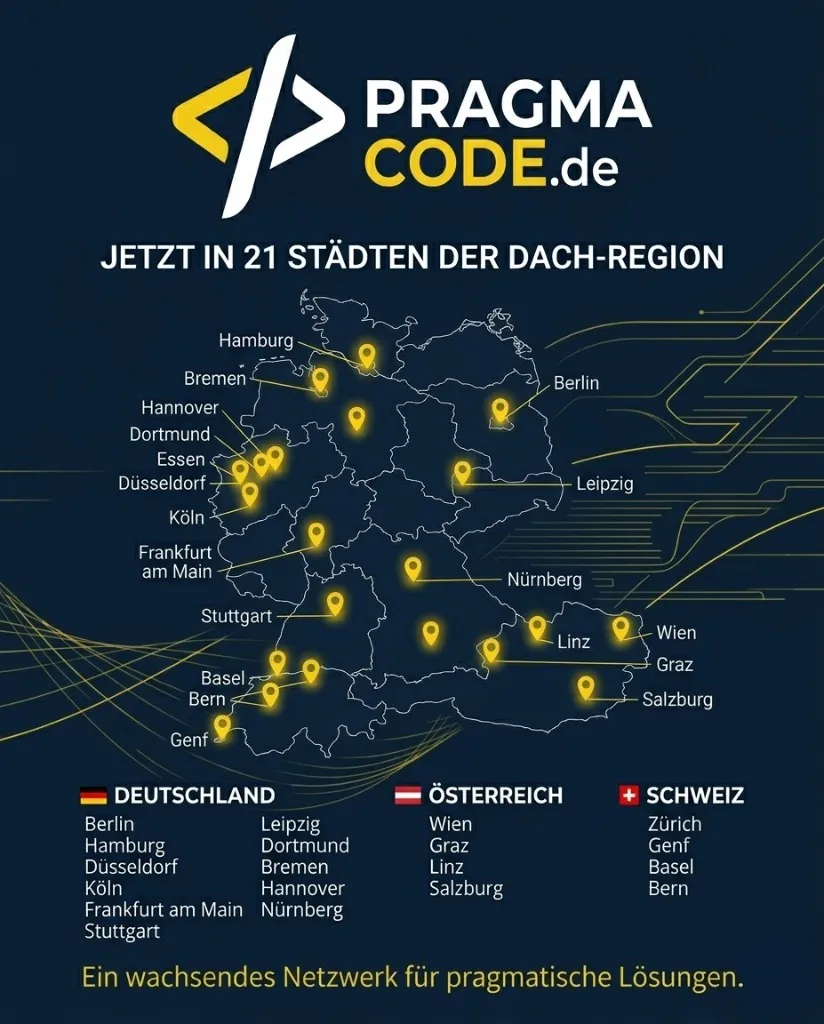
We are your digital partner – regionally anchored and successfully scaling across borders.
Have a vision?
Let's check together how we can make your idea take flight.
Book your free strategy call nowExtended Specialized Glossary
Commitly
A cloud-based corporate treasury and liquidity planning software designed for SMBs and startups, featuring multibank connectivity, predictive cash flow forecasting, and open APIs.
Liquidity Planning
The forward-looking operational projection and control of incoming and outgoing cash transactions to safeguard corporate solvency at all times.
DATEV
Germany's primary software cooperative for tax consultants and auditors, providing standard charts of accounts such as SKR03 and SKR04 alongside secure data exchange protocols.