

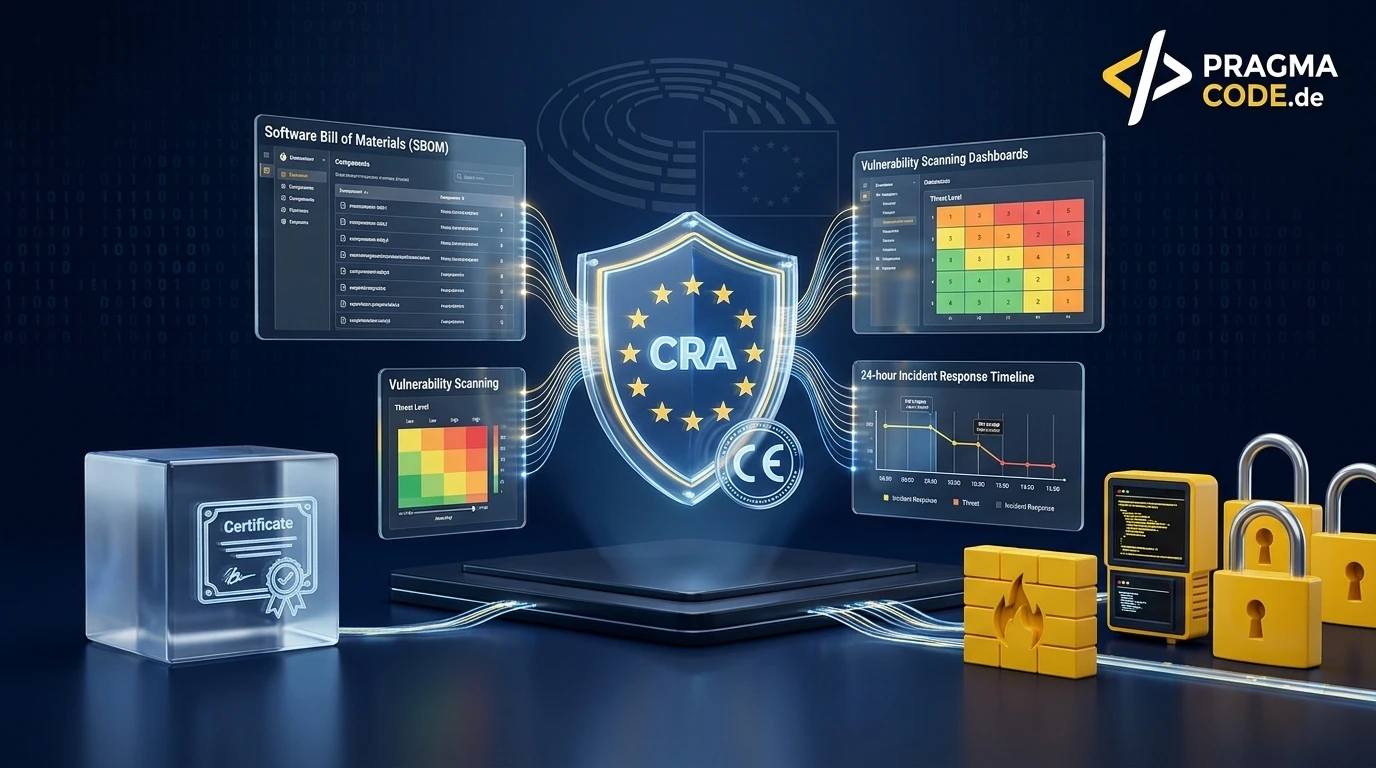
With the Cyber Resilience Act (Regulation (EU) 2024/2847), the European Union establishes a fundamental paradigm shift for all products with digital elements: for the first time, software vendors, hardware manufacturers, and developers of connected B2B systems are held directly liable for baseline cybersecurity throughout the entire product lifecycle. Anyone distributing commercial software, SaaS connectors, IoT systems, or mobile apps in the European Single Market must implement machine-readable Software Bills of Materials (SBOMs), automated vulnerability scanning, and strict 24-hour reporting obligations to national authorities and ENISA — culminating in the mandatory CE mark. This guide provides IT executives, CTOs, and engineering leads with a battle-tested roadmap for achieving compliance before deadlines expire.
This article is an in-depth expert contribution from our content cluster. Discover the complete overview on our main page: IT Security →
- Product Liability & CE Marking: Commercial software vendors are now directly accountable for baseline cybersecurity throughout the product lifecycle (minimum 5 years) and must legally affix the CE mark.
- Automated Machine-Readable SBOMs: Every production release requires an immutable Software Bill of Materials (CycloneDX or SPDX) integrated into CI/CD to track all open-source dependencies and CVEs.
- 24-Hour Early Warning Mandate: Actively exploited vulnerabilities must be formally reported to national CSIRTs and ENISA within 24 hours of discovery, backed by severe non-compliance fines of up to €15 million.
European digital regulation has accelerated dramatically in recent years. While the GDPR governs personal data privacy, the EU AI Act sets guardrails for artificial intelligence, and the NIS2 Directive mandates operational resilience for essential and important entities, the Cyber Resilience Act (CRA, Regulation (EU) 2024/2847) closes the most glaring loophole of all: the baseline security and liability standards of the software and hardware products themselves.
Historically, software developers and hardware vendors operated largely under the philosophy of “ship first, patch later.” Contractual disclaimers and End User License Agreements (EULAs) insulated vendors from financial consequences when third-party libraries or unpatched vulnerabilities caused systemic outages. Under the CRA, this era is permanently over: anyone placing products with digital elements on the EU market must prove that the product is secure by design, delivered free of known vulnerabilities, and continuously supported with complimentary security patches throughout its expected lifespan.
For mid-sized European companies — from specialized machine tool builders offering connected edge controllers to B2B SaaS platforms and custom web development agencies — the CRA requires a complete overhaul of the Software Development Life Cycle (SDLC).
CRA at a Glance: Key Milestones and Timelines
- Legislative Status: Regulation (EU) 2024/2847, officially published in the EU Official Journal on November 20, 2024, entered into force on December 10, 2024.
- Scope: All directly or indirectly connected hardware and software products (Products with Digital Elements) made available in the EU Single Market.
- Mandatory Reporting: Takes effect on June 11, 2026 (strict 24-hour notification window for actively exploited vulnerabilities to national CSIRTs and ENISA).
- Full Product Requirements & CE Marking: Mandatory from December 11, 2027.
- Penalties: Administrative fines up to €15,000,000 or 2.5% of total worldwide annual turnover, product recalls, and sales bans.
1. Scope: Which Businesses Fall Under the Cyber Resilience Act?
The CRA’s scope is intentionally horizontal and technology-agnostic. Article 2 applies to all “Products with Digital Elements” (PDE) whose intended or reasonably foreseeable use includes a direct or indirect logical or physical data connection to a device or network.
Pure Software Products
Operating systems, desktop applications, enterprise B2B suites, mobile apps, middleware, ERP connectors, databases, and commercial on-premise SaaS distributions.
Connected Hardware (IoT & OT)
Smart industrial sensors, programmable logic controllers (PLCs), edge compute gateways, robotics, network routers, IP cameras, and connected medical devices.
Software Components & Libraries
Commercially distributed SDKs, payment modules, developer frameworks, and integration modules intended for integration into third-party downstream products.
Open Source Exemption & Boundaries
Purely non-commercial open-source software developed outside a business activity is exempt. However, the moment open source is monetized, commercialized, or incorporated into a commercial release, the manufacturer assumes full liability.
Risk Classification: Default, Important, and Critical Products
The CRA categorizes digital products into four security tiers, which dictate the conformity assessment procedure:
Standard B2B & Consumer Software
- Standard B2B web applications, CMS platforms & ERP connectors
- Photo editing suites, mobile office apps & internal dashboards
- No core network or system-level cybersecurity role
Important Security Products
- Identity and Access Management (IAM) & password managers
- Antivirus and endpoint detection/response (EDR) software
- VPN routers, network interfaces & physical controllers
Critical System Infrastructure
- Firewalls, intrusion detection & prevention systems (IDS/IPS)
- Hypervisors, container runtime engines & OS kernels
- Smart meter gateways & industrial PLC automation controls
Maximum Cybersecurity Risk
- Hardware Security Modules (HSM) & smart cards
- Biometric readers & tamper-resistant cryptographic tokens
- Mission-critical security appliances for core utilities and grids
Statutory CRA Sanction Framework and Financial Liabilities
Non-compliance with the Cyber Resilience Act triggers rigorous statutory penalties enforced by European national market surveillance authorities:
Critical Essential Non-Compliance (Art. 13/14)
Failure to meet essential cybersecurity requirements, incorrect conformity evaluations, or distributing products without verified CE marking:
up to €15,000,000or up to 2.5% of the total worldwide annual turnover of the preceding financial year, whichever is higher.
Breach of Incident Reporting Mandates (Art. 14)
Failure or delay in delivering the mandatory 24-hour early warning notification for actively exploited vulnerabilities to CSIRTs and ENISA:
up to €10,000,000or up to 2.0% of the total worldwide annual turnover.
2. The 6 Core Obligations for Software Vendors and Developers
To legally affix the CE mark and distribute software in the European Union, manufacturers must implement six foundational requirements:
Security by Design & by Default
Security must be architected from day one. Products must ship with secure baseline configurations (no default credentials, unnecessary ports closed, strict transport encryption, and secure memory management).
Machine-Readable Software Bill of Materials (SBOM)
Every product release must include an immutable, machine-readable inventory of all third-party dependencies, open-source libraries, and version histories.
Continuous Vulnerability Management
Vendors are legally required to monitor, triage, and remediate newly discovered Common Vulnerabilities and Exposures (CVEs) across the entire product lifecycle (typically a minimum of 5 years), distributing free security patches without delay.
Mandatory 24-Hour Incident Reporting
Any actively exploited vulnerability or severe security incident must be reported to the national Computer Security Incident Response Team (CSIRT) and ENISA within 24 hours of discovery.
User Transparency & Coordinated Vulnerability Disclosure
Clear documentation detailing security settings, end-of-life support dates, and a public vulnerability reporting channel (via security.txt) for ethical security researchers.
Technical Documentation & CE Marking
Compilation of comprehensive technical files under Annex VII, formal signing of the EU Declaration of Conformity, and affixing the CE mark to the software or accompanying documentation.
3. Software Bill of Materials (SBOM): The Technical Standard
The requirement for an SBOM is the cornerstone of the CRA’s technical mandate. Modern enterprise software builds rely on open-source code for up to 80% of their total volume. Incidents like Log4j and the XZ Utils backdoor exposed how difficult it was for engineering organizations to identify where vulnerable components were embedded across disparate code repositories.
Under the CRA, your Software Bill of Materials must satisfy three non-negotiable architectural mandates:
Published in standardized formats such as CycloneDX (JSON/XML) or SPDX to enable automated ingestion across the B2B supply chain.
Generated dynamically on every pipeline build and release, eliminating outdated static spreadsheets and dependency drift.
Direct programmatic synchronization with the National Vulnerability Database (NVD) and CVE feeds for real-time risk alerts.
Example: Automated SBOM Generation in GitHub Actions
Here is an enterprise-grade CI/CD pipeline snippet generating a compliant CycloneDX SBOM and scanning against the National Vulnerability Database (NVD):
# .github/workflows/cra-sbom-check.yml
name: "CRA Compliance: SBOM & Vulnerability Scan"

on:
  push:
    branches: [ "main", "release/*" ]
  schedule:
    # Daily recurring scan for newly published CVEs in active releases
    - cron: '0 4 * * *'

jobs:
  sbom-and-security-audit:
    runs-on: ubuntu-latest
    steps:
      - name: Checkout Source Code
        uses: actions/checkout@v4

      - name: Setup Node.js Environment
        uses: actions/setup-node@v4
        with:
          node-version: '22'
          cache: 'npm'

      - name: Install Production Dependencies
        run: npm ci --omit=dev

      - name: Generate CycloneDX SBOM (JSON Format)
        run: |
          npx @cyclonedx/cyclonedx-npm --output-file dist/sbom.cdx.json \
            --output-format JSON \
            --spec-version 1.5 \
            --validate

      - name: Scan SBOM against National Vulnerability Database (NVD) via Grype
        uses: anchore/scan-action@v3
        with:
          sbom: "dist/sbom.cdx.json"
          fail-build: true
          severity-cutoff: high
          output-format: sarif

      - name: Archive SBOM Artifact for CRA Technical Documentation
        uses: actions/upload-artifact@v4
        with:
          name: release-sbom-cyclonedx
          path: dist/sbom.cdx.json
          retention-days: 1825 # 5-year legal retention mandate under CRA
Best Practice: The 5-Year Legal Retention Mandate
Under Article 13(8) of the CRA, manufacturers must preserve the complete technical file — including exact build-level SBOMs and vulnerability audit trails — for a minimum of 10 years or throughout the entire defined product support period (at least 5 years post-launch). Regulatory authorities can request digital access at any time during market surveillance audits.
4. The 24-Hour Incident Reporting Framework
The most demanding operational requirement is the accelerated notification window for actively exploited security vulnerabilities. The CRA establishes a multi-stage escalation path:
Initial alert transmitted to the designated national CSIRT and ENISA via the centralized EU reporting platform. The early warning must disclose whether the vulnerability is actively being exploited in the wild and if cross-border impacts are suspected.
In-depth technical briefing: detailed vulnerability description, affected versions, severity scoring (CVSS v3.1/v4.0), and immediate mitigating steps (workarounds or temporary component deprecation).
Comprehensive post-mortem report containing root cause analysis, evidence of the deployed security patch, and verification that downstream B2B customers have been notified with actionable remediation instructions.
5. Synergies and Distinctions: CRA vs. NIS2
Enterprise leaders frequently confuse CRA and NIS2. While both stem from the European Cybersecurity Strategy, they serve complementary purposes:
| Evaluation Criteria | NIS2 Directive (2022/2555) | Cyber Resilience Act (2024/2847) |
|---|---|---|
| Legal Form | EU Directive (transposed into national law by member states) | EU Regulation (directly applicable across all 27 member states) |
| Primary Scope | Entities and Operators (organizational operational resilience) | Product Manufacturers (hardware and software product safety) |
| Objective | Securing corporate infrastructure, business continuity, and supply chains | Ensuring built-in cyber security, automated patchability, and transparency |
| Verification | Audits, risk assessments, Information Security Management Systems (ISO 27001) | Technical documentation, SBOMs, conformity assessment, CE marking |
| Enforcement | Personal executive liability, administrative operational suspensions | Product recalls, market withdrawal, commercial sales bans, revenue fines |
The B2B Supply Chain Multiplier
Even if your company does not qualify as an "essential entity" under NIS2, your enterprise B2B customers almost certainly do. Because NIS2 strictly regulates supply chain security, tier-1 enterprises will mandate CRA compliance, verifiable SBOMs, and rapid patch SLAs as non-negotiable procurement criteria. Failing to meet CRA standards will disqualify vendors from enterprise B2B tenders.
6. Actionable 5-Step CRA Compliance Roadmap for Engineering Teams
To achieve compliance systematically without derailing ongoing product feature roadmaps, engineering organizations should adopt this 5-stage framework:
-
1. Product Inventory and Scoping
Catalog all commercial software products, firmware distributions, client-facing web portals, and mobile apps. Determine each product's classification: Standard Product (self-assessment Module A) or Important Product Class I/II (requiring external notified bodies and accredited third-party auditing).
-
2. Automated SBOM Infrastructure
Integrate automated dependency scanners (CycloneDX, Syft, Trivy) into your CI/CD pipelines. Ensure every release candidate automatically produces and archives an immutable, validated JSON SBOM artifact in compliance storage.
-
3. Vulnerability Scanning and SLA Policies
Implement automated daily scans matching your SBOM against national and vendor CVE databases. Establish binding internal SLAs: critical CVEs (≥ 9.0) must have a verified hotfix deployed within 48 to 72 hours.
-
4. Coordinated Vulnerability Disclosure (security.txt)
Deploy a standardized
/.well-known/security.txtfile on all public web properties with encrypted PGP communication keys, clear reporting guidelines, and a dedicated security contact email for white-hat security researchers. -
5. Technical File & CE Declaration
Assemble the comprehensive technical compliance file per Annex VII: architectural security blueprints, threat models, automated test reports, penetration testing certificates, and the signed EU Declaration of Conformity.
Quick-Check: Your Roadmap to CRA Compliance
7. Conclusion: Transforming Compliance into a Market Advantage
The Cyber Resilience Act introduces rigorous standards, but it reflects modern, professional software engineering practices. Companies that embrace automated CI/CD security scanning, maintain clean dependency trees, and document clear patch lifecycles will discover that CRA compliance is readily achievable.
More importantly, CRA compliance transforms into a powerful commercial differentiator. When enterprise buyers evaluate B2B software vendors, the presence of verified CE marking, transparent SBOMs, and guaranteed 5-year security maintenance will consistently win contracts over opaque competitors.
Primary Sources & Regulatory Documentation
- European Union: Regulation (EU) 2024/2847 of the European Parliament and of the Council of 23 October 2024 on horizontal cybersecurity requirements for products with digital elements (Cyber Resilience Act), Official Journal of the European Union, L Series, 20.11.2024.
- ENISA: Guidelines on Coordinated Vulnerability Disclosure and Supply Chain Cybersecurity Standards, European Union Agency for Cybersecurity, Athens.
- BSI: Technical Guideline BSI TR-03183 — Cyber Resilience Requirements for Software and Hardware Products, Federal Office for Information Security, Germany.
- CycloneDX: OWASP CycloneDX Software Bill of Materials (SBOM) Specification v1.5 / v1.6, OWASP Foundation.
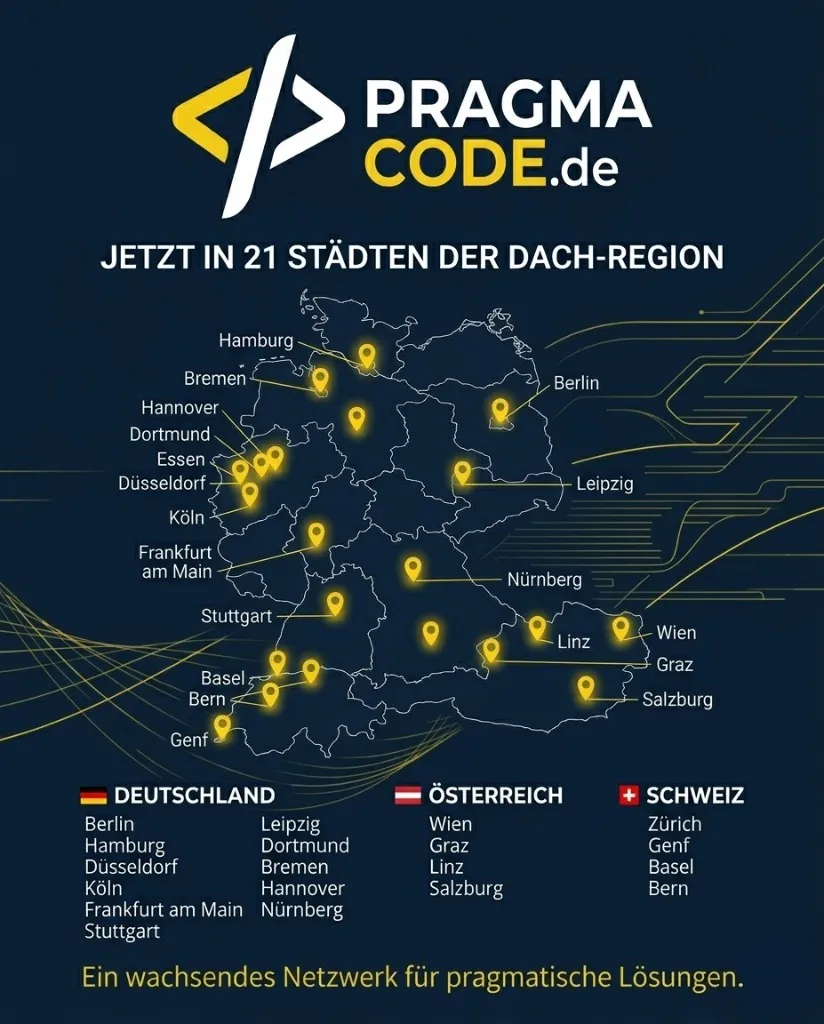
Our Regional Expertise
We are your digital partner – regionally anchored and successfully scaling across borders.
Have a vision?
Let's check together how we can make your idea take flight.
Book your free strategy call nowExtended Specialized Glossary
Software Bill of Materials (SBOM)
A structured, machine-readable inventory of software components detailing all direct and transitive open-source dependencies, licenses, and versions (e.g., in CycloneDX or SPDX format).
Cyber Resilience Act (CRA)
EU Regulation 2024/2847 establishing horizontal cybersecurity requirements for products with digital elements, holding vendors accountable across the lifecycle with mandatory CE marking.
Security by Design
An engineering methodology where security principles such as access control, encryption, least-privilege architectures, and automated testing are built in from day one.
Vulnerability Disclosure Policy
A documented, public process enabling external security researchers to report discovered vulnerabilities responsibly through a secure channel (such as security.txt).