


Trade secrets, engineering schematics, and sensitive financial metrics do not belong on third-party cloud infrastructure. Caught between the EU AI Act, the US CLOUD Act, and surging token fees, mid-sized business leaders in 2026 recognize a vital truth: Long-term enterprise resilience demands technological self-determination. Discover in this strategic architecture blueprint how to harness open-weight language models, on-premise inference clusters, and private infrastructure to secure genuine model sovereignty—free from vendor lock-in, external data transfers, and volatile operating costs.
This article is an in-depth expert contribution from our content cluster. Discover the complete overview on our main page: Services & Consulting →
- Hyperscaler Cluster Risk: Coupling mission-critical enterprise workflows to US hyperscalers exposes valuable trade secrets to the US CLOUD Act, arbitrary pricing shifts, and steep regulatory penalties under the EU AI Act.
- Open-Source Model Parity: Modern open-weight architectures (such as Llama 4, Mistral NeMo, and Qwen 2.5) deliver identical precision on specialized B2B workloads compared to closed APIs—while keeping enterprise data 100% internal.
- TCO Amortization in 9.4 Months: Dedicated local inference clusters replace volatile per-token monthly invoices with predictable capital hardware assets and deliver deterministic sub-second network latencies.
- 5-Stage Implementation Blueprint: From data classification audits and air-gapped DMZ network zoning to bi-directional legacy ERP and CRM integration via REST and the Model Context Protocol (MCP).
While global cloud monopolies package artificial intelligence as black-box subscription software, forward-thinking industrial champions and mid-market leaders are executing a decisive competitive pivot: Retaining model weights, compute clusters, and proprietary training datasets entirely within company perimeter walls. In 2026, digital sovereignty is no longer an academic debate—it is the operational cornerstone of enterprise risk mitigation.
- 1. Strategic Hyperscaler Risk: Why Cloud AI Leaves Mid-Sized Firms Vulnerable
- 2. The 4 Pillars of Enterprise Model Sovereignty in 2026
- 3. Financial Economics: Cloud APIs vs. On-Premise AI Clusters (TCO Analysis)
- 4. EU AI Act & NIS2: Full Regulatory Compliance Without Data Transfers
- 5. The 5-Phase Implementation Blueprint for CIOs and Executive Boards
- 6. Engineering Best Practices & Hardware Sizing: Avoiding Costly Pitfalls
- 7. Conclusion: Technological Self-Determination as a Competitive Edge
1. Strategic Hyperscaler Risk: Why Cloud AI Leaves Mid-Sized Firms Vulnerable
Mid-sized industrial champions have thrived across generations on a foundational principle: Safeguarding proprietary engineering know-how. CAD schematics, specialized formulations, machine operating parameters, and strategic client histories constitute the core valuation of mid-market innovators. Yet, as generative AI permeates research, marketing, and client services, an unprecedented strategic vulnerability has emerged: Systematically delegating internal enterprise intelligence to public cloud hyperscalers.
What begins as a convenient pilot rollout via API endpoints (such as OpenAI, Microsoft Azure, or Google Cloud) quickly turns into a severe structural lock-in during production scale. Executive leaders face three critical systemic threats:
01. Extraterritorial Jurisdiction & The US CLOUD Act
Even when hyperscalers contractually guarantee data storage in Frankfurt or Amsterdam, parent entities remain bound to the extraterritorial US CLOUD Act. Foreign security agencies can subpoena confidential records without notifying European customers or securing local judicial warrants. For advanced manufacturing, medtech, and tier-one automotive suppliers, this represents an unacceptable trade secret risk.
02. Uncontrollable Token Inflation & Margin Erosion
Cloud AI charges per million tokens processed. While testing prompts incur minimal expense, production scale across company-wide Retrieval-Augmented Generation (RAG) workflows and autonomous AI agents causes invoices to surge unpredictably. Hyperscalers adjust rate tiers at will, forcing businesses to absorb severe margin shrinkage or pass volatile overhead directly to end buyers.
03. Vendor Lock-In & Unannounced Behavioral Drift
Engineering internal business logic around proprietary cloud APIs (such as closed function calling or copilot frameworks) forfeits model governance. When providers deploy unannounced model revisions, automated parsing scripts break, hallucination rates shift, and deterministic formatting collapses—leaving internal development teams powerless to debug or roll back.
True digital sovereignty does not mean resisting modern AI innovation. It means asserting sovereign command over the critical components of your enterprise value chain. As demonstrated across our client implementations at Pragma Code IT Consulting, migrating toward on-premise and private cloud inference architectures is no longer an experimental luxury—it represents a high-return strategic hedge that protects enterprise equity.
2. The 4 Pillars of Enterprise Model Sovereignty in 2026
Establishing resilient technical autonomy requires a robust multi-layered architectural approach. Sovereignty extends far beyond purchasing GPU servers; it rests on four coordinated architectural pillars: open-weight foundations, hardened on-premise compute, sovereign private cloud hosting, and strict architectural reversibility.
Open-Weights & Model Sovereignty
The gap between closed API giants and open-source models has effectively closed. Leading architectures like Meta's Llama 4, Mistral Large / NeMo, and Qwen 2.5 make complete model weights openly downloadable. They can be hosted on private hardware, customized via LoRA or full parameter fine-tuning on company data, and retained indefinitely. No external entity can throttle, alter, or retire your deployed intelligence asset.
On-Premise Compute & Air-Gapped Inference
For confidential IP, patents, and financial balance sheets, even encrypted cloud pipelines pose residual exposure. The definitive answer is dedicated Air-Gapped LLM deployment: Compute engines operate within server enclosures physically severed from public networks. Zero packets escape to the internet, and queries resolve in sub-second timeframes over high-speed local 10 GbE networks.
Sovereign European Private Cloud
Enterprises preferring not to manage on-site server rooms deploy dedicated bare-metal infrastructure through compliant European cloud operators (such as Hetzner, OVHcloud, or regional data centers). By eschewing US hyperscaler virtualization tiers, all processing remains strictly within European jurisdiction. Dedicated physical hosts eliminate multi-tenant noisy neighbor and side-channel threats.
Reversibility & Exit Governance
Genuine autonomy requires that every layer of your stack remains portable and swappable on demand. By standardizing on containerized microservices, open-source vector engines (PostgreSQL/pgvector), and vendor-neutral REST interfaces, your full pipeline can migrate to alternate hardware or European providers within hours. No proprietary traps exist.
This four-part architectural model empowers mid-sized enterprises with immense operational agility: Standard workloads scale dynamically across European private clouds, while core trade secrets remain safeguarded inside local corporate networks. As detailed in our guide to GDPR-compliant local enterprise RAG, this paradigm serves as the bedrock for enterprise-grade knowledge retrieval.
3. Financial Economics: Cloud APIs vs. On-Premise AI Clusters (TCO Analysis)
A prevalent misconception claims that dedicated on-premise AI infrastructure requires multi-million-dollar budgets accessible only to Fortune 500 corporations. A meticulous 36-month Total Cost of Ownership (TCO) calculation reveals the exact opposite: Beyond an operational threshold of 30 to 50 million tokens per month, self-hosted On-Premise AI Clusters dramatically outperform recurring cloud API billing.
Consider a representative 250-employee manufacturing firm utilizing AI across technical customer support, sales automation, and engineering R&D. Document retrieval, contextual search, and automated correspondence yield an aggregate monthly volume of 75 million input tokens and 15 million output tokens:
| Cost Component & Metric | Hyperscaler Cloud API (e.g., GPT-4o) | Dedicated On-Premise Cluster (vLLM) |
|---|---|---|
| Monthly Variable Operating Costs | $3,100 – $4,850 (volatile, usage-dependent) | $200 – $350 (electricity at ~1,200W active sustained load) |
| Upfront Hardware Investment | $0 (pure operating expense / OPEX) | $28,500 (chassis, 4x GPUs, redundancy & UPS) |
| Annual SLA & Infrastructure Maintenance | $2,600 (API monitoring & schema adjustments) | $5,200 (OS patching, monitoring & stack maintenance) |
| Inference Latency & Response Times | 800 ms – 3,200 ms (cloud queuing & transit jitter) | 120 ms – 450 ms (deterministic via internal 10 GbE LAN) |
| Context Caching & Memory Retention | External storage; per-token cache tier markups | Unlimited local key-value caching in high-speed host RAM |
| Cumulative 36-Month TCO | ~$139,800 (based on conservative monthly billing) | ~$53,700 (hardware asset + power + managed SLA) |
| Return on Investment (Payback Period) | Perpetual operational drain; zero capital asset value | Full capital cost recovery within 9.4 months |
The empirical balance sheet is conclusive: In less than ten months, initial hardware outlays are completely recovered. In years two and three, the organization retains over $35,000 annually in avoided software subscriptions—while simultaneously constructing a capitalized enterprise asset and bulletproofing operational resilience. Review our service catalog under Packages & Pricing for tailored deployment tiers.
4. EU AI Act & NIS2: Full Regulatory Compliance Without Data Transfers
Beyond capital savings, European regulatory mandates are compelling IT leaders to re-evaluate their architectural posture. With the complete rollout of the EU Artificial Intelligence Act and the NIS2 Cybersecurity Directive, C-suite executives face strict personal liability for corporate data breaches and non-compliant algorithmic deployments.
Liability Risk: Shadow AI & Unregulated Data Leakage
When staff members utilize commercial cloud chatbots on unmanaged devices, proprietary designs, personnel records, and financial balance sheets leak continuously into remote data centers. This violates fundamental GDPR Articles 5 and 6, triggering statutory fines of up to €20 million or 4% of worldwide annual turnover. On-premise AI eliminates shadow IT by providing employees with a superior, sanctioned internal workspace.
EU AI Act Alignment: Algorithmic Transparency & Governance
Enterprises implementing automated decision-making must prove data pedigree, training provenance, and verifiable auditability under the EU AI Act. Commercial hyperscalers treat their underlying datasets as proprietary black boxes, preventing rigorous compliance verification. Open-weight models offer fully audited model weights, published whitepapers, and verifiable local reproducibility.
NIS2 Operational Resilience: Business Continuity During Global Outages
NIS2 obligates key infrastructure entities to ensure continuous supply-chain availability. Coupling production control systems or ERP pipelines to remote hyperscalers creates single points of failure during undersea fiber cuts or cloud outages. On-premise inference clusters operate autonomously—processing work orders seamlessly even if outside internet connections fail.
Companies adopting on-premise infrastructure resolve compliance friction at the root: When proprietary data never departs the internal subnet, organizations bypass complex cross-border transfer assessments, US-centric Standard Contractual Clauses (SCCs), and continuous legal vulnerability.
5. The 5-Phase Implementation Blueprint for CIOs and Executive Boards
Successfully commissioning an on-premise AI cluster demands a methodical deployment strategy coordinating IT security, enterprise software architects, and departmental heads. We recommend this tested 5-stage blueprint:
-
Data Stream Audit & Use-Case Prioritization
Catalog all prospective generative AI applications across the organization: Automated bill-of-materials analysis in ERP, internal technical service assistants, and automated accounting workflows. Classify corporate data into public, internal, confidential, and strictly secret tiers. Establish which business processes strictly require air-gapped isolation.
-
Hardware Sizing & Network Topology (Air-Gapped DMZ)
Determine compute capacity and memory specifications based on token throughput and model class (e.g., 8B, 14B, or 70B parameter models). Place the server within a dedicated, isolated subnet (AI DMZ) enforced by strict firewall rules: Only authorized application backends and directory services (LDAP/AD) may communicate with the cluster. Outbound internet egress is blocked at the hardware firewall.
-
Inference Engine & Vector Database Deployment
Provision production-grade inference orchestration software such as vLLM or TensorRT-LLM on enterprise Linux. These runtimes leverage PagedAttention and continuous batching to multiply GPU concurrency up to fourfold compared to default endpoints. Simultaneously configure a local relational vector store (e.g., PostgreSQL with pgvector) for dense semantic retrieval.
-
Legacy Systems Integration via MCP & REST
Integrate the local inference engine with existing enterprise software (ERP, CRM, DMS, document archives). Implementing the standardized Model Context Protocol (MCP) enables autonomous agents to securely query relational SQL databases without exposing administrative master credentials.
-
Governance, Fine-Tuning & Continuous Monitoring
Enforce strict Role-Based Access Control (RBAC): Employees only retrieve answers derived from documents their user permissions allow them to inspect. Instrument continuous tracking of latency, GPU thermals, and response quality. Apply localized LoRA adapters to tailor base models to company-specific technical lexicons.
6. Engineering Best Practices & Hardware Sizing: Avoiding Costly Pitfalls
Many in-house AI initiatives flounder not due to model limitations, but because of foundational miscalculations in hardware dimensioning and memory management. Avoiding these common engineering errors preserves capital and ensures smooth adoption:
Pragma Code Field Advisory: The VRAM Golden Rule for Concurrent Enterprise Inference
Never dimension GPU video memory strictly to model weight footprint: A 70B parameter model in 4-bit quantization (INT4) consumes approximately 38 GB of raw VRAM. Under multi-user production loads with long context windows (e.g., 32,000 tokens), the Key-Value (KV) cache in vLLM demands an additional 16 to 24 GB of VRAM. A 48 GB configuration quickly runs out of memory. For 70B production workloads, plan for at least 80 to 96 GB of aggregate VRAM (such as 2x NVIDIA RTX 6000 Ada or a 4x workstation GPU array).
Incorporate the following architectural standards throughout planning:
1. Select Quantization Strategically (AWQ vs. GGUF vs. FP16)
Employ AWQ or EXL2 quantization formats for multi-user Linux production servers running vLLM. While GGUF excels for local CPU experimentation via Ollama, it lacks the concurrent batching throughput required for organizational deployments.
2. Plan Thermal Dissipation and Dedicated UPS
An inference server hosting four enterprise accelerator GPUs generates 1,200 to 1,800 Watts of thermal output under sustained load. Ensure adequate rack ventilation and isolate hardware behind an enterprise-grade uninterruptible power supply (UPS) to prevent corrupted vector indices during electrical brownouts.
3. Enforce Local Prompt Injection Filtering
Zero-trust network principles apply internally. Implement proxy middleware that strips prompt jailbreaks, control tokens, and unvalidated SQL injection vectors before user inputs reach the inference engine.
4. Establish Automated Regression Benchmarks
Maintain an internal evaluation suite of 100 standardized domain queries. Run automated evaluations prior to deploying new model weights or system prompts to prevent unintended regressions in customer-facing workflows.
Key Takeaways for Technical Leadership
On-premise AI eliminates hyperscaler dependency, preserving core competitive know-how against the US CLOUD Act.
Generating upwards of 50M tokens monthly yields full hardware capital amortization in under 12 months.
Keeping confidential records inside company network perimeters fulfills GDPR and EU AI Act mandates without complex data transfer pacts.
Deterministic sub-second LAN execution enables snappy real-time workflows that would feel sluggish over congested public cloud endpoints.
7. Conclusion: Technological Self-Determination as a Competitive Edge
Artificial intelligence is too vital and foundational to be leased indefinitely as a proprietary black box from overseas providers. Mid-market enterprises that claim ownership of their AI infrastructure today not only safeguard confidential intellectual property and operating margins—they cultivate an enduring technological capability resilient to geopolitical shifts and corporate monopolization.
Pragma Code guides mid-market enterprises across the DACH region and internationally through every milestone: From initial feasibility audits and hardware procurement to turnkey installation of your local AI cluster. Contact our engineering team today to schedule an initial consultation.
Official References & Primary Documentation
- European Parliament (2026): „The EU Artificial Intelligence Act (AI Act) Compliance Guidelines“ – Official legislative portal on risk categorization.
- Federal Office for Information Security (BSI): „Security Requirements for Local AI and Language Model Infrastructures“ – Technical guideline for operating local LLM clusters.
- vLLM Project: „vLLM: High-Throughput and Memory-Efficient Inference Engine for LLMs“ – Architecture documentation on PagedAttention.
Ready to Achieve True Digital Sovereignty with On-Premise AI?
Schedule a Free Architecture ConsultationOur Regional Expertise
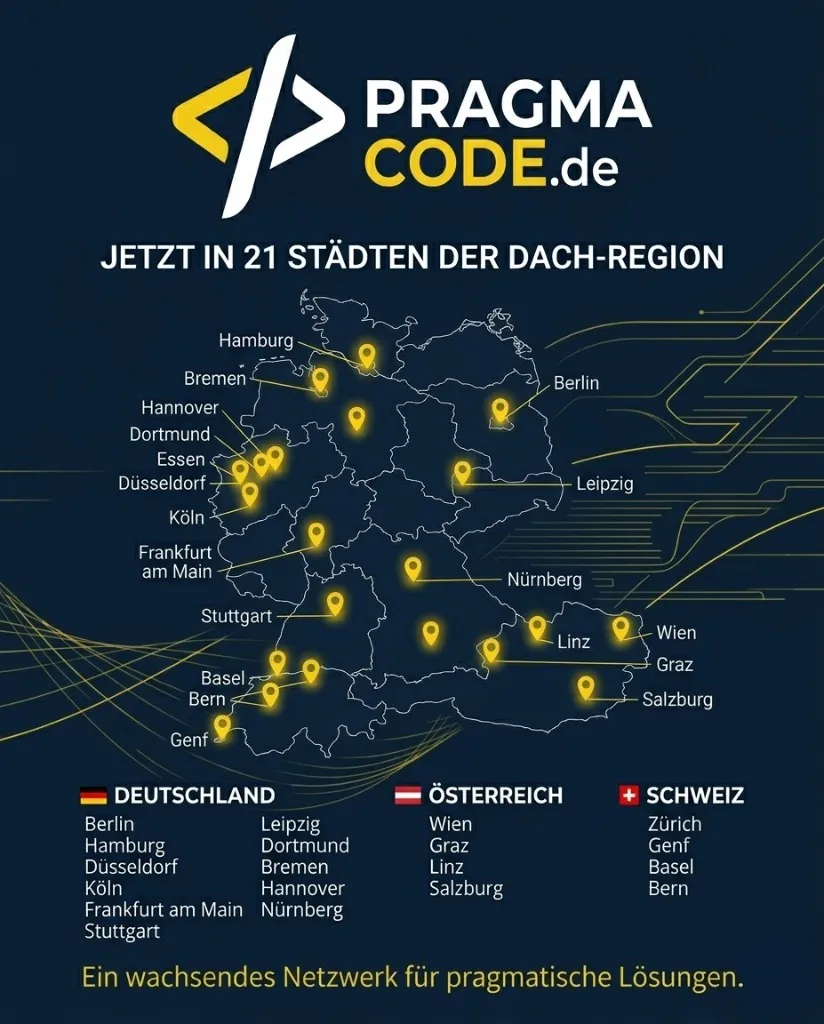
We are your digital partner – regionally anchored and successfully scaling across borders.
Have a vision?
Let's check together how we can make your idea take flight.
Book your free strategy call nowExtended Specialized Glossary
Digital Sovereignty
The capacity of organizations to independently govern, manage, and execute digital technologies, information flows, and software architectures without dependency on monopolistic external vendors.
Air-Gapped LLM
A large language model hosted on computing hardware that is physically or logically isolated from the public internet, completely eliminating remote exfiltration risks.
On-Premise AI Cluster
A dedicated local compute deployment situated in an on-site data center or server room, equipped with accelerator hardware (GPUs/NPUs) for local inference and RAG.
Model Sovereignty
Strategic independence achieved by utilizing freely accessible open model weights, proprietary internal datasets, and customizable inference runtimes without third-party API dependencies.
Sovereign Cloud
Cloud compute and storage infrastructure operating strictly under European jurisdiction, shielded from extraterritorial surveillance statutes such as the US CLOUD Act.