


Traditional cloud-first applications reach their limits during network outages in field service, manufacturing plants, or construction sites. Local-first software architecture combined with CRDTs (Conflict-free Replicated Data Types) restores data ownership to the client device – delivering resilient, high-performance B2B web apps with seamless background synchronization.
This article is an in-depth expert contribution from our content cluster. Discover the complete overview on our main page: Web Development & IT Solutions →
- Field Reliability: Cloud-first applications fail under unstable network coverage in field service, production halls, or basements. Local-first ensures uninterrupted operations.
- Conflict-Free Synchronization: CRDTs (Conflict-free Replicated Data Types) eliminate data loss, server lockups, and manual "Last-Write-Wins" conflict resolution dialogues once and for all.
- Future-Proof Sovereignty: Enterprises leverage local-first to combine the speed of local desktop applications with the seamless collaboration of modern cloud systems.
- 1. The Cloud Dependency Paradox in B2B
- 2. What is Local-First Software Architecture?
- 3. The Mathematical Magic of CRDTs
- 4. Framework Comparison: Yjs, Automerge & Electric SQL
- 5. Practical Enterprise Architecture for SMBs
- 6. Real-World B2B Use Cases: Where Local-First Saves Millions
- 7. Security, End-to-End Encryption & Compliance
- 8. Implementation Roadmap & Quick-Check
1. The Cloud Dependency Paradox in B2B
Over the past fifteen years, cloud transformation has dominated the enterprise software landscape. SaaS solutions and centralized databases brought undisputed benefits for maintenance, scalability, and central administration. However, in the harsh operational reality of mid-sized B2B enterprises, the flip side of total centralization is becoming increasingly obvious: complete dependence on a permanent, ultra-reliable Internet connection.
Whether service technicians working in industrial basements, sales representatives traveling through connectivity dead zones, construction crews on remote sites, or logistics personnel in high-bay warehouses – when the network connection drops, traditional cloud-first applications freeze. Input fields lock up, loading spinners spin infinitely, and in the worst cases, unsaved form inputs are permanently lost.
Cost Trap 1: Field Downtime & Idle Hours
When maintenance protocols or diagnostic records cannot be entered due to lack of network coverage, expensive downtime and manual double data entry at the office occur.
Cost Trap 2: Data Loss via Last-Write-Wins
If two employees edit the same customer file offline, reconnecting usually means the server keeps the last upload – silently overwriting and destroying the first employee's changes.
Cost Trap 3: Latency Friction in Core Workflows
Every single user action requires a server roundtrip. Even on functional 5G networks, a 200 ms latency noticeably degrades fluid data entry and productivity.
To mitigate these issues, development teams frequently resort to ad-hoc offline caching mechanisms. But the devil lies in the details: as soon as multiple users modify the same data objects offline, reconnection triggers massive data synchronization conflicts. The Local-First Software architecture paired with CRDT (Conflict-free Replicated Data Types) solves this problem not through superficial workarounds, but at a fundamental mathematical level.
2. What is Local-First Software Architecture?
Coined in 2019 by Ink & Switch research, the term "Local-First" defines an architectural paradigm that combines the benefits of local desktop software (zero latency, full offline capability, data ownership) with the strengths of cloud applications (real-time collaboration, cloud backups, multi-device synchronization).
Unlike traditional "offline-first" approaches where browser storage acts merely as a temporary cache and the central server remains the absolute "Single Source of Truth", local-first dictates: The local database on the client device is the primary data source.
Comparison: Cloud-First vs. Local-First Architecture
- Primary Source: Central Server Database (e.g. PostgreSQL/Oracle)
- Network Requirement: Mandatory for all actions (REST/GraphQL)
- Offline Behavior: Blocked or limited read-only fallback
- Conflict Resolution: Last-Write-Wins (LWW) or exclusive locks
- Latency: Dependent on server distance & signal quality
- Primary Source: Local Client Database (IndexedDB / OPFS)
- Network Requirement: None – Server is an async sync node
- Offline Behavior: 100% read & write capabilities without limits
- Conflict Resolution: Mathematically conflict-free merge via CRDTs
- Latency: 0 ms (instantaneous UI response to local mutations)
At the core of this architecture lie seven key principles that modern enterprise B2B applications must satisfy:
1. Zero Latency (No Wait)
All reads and writes execute against the client device's local memory. User interfaces respond instantaneously in 0 milliseconds.
2. Multi-Device Offline Functionality
Users can work at any location without an Internet connection. The client device stores all mutations locally and waits for connectivity.
3. Seamless Background Sync
As soon as a connection becomes available, client devices exchange delta update packages seamlessly in the background.
4. Conflict-Free Collaboration
Multiple users can edit shared documents or records concurrently without triggering annoying manual merge conflict prompts.
3. The Mathematical Magic of CRDTs
Historically, the biggest obstacle in decentralized storage architectures was concurrency control. If Technician A on Site 1 updates a component status to "Inspected" and Technician B at the exact same time on Site 2 corrects the serial number of that same component, which state is correct?
Traditional relational databases address this via distributed transactions and locking mechanisms (e.g. Two-Phase Commit). However, locking requires all participating nodes to be online simultaneously. If the network drops, locking fails.
This is where CRDTs (Conflict-free Replicated Data Types) come into play. These are specialized data structures that mathematically guarantee convergence to the exact same end state (Eventual Consistency) across all nodes – regardless of the order in which update operations arrive.
Expert Tip: The Two Core Flavor Categories of CRDTs
Computer science distinguishes between two fundamental implementations:
- State-based CRDTs (CvRDT): Replicas transmit their entire local state to other nodes. Merging relies on semi-lattice join semantics (least upper bound).
- Operation-based CRDTs (CmRDT): Replicas send individual mutation operations (e.g., "Insert character X at index 5"). The underlying transport layer must guarantee causally ordered delivery without message loss.
To understand why CRDTs operate seamlessly without a central coordinator, we examine the algebraic properties of their merge operator (⊔):
A ⊔ B = B ⊔ A
Commutativity (Order Independence)
Arrival order of update A versus B does not alter the resulting replicated state.
(A ⊔ B) ⊔ C = A ⊔ (B ⊔ C)
Associativity (Grouping Independence)
How intermediate update batches are grouped has zero impact on final convergence.
A ⊔ A = A
Idempotency (Duplication Safety)
If a network retry transmits an update multiple times, the final state remains identical.
By leveraging causal graphs, Vector Clocks, and unique client identifiers, lists, text documents, JSON trees, and key-value maps can be merged deterministically.
4. Framework Comparison: Yjs, Automerge & Electric SQL
For enterprise software architects, the question is no longer whether CRDTs are production-ready, but which open-source framework best suits their specific B2B stack. Three major open-source technologies lead the ecosystem:
Yjs (High Performance)
Written in JavaScript, ultra-memory-efficient, and optimized for maximum speed. The de-facto standard for collaborative editors (ProseMirror, Quill, Monaco, TipTap) and complex form state trees.
Automerge (JSON-Native)
Built in Rust with JavaScript & iOS bindings. Provides a full Git-like commit history for arbitrary JSON structures. Ideal for complex data models requiring time-travel auditing and history tracking.
Electric SQL (Postgres Sync)
Bridges PostgreSQL in the backend with SQLite/IndexedDB on the client. Uses log-based replication to sync SQL tables bidirectionally in CRDT format to web clients.
Below is a comparative breakdown of architectural characteristics for B2B engineering teams:
B2B Matrix: Yjs vs. Automerge vs. Electric SQL
- Core Focus:
- Memory Footprint:
- History Management:
- Backend Integration:
- Best for:
- Real-time Text & Documents
- Extremely Low (~ 1-2 MB RAM)
- Garbage Collected (Compact)
- Node.js, WebSocket, WebRTC
- Rich-Text, Canvas, Web Apps
- Complex JSON Objects
- Moderate to High (Rust Core)
- Full Commit History
- Rust, Node.js, P2P
- B2B CRMs, Configurators
5. Practical Enterprise Architecture for SMBs
How does a battle-tested local-first enterprise architecture look in production? At Pragma-Code, we deploy a proven 3-tier architecture that integrates seamlessly with existing enterprise backends (SAP, PostgreSQL, Microsoft Dynamics):
Tier 1: Client Storage & State Engine
The web app (React, Vue, or Svelte) utilizes IndexedDB as persistent browser storage. State mutations are encapsulated in Yjs doc instances and persisted locally in microseconds.
Tier 2: Asynchronous Transport & Relay Nodes
A lightweight Node.js or Go WebSocket relay server handles incoming state updates (deltas). If the client is offline, updates queue locally in an IndexedDB outbox until reconnection occurs.
Tier 3: Persistence Backend & Enterprise Sync
The sync server validates and translates CRDT updates into structured SQL transactions on the central PostgreSQL database, enforcing enterprise access rules and business logic.
Here is a concise code example demonstrating how to set up a local Yjs instance with IndexedDB persistence and WebSocket synchronization in a modern web application:
import * as Y from 'yjs';
import { IndexeddbPersistence } from 'y-indexeddb';
import { WebsocketProvider } from 'y-websocket';

// 1. Initialize the root Yjs document
const doc = new Y.Doc();

// 2. Bind local IndexedDB for immediate offline access (0 ms latency)
const providerIdb = new IndexeddbPersistence('b2b-maintenance-order-104', doc);

providerIdb.on('synced', () => {
  console.log('Local state successfully loaded from IndexedDB!');
});

// 3. Attach asynchronous WebSocket provider for background synchronization
const providerWs = new WebsocketProvider(
  'wss://sync.your-company.com',
  'b2b-maintenance-order-104',
  doc
);

// 4. Access shared CRDT data structures (e.g. Map for order details)
const yMap = doc.getMap('orderDetails');

// Local mutation – works 100% identically offline and online!
yMap.set('status', 'Inspection Completed');
yMap.set('technicianNotes', 'Valve 4B successfully replaced.');
6. Real-World B2B Use Cases: Where Local-First Saves Millions
Adopting local-first software architecture is not an academic exercise – it yields tangible financial and operational returns across industrial sectors:
1. Field Service & Mobile Maintenance Apps
Mechanical engineering technicians operate in deep basements or reinforced concrete facilities without mobile reception. Local-first enables seamless checklist and diagnostic entry without spinner delays. Upon exiting, data syncs automatically in the background.
2. Shopfloor Terminals & Manufacturing Execution Systems (MES)
In Industry 4.0 production lines, Wi-Fi latency spikes must never stall assembly terminals. Local-first guarantees continuous line execution even during corporate IT network blips.
3. B2B Collaboration & Multi-User Editors
Collaborative product configurators, CAD review tools, and pricing calculators benefit from simultaneous real-time multi-user editing – eliminating frustrating "File is locked by User X" alerts.
7. Security, End-to-End Encryption & Compliance
Because local-first architecture stores confidential business records locally on employee client devices, CISO and IT compliance officers demand strict security controls. Local-first delivers distinct compliance advantages over conventional cloud setups:
End-to-End Encryption (E2EE)
CRDT update deltas can be encrypted directly on the client using AES-GCM-256 via Web Crypto API. The cloud WebSocket relay server acts as a Zero-Knowledge Relay, forwarding encrypted blobs without reading payload contents.
Privacy by Design (GDPR / NIS-2 Compliance)
Keeping primary data stores on local devices minimizes unencrypted third-party cloud transfers, simplifying compliance with European data sovereignty regulations.
Client-Side Database Encryption
Leveraging modern browser capabilities (OPFS + SQL.js / Origin Private File System) enables cryptographic protection of local client database files on lost or stolen laptops.
8. Implementation Roadmap & Quick-Check
Transitioning from a legacy cloud monolith to a resilient local-first architecture requires structured execution. We advise mid-market enterprises to follow this 5-step implementation roadmap:
-
Step 1: Domain & Data Modeling Audit
Identify high-value offline business domain entities. Separate append-only audit logs from complex collaborative data structures.
-
Step 2: Proof-of-Concept with Yjs or Automerge
Build an isolated PoC for a key frontend module (e.g. maintenance form or mobile report) utilizing IndexedDB persistence.
-
Step 3: Sync Relay Setup & Stress Testing
Deploy the WebSocket sync service and simulate extreme offline scenarios (e.g. 3 days of offline edits by 5 concurrent users).
-
Step 4: Backend Integration & Postgres Replication
Connect the sync relay to central PostgreSQL databases, enforcing Row-Level Security and enterprise authorization policies.
-
Step 5: Production Rollout & Telemetry
Phase rollout across pilot field teams while monitoring synchronization latency, conflict convergence, and local storage usage.
Quick-Check: Is Your Enterprise Ready for Local-First?
If you answered "Yes" to two or more questions, local-first software architecture holds the key to your next major productivity gain.
Do you have questions about Local-First Architecture & CRDTs?
Schedule a Free ConsultationOur Regional Expertise
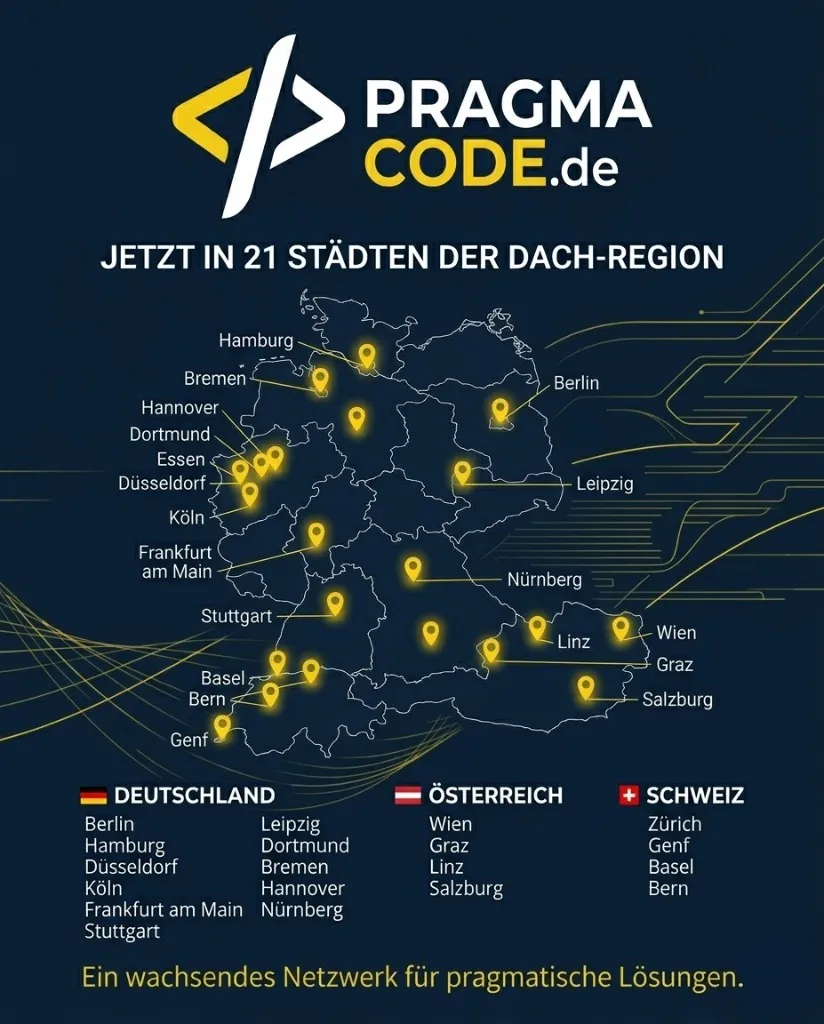
We are your digital partner – regionally anchored and successfully scaling across borders.
Have a vision?
Let's check together how we can make your idea take flight.
Book your free strategy call nowExtended Specialized Glossary
Local-First Software
A software architecture where data is stored and processed primarily on the user's local device (e.g. via IndexedDB). Synchronization with servers happens asynchronously in the background, making applications fully offline-capable and real-time.
CRDT (Conflict-free Replicated Data Types)
Mathematical data structures that can be mutated independently across multiple devices without central coordination. Through commutative and idempotent operations, they guarantee conflict-free convergence of all updates.
IndexedDB
A high-performance, object-oriented browser NoSQL database that persists large amounts of structured data locally on the client, enabling complex offline queries and transactions.
Eventual Consistency
A consistency model in distributed systems guaranteeing that once all write operations settle and sync completes, all replicas converge to the exact same state.
Yjs
A high-performance, open-source CRDT framework for JavaScript providing real-time collaboration and offline editing with minimal memory overhead and extensive editor integrations.
Automerge
A popular CRDT framework in Rust and JavaScript offering Git-like history tracking and automatic merging for complex JSON data structures in local-first applications.
Vector Clock
An algorithm for causally ordering events in distributed systems using logical timestamps per node to unambiguously track concurrency and cause-and-effect relationships.