

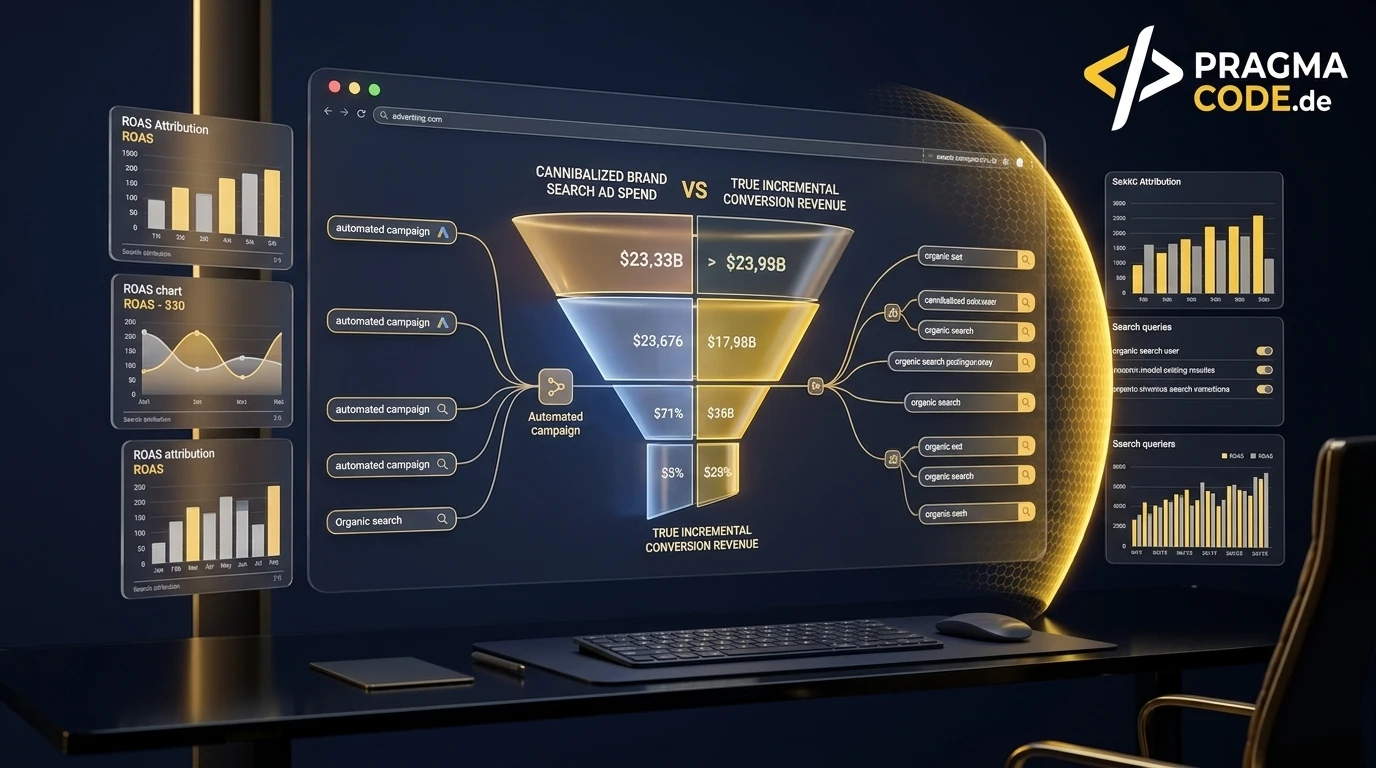
Google Performance Max promises peak efficiency through automated cross-channel ad distribution. Yet in day-to-day operations, stellar platform ROAS metrics frequently mask an expensive trap: PMax captures proprietary branded searches, cannibalizing organic traffic and dedicated brand campaigns. Learn how to calculate true incremental ROAS and systematically stop budget waste.
This article is an in-depth expert contribution from our content cluster. Discover the complete overview on our main page: SEO & Content Marketing →
The Illusion of Automated Campaign Returns
While machine learning in Google Ads executes bidding calculations in fractions of a second, auditing granular attribution logs exposes the fundamental vulnerability of Performance Max: Smart Bidding deterministically pursues the path of least resistance. Without stringent negative governance, PMax routinely claims prospects who were already searching for your brand.
- The PMax Vulnerability: Unregulated Smart Bidding naturally prioritizes branded search queries, inflating reported account ROAS to 800% - 1,500% while net-new customer acquisition stalls.
- Subsidized Conversions: Every dollar spent by PMax on proprietary branded queries subsidizes website visits that would have closed organically via the top SERP listing at zero media cost.
- Methodical Separation: By deploying incremental ROAS formulas, Google Search Console verification, and campaign-level brand exclusion lists, media spend is redirected to authentic customer prospecting.
- 1. Defining Performance Max Cannibalization in Google Ads
- 2. Algorithmic Mechanics: Why Smart Bidding Exploits Brand Traffic
- 3. Diagnostic Framework: 4 Core Indicators of Budget Waste
- 4. Step-by-Step Measurement with Search Console & Ads
- 5. Standard ROAS vs. Incremental ROAS (iROAS): The Mathematical Proof
- 6. The 5 Typical Cost Traps in Uncontrolled PMax Deployments
- 7. Tactical Countermeasures: Brand Exclusions & Split Architectures
- 8. The 4-Stage Implementation Roadmap to Cleanse Campaigns
- 9. Quick-Check Checklist for Your Advertising Account
- 10. Conclusion & Strategic Guidance for B2B Leaders
1. Defining Performance Max Cannibalization in Google Ads
The introduction of Performance Max (PMax) fundamentally reshuffled enterprise search engine marketing. Where digital advertisers formerly calibrated manual cost-per-click bids across tight phrase- and exact-match keyword structures, an autonomous machine-learning engine now controls placements across Search, Shopping, YouTube, Display, Discover, and Google Maps.
The core objective embedded into the bidding model is straightforward: maximize total conversions or conversion value within designated target ROAS or CPA constraints. While this mathematical optimization is undeniably robust, in real-world business environments it produces a severe distortion: Brand Cannibalization.
During brand cannibalization, the automated algorithm allocates media budget toward search queries containing your corporate trademark, company name, or core product titles. Because prospects entering branded queries already exhibit acute purchasing intent, the PMax campaign logs rapid, low-friction transactions. Platform ROAS surges on executive dashboards. In reality, this is internal Keyword-Kannibalisierung: advertising dollars are squandered acquiring visitors who intended to navigate directly to your web presence regardless.
Expert Tip: Detecting the ROAS Mirage
A sudden upward spike in reported PMax ROAS alongside flat or declining revenue inside your corporate CRM or ERP database is the definitive diagnostic signature of brand cannibalization. Never evaluate advertising returns in an isolated platform vacuum; cross-reference PMax spend against organic brand click rates in Google Search Console.
2. Algorithmic Mechanics: Why Smart Bidding Exploits Brand Traffic
To eliminate cannibalization permanently, performance marketers must understand the incentives driving automated bidding algorithms. Machine learning algorithms naturally seek the path of least mathematical friction. Given a mandate to hit a 400% target ROAS, the neural network faces two contrasting operational pathways:
1. Cold Acquisition Traffic
The algorithm explores unbranded categorical keywords, YouTube video pre-rolls, and programmatic display banners. Conversion rates in cold audiences typically hover around 1% to 3%. Auction competition is fierce, and training the model requires substantial testing capital.
2. High-Intent Brand Traffic
A past client or word-of-mouth lead types your company name directly into Google. Conversion probability reaches 15% to 30%. Conversion costs are fractional, enabling the campaign to post effortless ROAS figures exceeding 1,000%.
Without negative governance, the bidding engine predictably selects Pathway 2. This triggers a destructive cycle: as you increase budget allocations to Performance Max, the system funnels greater proportions of that spend into harvesting organic momentum. Media investment that was intended to acquire market share merely pays tolls on existing business equity.
3. Diagnostic Framework: 4 Core Indicators of Budget Waste
In many enterprise setups, this drain operates unnoticed for quarters because standard Google Ads interfaces collapse placement and search query data into blended performance totals. Applying this 4-pillar diagnostic framework identifies whether your account is suffering from cannibalization:
1. Decay of Organic Brand Clicks
If scaling Performance Max spend correlates with a marked decline in organic branded clicks in Google Search Console—while total brand search impressions remain unchanged—PMax paid ads are siphoning your free top organic listing.
2. Inflated ROAS with Stagnant New-Customer Volume
When PMax reports 800%+ returns but internal enterprise data warehouses reveal zero acceleration in first-time customer acquisition, the campaign is simply monetizing customer retention.
3. Starvation of Dedicated Brand Search Campaigns
If you maintain an exact-match Brand Search campaign, its impression share collapses after launching PMax because Google's ad server systematically grants internal auction priority to PMax containers.
4. Brand Dominance in Search Term Insights
Under PMax Insights > Search Terms, your branded queries account for the majority of recorded conversion volume rather than commercial product or category inquiries.
4. Step-by-Step Measurement with Search Console & Ads
Proving budget cannibalization requires objective data reconciliation between paid campaign spend and unbilled search performance inside Google Search Console. Execute the following three-step verification audit:
Analyze Search Category Volume in Performance Max
Open Google Ads, navigate to the target PMax campaign, and select Insights and Reports > Search Terms. Sort search categories by conversion value. Calculate the exact percentage of attributable revenue originating from your corporate brand terms.
Evaluate Organic Brand Click-Through Rates (GSC)
Open Google Search Console and filter queries by your trademark names. Compare organic click-through rates (CTR) before PMax scaled against current performance. A CTR decline from 65% down below 40% on Position 1 provides empirical proof of paid ad displacement.
Inspect Network Placement Distribution
Generate a placement and network distribution report via Google Ads Scripts or Report Editor > Campaign > Placements. If Search channel spend exceeds 80% while branded search terms dominate, PMax is operating as an overpriced brand proxy.
As documented in our guide to Google & Meta Ads Setups, profitable paid media scaling requires isolated experimentation loops. Unchecked automated campaigns distort corporate multi-touch attribution models.
5. Standard ROAS vs. Incremental ROAS (iROAS): The Mathematical Proof
The strategic pitfall in automated advertising lies in confusing platform-reported ROAS with true financial contribution. When an existing customer searches for your brand with immediate intent to purchase, paid ad intervention adds zero incremental business value. True marketing performance is determined solely by Incremental ROAS (iROAS).
Comparison: Reported Platform ROAS vs. Incremental Reality
- Reported ROAS: Superficially impressive 950% (9.5:1).
- Budget Allocation: 65% of media capital spent on brand queries.
- New Customer Ratio: Only 18% of conversions represent net-new clients.
- Economic Reality: Re-purchasing web traffic that was already secured organically.
- Scalability: Strictly limited by organic brand search volume.
- Reported ROAS: Realistic 320% to 450% (pure non-brand prospecting).
- Budget Allocation: 100% of media capital directed toward cold acquisition.
- New Customer Ratio: Exceeds 85% verified net-new buyers.
- Economic Reality: Drives genuine pipeline expansion and incremental market share.
- Scalability: Highly expandable across generic semantic search clusters.
The mathematical formulation for true Incremental ROAS is defined as:
iROAS = (Total Revenue WITH Campaign - Baseline Revenue WITHOUT Campaign) / Advertising SpendSuppose your baseline organic revenue stands at 100,000 € monthly. Deploying 10,000 € in PMax spend brings total revenue to 108,000 €. The true incremental revenue generated by advertising is merely 8,000 €. While Google Ads trumpets a platform ROAS of 108,000 / 10,000 = 1,080%, real iROAS is 8,000 / 10,000 = 80%—meaning the business is losing 20 cents on every dollar spent!
6. The 5 Typical Cost Traps in Uncontrolled PMax Deployments
Across commercial account audits, enterprise teams routinely stumble into five repeatable structural pitfalls when running unmanaged PMax configurations:
1. Unnecessary CPC Bids Without Competitor Conquesting
If no competitors bid on your brand name, your site holds undisputed organic rank 1. Bidding PMax on your brand costs 0.50 € to 3.00 € per click for prospects who would have clicked your organic snippet gratis.
2. Cannibalizing Dedicated Brand Search Campaigns
When custom brand campaigns with tailored promotional sitelinks and specific compliance copy are live, PMax frequently outbids them with autogenerated ad copy, eroding message precision.
3. Polluting Algorithmic Training Signals
Because PMax primarily converts existing brand advocates, the neural network mistakenly identifies brand loyalists as the primary audience model, weakening cold lookalike prospecting.
4. Budget Depletion During Seasonal Brand Spikes
During trade shows, press releases, or broadcast commercials, brand query volume surges. PMax exhausts its entire daily cap within hours on brand keywords, leaving zero funding for prospecting.
5. Flawed Strategic Resource Allocation
Leadership observes a 1,000% PMax ROAS and cuts SEO or content marketing budgets, assuming paid ads are vastly superior. In reality, legacy organic brand equity is subsidizing reported ad efficiency.
7. Tactical Countermeasures: Brand Exclusions & Split Architectures
To curb cannibalization and reconfigure Performance Max into an authentic prospecting engine, implement Google's native negative governance controls:
1. Configure Campaign-Level Brand Exclusion Lists
Navigate to Campaign Settings > Additional Settings > Brand Exclusions to bind a verified Brand Exclusion List. This registry encompasses your official corporate names, trademark variations, and common typographical errors, mechanically barring PMax from bidding on these terms.
2. Account-Level Negative Keyword Governance
Utilize account settings to establish a global negative keyword list. Because PMax does not offer ad group-level negatives, global account negatives prevent algorithmically broadened queries from creeping into branded variants.
3. Establish a Clean Two-Pillar Campaign Architecture
Isolate brand defense from acquisition: Maintain a manual Standard Search campaign targeting exact-match brand keywords with capped manual bids to fend off competitor conquesting. PMax operates simultaneously in a strictly non-brand capacity to discover new customer segments.
When combined with calibrated Search Themes, advertisers steer autonomous PMax delivery directly into commercially intentful category themes, as outlined in our insights on Performance Marketing for AI Search Engines.
8. The 4-Stage Implementation Roadmap to Cleanse Campaigns
Transitioning an established account must be orchestrated deliberately, as abruptly revoking branded traffic forces Smart Bidding into a recalibration phase. Follow this tested 4-stage engineering roadmap:
-
Audit & Brand Registry Formulation
Compile an exhaustive inventory of corporate trademarks, localized domain variants, subsidiary names, and common typos in a dedicated Brand List within Google Ads Shared Library.
-
Deploy an Isolated Brand Defense Search Campaign
Prior to activating exclusions in PMax, launch a traditional search campaign with exact-match brand keywords. Set manual bidding or a target impression share constraint (e.g. 95% absolute top of page) to protect brand territory against competitors.
-
Activate Brand Exclusions in PMax & Lower Target ROAS
Apply the Brand Exclusion List to your PMax campaign. Crucial step: Temporarily reduce the target ROAS threshold in PMax (e.g., from 600% down to 300%). Because PMax now engages exclusively in cold acquisition, an obsolete, inflated ROAS target would strangle impression volume.
-
Evaluate Re-Attribution & Incrementality at Day 21
Following a 2-3 week learning phase, analyze verified net-new customer conversions. Appraise blended efficiency across organic search, dedicated brand search defense, and pure non-brand Performance Max prospecting.
9. Quick-Check Checklist for Your Advertising Account
Review this operational checklist to verify whether your Google Ads account is safeguarded against margin-diluting cannibalization:
Quick-Check: PMax Brand Protection
10. Conclusion & Strategic Guidance for B2B Leaders
Google Performance Max remains an exceptional mechanism for scalable customer acquisition—provided human marketing strategists dictate structural capital allocation. Left unconstrained, automated machine learning naturally prioritizes pre-converted branded audiences over challenging cold prospects.
By enforcing brand exclusion lists and decoupling brand defense from automated discovery, marketing executives unveil the unvarnished reality of their acquisition costs while building a robust foundation for genuine business expansion. Stop celebrating subsidized platform vanity metrics and hold every advertising dollar accountable to verified incremental returns.
Ready to Audit Your Google Ads Account for Brand Cannibalization?
We analyze your campaign architecture, expose hidden budget drains, and calibrate your acquisition funnel for true incremental ROAS.
Request a Free Performance AuditOur Regional Expertise
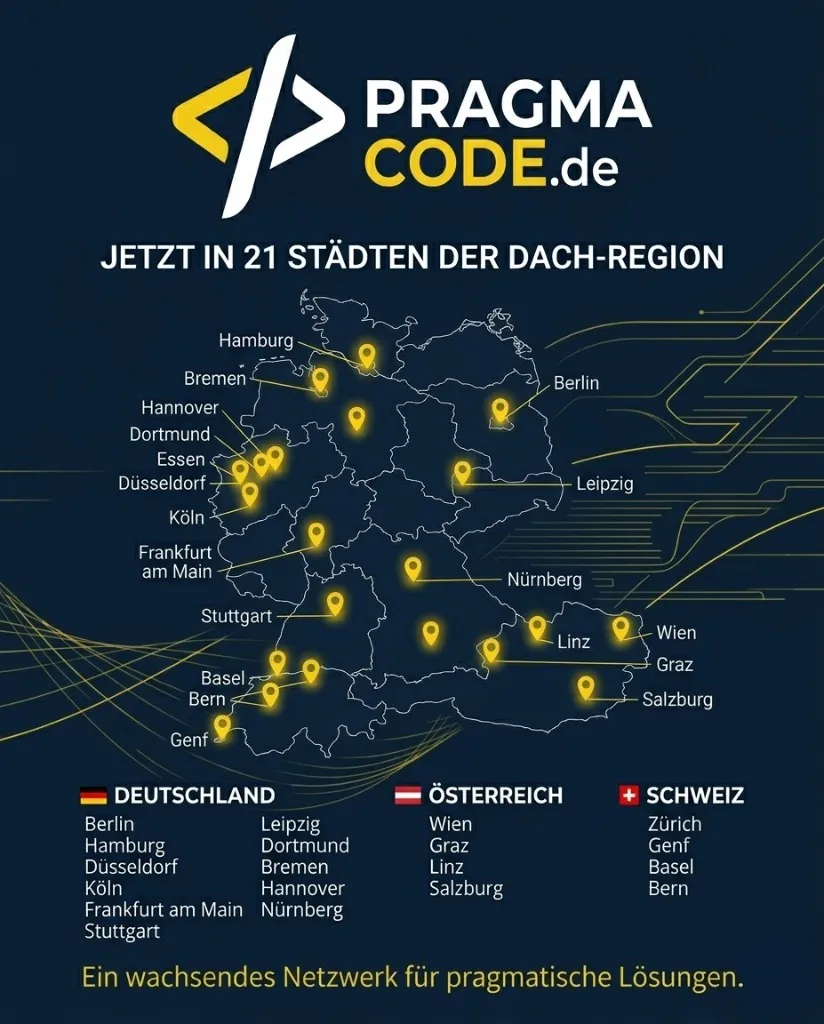
We are your digital partner – regionally anchored and successfully scaling across borders.
Have a vision?
Let's check together how we can make your idea take flight.
Book your free strategy call nowExtended Specialized Glossary
Performance Max (PMax)
Google Ads' premier AI campaign type that dynamically allocates ad spend across Search, Shopping, YouTube, Display, Discover, and Maps from a single asset container.
Brand Exclusion Lists
Account- or campaign-level negative brand lists in Google Ads that prevent Performance Max campaigns from serving on proprietary branded queries to protect incremental ROAS.
Incremental ROAS (iROAS)
An advertising metric calculating the true net-new revenue generated exclusively by paid media intervention rather than organic momentum.
Search Themes
AI guidance signals within Google Performance Max that direct semantic query matching across search channels without legacy exact-match keyword lists.
Keyword-Kannibalisierung
A marketing conflict where multiple internal campaigns or URLs target identical search intents, creating artificial competition and inflated customer acquisition costs.