

From Japanese product innovation models in the 1980s to AI-augmented software engineering in 2026: Scrum has fundamentally revolutionized how enterprise applications, customer portals, and web platforms are conceived, coded, and deployed. Discover the roots of this agile framework, why two-week sprint cycles consistently outperform monolithic specifications, and how modern engineering teams marry process discipline with autonomous coding agents.
This article is an in-depth expert contribution from our content cluster. Discover the complete overview on our main page: Modern Web Development & Engineering →
Agile Guardrails in the Era of Autonomous Coding Agents
In 2026, generative AI models and autonomous coding agents like Cursor, Claude Code, and Antigravity can generate hundreds of lines of syntactically flawless code in minutes. Yet this technological leap poses a critical danger for businesses: Without empirical process discipline, rigorous backlog curation, and strict verification gates, unguided code generation produces compounding technical debt rather than genuine productivity. In the AI era, Scrum is experiencing a vital renaissance – not as administrative overhead, but as an indispensable governance and validation framework.
1. Historical Paradigm Shift
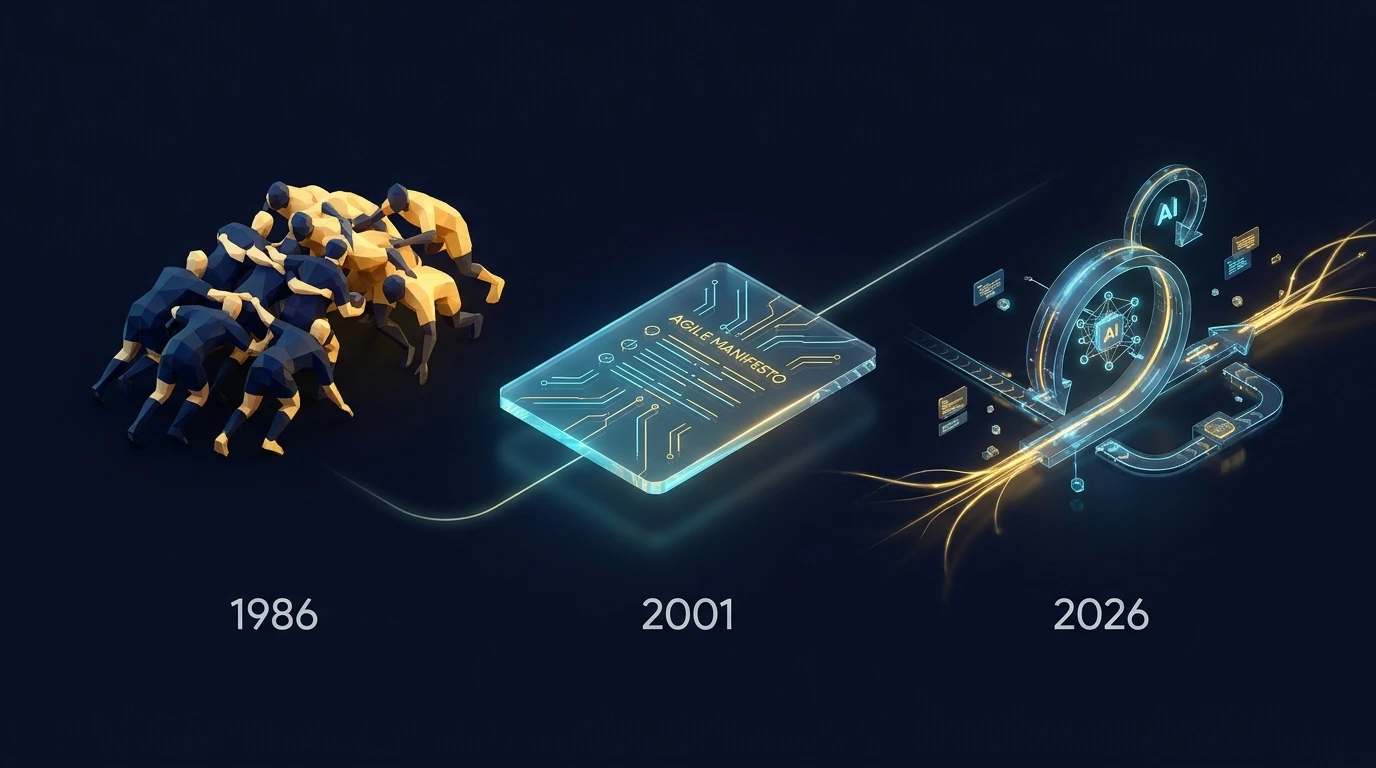
Scrum replaced the rigid relay race of the waterfall model. Inspired by the rugby formation analyzed by Takeuchi and Nonaka (1986) and formalized by Schwaber and Sutherland (1995), Scrum emphasizes collective team momentum over sequential handoff friction.
2. Prototypes Beat Specifications
Rather than authoring theoretical 100-page specification binders, every two-week sprint produces a fully tested, clickable software increment. This approach eliminates catastrophic budget misallocation for digital transformation projects.
3. AI-Augmented Engineering
At Pragma-Code, we integrate agile two-week iterations with cutting-edge web architectures (Astro, Next.js, TypeScript) and AI-assisted engineering. The result: up to 60 % faster time-to-market with absolute financial transparency and control.
- 1. Introduction: Why Scrum Matters More Than Ever
- 2. Origins & History: From the Rugby Pitch to Global Tech Standard
- 3. Scrum in Engineering Practice: Roles, Artifacts & Ceremonies
- 4. Comprehensive Comparison: Waterfall vs. Traditional vs. AI-Augmented Scrum
- 5. The 5 Core Scrum Values and Overcoming Enterprise Anti-Patterns
- 6. Pragma-Code Service Matrix: Which Project Demands Which Cadence?
- 7. The Pragma-Code Philosophy: “Working Prototypes Beat Specifications”
- 8. Engineering Roadmap: In 4 Phases from Vision to Production Increment
- 9. Conclusion & Decision-Maker Quick Check
1. Introduction: Why Scrum Matters More Than Ever
In enterprise software engineering, mid-market businesses routinely face a familiar and costly trap: A company commissions a comprehensive redesign of its customer portal or the ground-up development of a proprietary ERP integration. Three to six months are spent conducting committee workshops, writing exhaustive requirements documentation, and signing legally binding functional specifications. When the first alpha build is finally delivered six months later, reality strikes: Market conditions have shifted, internal workflows have evolved, third-party APIs have changed, and the software fails to address the real operational bottleneck.
This failure mode is precisely what Scrum was designed to eliminate. As the cornerstone of agile software development, Scrum replaces the illusion of upfront predictability with empirical process control: Transparency, Inspection, and continuous Adaptation.
In an era where composable web architectures, headless CMS systems, and autonomous coding tools define modern engineering, Scrum is more critical than ever. It prevents executive stakeholders from committing massive budgets to unvalidated hypotheses, substituting abstract promises with real, demonstrable software milestones every 14 days.
2. Origins & History: From the Rugby Pitch to Global Tech Standard
To fully appreciate the architectural efficiency of Scrum, one must explore its foundational origins. Scrum did not emerge from a Silicon Valley incubator; it was created as a strategic antidote to the systemic failures of traditional industrial manufacturing.
Japanese organizational theorists Hirotaka Takeuchi and Ikujiro Nonaka publish their landmark paper “The New New Product Development Game” in Harvard Business Review. Analyzing world-class innovations at Honda, Canon, 3M, and Fuji-Xerox, they conclude that high-performing teams do not operate like a sequential relay race where work is handed off across siloed boundaries. Instead, they act like a rugby team in a “Scrum” formation – a unified, multidisciplinary unit moving the ball forward in unison while adapting dynamically to shifting obstacles.
Jeff Sutherland (at Easel Corporation) and Ken Schwaber adapt these agile manufacturing principles to solve the software industry’s delivery crisis. At the time, bureaucratic waterfall models caused over 70 % of enterprise IT initiatives to overshoot budgets or suffer outright cancellation. In 1995, Schwaber and Sutherland present their formal framework at the OOPSLA conference in Austin, Texas, establishing Scrum as a recognized methodology for software engineering.
In February 2001, 17 visionary software practitioners (including Ken Schwaber, Jeff Sutherland, Kent Beck, Martin Fowler, and Robert C. Martin) convene in Utah to draft the Agile Manifesto. Scrum becomes the primary vehicle for its four core values: Individuals and interactions over processes and tools, working software over comprehensive documentation, customer collaboration over contract negotiation, and responding to change over following a rigid plan.
Schwaber and Sutherland formalize the open-source Scrum Guide. Over successive editions, the framework sheds extraneous mechanistic rules to focus on core human and empirical values: Focus, Courage, Openness, Respect, and Commitment. The 2020 revision introduces the unifying “Product Goal” and reaffirms that there are no sub-hierarchies within the Scrum Team – all members operate as equal partners toward shared business outcomes.
Today, Scrum serves as the structural foundation for high-velocity software engineering. As AI agents write boilerplate code, generate integration tests, and orchestrate build pipelines, Scrum guarantees architectural intent, user empathy, and business accountability.
3. Scrum in Engineering Practice: Roles, Artifacts & Ceremonies
Scrum is intentionally lightweight by design: It defines exactly three roles, three core artifacts, and four recurring ceremonies, all contained within the structured cadence of a sprint.
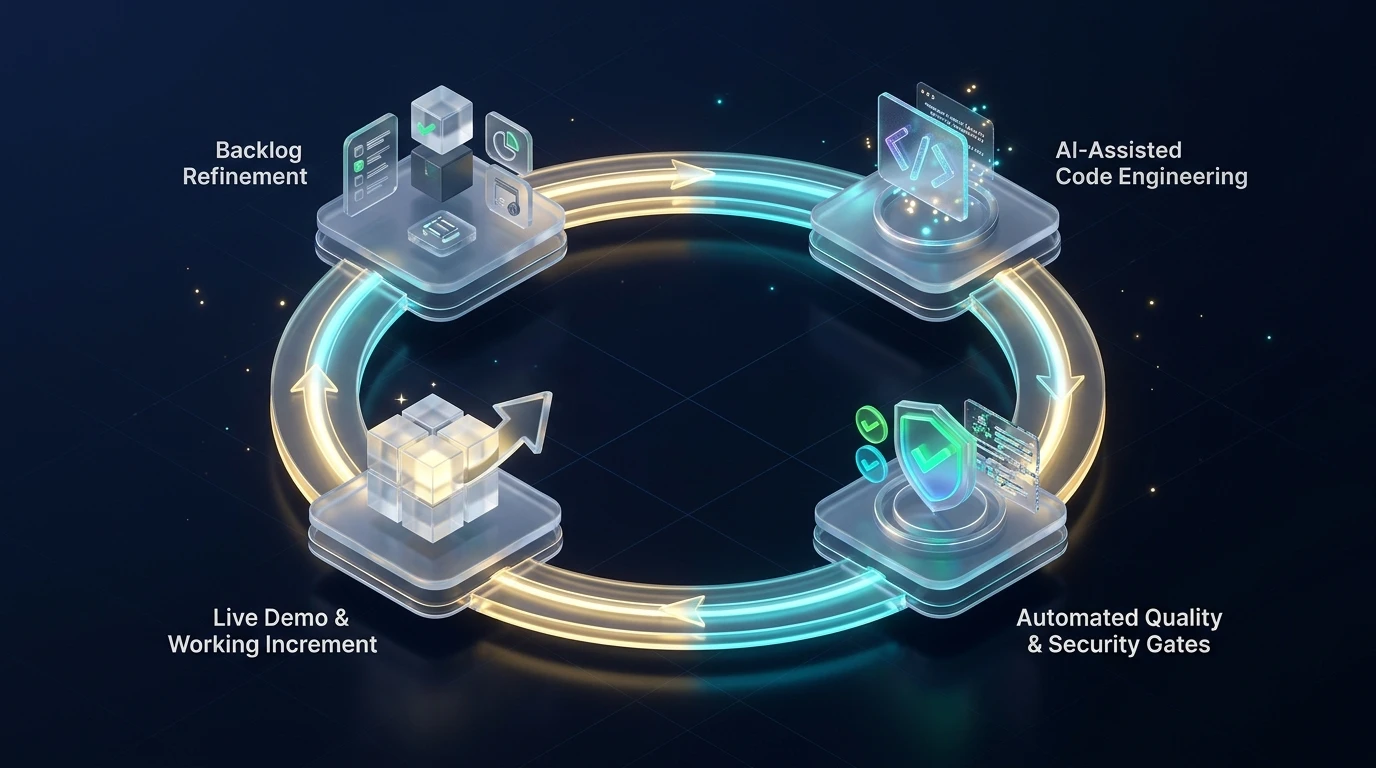
A sprint represents a consistent time-box – typically 14 days – designed to output a potentially shippable, fully tested product increment. Within this cadence, the team executes four structured events:
1. Sprint Planning
Aligning the team for the upcoming cycle: The Product Owner presents top-priority user stories from the Product Backlog. The engineering team evaluates technical feasibility, clarifies acceptance criteria, and forecasts work items into the Sprint Backlog.
2. Daily Scrum (Standup)
A focused 15-minute daily check-in: What did I achieve yesterday toward the Sprint Goal? What will I work on today? Are there any blockers or technical impediments risking our delivery timeline? It is an alignment meeting by developers, for developers.
3. Sprint Review & Demo
On the final day of the sprint, the team demonstrates working software live on a staging server – never through static slide decks. Stakeholders, product leaders, and engineers interact with the new increment, providing direct feedback that reshapes the Product Backlog.
4. Sprint Retrospective
Following the business review, the team reflects on operational processes, tooling, and communication: What worked well? Where did integration friction occur? The team commits to 1 or 2 targeted process optimizations to execute in the very next sprint.
The linchpin of successful agile delivery is an uncompromising Definition of Done (DoD). It prevents teams from declaring backlog tickets “almost finished.” At professional software agencies, a feature is only marked complete when the code is fully implemented, peer-reviewed, verified by automated unit and integration tests, audited for accessibility, and deployed to a staging environment.
4. Comprehensive Comparison: Waterfall vs. Traditional vs. AI-Augmented Scrum
To demonstrate the economic advantages for business leadership, the following comparison highlights the operational contrast between traditional waterfall management and modern AI-augmented agile delivery:
Comparison: Traditional Waterfall vs. Agile Execution
- Requirements: Rigid specifications documented upfront; months spent writing theory with zero running software.
- Feedback Cadence: Stakeholders inspect the system only after 6 to 12 months, causing massive risk of misalignment.
- Budget Risk: Late changes trigger expensive change requests, contract disputes, and timeline blowouts.
- Deployment: High-risk “Big Bang” release fraught with integration failures and rollback panic.
- Requirements: Dynamic Product Backlog with prioritized user stories, continuously refined against real market data.
- Feedback Cadence: Interactive, clickable staging deployments every 14 days, empowering direct customer steering.
- Budget Risk: Fixed iteration budgets; ineffective features are discontinued before incurring development costs.
- Deployment: Automated CI/CD pipeline deployments with regression suites and zero downtime.
Examining this progression across each phase of the modern software engineering lifecycle highlights key performance differences:
Table 1: Methodology & Evolution Comparison
| Evaluation Metric | Classical Waterfall | Traditional Scrum (1995/2001) | AI-Augmented Scrum (Pragma-Code 2026) |
|---|---|---|---|
| Planning Cycle | Months of upfront specification binders before coding begins | 2 to 4-week sprint planning based on estimated user stories | Continuous backlog refinement with AI-assisted user story spikes (1–2 weeks) |
| Feedback Frequency | Only during final acceptance testing after 6–12 months | At the conclusion of every sprint in the formal Sprint Review | Continuous staging builds + interactive live customer demo every 14 days |
| Handling Scope Change | Bureaucratic change request procedures and budget escalations | Prioritized flexibly into subsequent sprint cycles | Immediate adaptation: Working prototypes test hypotheses in days rather than quarters |
| Velocity & Tooling | Manual coding with late, error-prone manual integration tests | Collaborative team pairing, automated CI/CD pipelines, TDD | AI-assisted engineering (Cursor/Agents), automated test suites, zero-JS islands |
| Risk Allocation | Financial and product failure risk rests entirely with the client | Shared risk: tangible increments deliver progressive value | Minimal risk: Fixed-fee iteration blocks, clickable MVPs, clear milestone control |
| Time-to-Value | 6 to 18 months before real users interact with the system | 4 to 8 weeks to release an initial beta environment | 2 to 4 weeks to deploy a production-ready MVP or core workflow engine |
5. The 5 Core Scrum Values and Overcoming Enterprise Anti-Patterns
In enterprise settings, Scrum rarely stumbles due to its procedural rules; it fails when organizations adopt its vocabulary while clinging to command-and-control habits. This dynamic creates the dreaded “Zombie Scrum”: Teams perform ceremonies mechanically, yet no one assumes ownership, and no valuable software reaches production.
To guard against this dysfunction, the Scrum Guide establishes five indispensable ethical pillars:
1. Focus
During the sprint, the team dedicates its collective energy exclusively to the items supporting the Sprint Goal. Interruptions and unplanned management side-requests are rigorously deflected.
2. Courage
Engineers possess the courage to decline poorly defined user stories, speak openly about emerging technical debt, and pivot away from flawed architectural decisions before they cause financial harm.
3. Openness
Developers and stakeholders maintain absolute transparency regarding progress, delivery risks, and unforeseen blockers. Problems are treated as collective learning opportunities in retrospectives.
4. Respect
Business leaders and technical experts collaborate as peers. The Product Owner trusts the team’s architectural craftsmanship, while engineers respect business constraints and market timelines.
5. Commitment
Every team member commits personally to achieving the Sprint Goal and upholding the Definition of Done – refusing to compromise on security, test coverage, or accessibility standards.
Expert Tip: Eliminating Story-Point Inflation and Estimation Fatigue
Too many engineering organizations waste hours in sprint planning debating whether a backlog item represents 5 or 8 story points. At Pragma-Code, we advocate a practical alternative: Decompose every requirement into tasks small enough to be fully developed, tested, and reviewed according to the Definition of Done within 1 to 2 days by an engineer paired with an AI assistant. If a feature exceeds that scope, it is an epic that must be split. This simple heuristic eliminates estimation debates and stabilizes team throughput.
6. Pragma-Code Service Matrix: Which Project Demands Which Cadence?
Different digital initiatives require distinct engineering rhythms. Rapid exploratory prototyping thrives on concise 7-day iterations, while complex enterprise portal migrations demand structured 14-day cycles equipped with rigorous automated validation.
The following matrix outlines how we configure agile sprint frameworks across our core service offerings at Pragma-Code:
Table 2: Project Matrix in the Pragma-Code Service Portfolio
| Service Offering & Project Type | Sprint Cadence | Role Distribution | Artifacts & Definition of Done | Core Business Value Delivered |
|---|---|---|---|---|
| Custom MVP & Prototyping Validation & Rapid Launch | ⚡ 1–2 Weeks |
Client Product Owner (Prioritizes business logic)
Pragma-Code Tech Lead & Fullstack Engineering
|
Clickable Prototype Staging URL End-to-End Core Flow 100 % TypeScript | Rapid Market Validation: Fully testable software without months of specification waste; total investor confidence. |
| Enterprise Web Portals Next.js / Astro 5 Island Architecture | ⚡ 2 Weeks |
Client Key Stakeholders & End-User Testers
Pragma-Code Solution Architect, UI/UX & Backend
|
Production Increment Core Web Vitals Green Accessibility Compliance Automated Test Suites | Budget Certainty: Fixed milestone delivery, predictable release schedules, and continuous customer steering. |
| Legacy CMS Migration WordPress / TYPO3 → Headless | ⚡ 2–3 Weeks |
Client Content Directors & SEO Managers
Pragma-Code Migration Engineers & DevOps
|
Automated ETL Pipeline SEO 301 Redirect Matrix SSG/SSR High-Speed Frontend Zero-Downtime Cutover | Risk-Free Transition: Zero downtime, zero search ranking losses, and substantial ongoing hosting savings. |
| AI & n8n Automation Autonomous Workflows & APIs | ⚡ 1 Week |
Client Operations Lead (Domain knowledge)
Pragma-Code Automation Engineers & AI Leads
|
Deployed Live Workflow Error-Handling Fallbacks GDPR Webhook Audit Logs API Monitoring Alerts | Immediate Operational ROI: Relieving repetitive administrative workloads in days rather than quarters. |
7. The Pragma-Code Philosophy: “Working Prototypes Beat Specifications”
A core principle guiding our engineering practice at Pragma-Code is simple: A working software prototype beats any written specification document. A functional specification merely describes how software ought to operate in theory. A live prototype on a staging server demonstrates how real users interact, where edge cases arise, and how data flows across live API endpoints.
Traditional IT consultancies charge substantial fees and consume months drafting speculative requirement catalogs that are obsolete before the first line of code is compiled. At Pragma-Code, we invert this paradigm:
Validating Hypotheses with Real Code
Rather than holding protracted debates over technical architectures or UI layouts, we build interactive staging prototypes within the opening days of the first sprint. Clients and stakeholders test the real system directly in the browser.
Predictable Fixed-Fee Sprint Packages
We eliminate budgetary risk for our clients. Projects are structured in modular, fixed-price sprint blocks. Following each sprint review, stakeholders decide whether to proceed with subsequent enhancements, maintaining total capital control without unexpected scope bills.
Non-Negotiable Engineering Standards from Day One
Agile velocity never excuses sloppy code. Every pull request is strictly typed with TypeScript, follows modular clean-architecture guidelines, and passes automated security and accessibility checks before demo presentation.
8. Engineering Roadmap: In 4 Phases from Vision to Production Increment
When launching a new digital product or enterprise web application with Pragma-Code, we guide the project through a proven, four-stage implementation roadmap:
-
Phase 1: Discovery & Backlog Genesis (Days 1–3)
In a focused kickoff workshop, we establish the strategic product vision and identify target user profiles. We draft the initial 10 to 15 critical user stories, formalize the Definition of Done, and configure the modern architecture stack (such as Astro or Next.js with secure backend APIs).
-
Phase 2: Sprint 1 – The Functional Core MVP (Weeks 1–2)
Engineering the core Minimum Viable Product. Within 14 days, we host a live Sprint Review demonstrating a responsive, testable software increment deployed to a staging environment. Stakeholders log in and execute real end-to-end transactions.
-
Phase 3: Iterative Expansion & System Integration (Weeks 3–6)
Subsequent two-week sprints integrate third-party systems (ERP, CRM, payment gateways, n8n automations), implement advanced features, and optimize frontend speed for flawless Core Web Vitals and full accessibility.
-
Phase 4: Production Deployment & Handover (Weeks 7–8)
Comprehensive security audits, regression test validation, and zero-downtime production deployment. We deliver clean, self-documenting codebases and mentor your in-house teams on maintaining the Product Backlog effectively.
9. Conclusion & Decision-Maker Quick Check
Scrum is not dogmatic process overhead; it is the most effective operational framework for derisking software engineering in fast-moving markets. By unifying empirical agile ceremonies, modern web technologies, and disciplined AI-assisted pairing, mid-market organizations can deliver sophisticated digital solutions with the speed and reliability previously reserved for top-tier tech enterprises.
Quick Check: Is Your Organization Ready for Agile Scrum?
Official Sources & Primary Documentation
- Hirotaka Takeuchi & Ikujiro Nonaka (1986): “The New New Product Development Game” – Harvard Business Review, introducing the rugby metaphor that founded modern agile product management.
- Ken Schwaber & Jeff Sutherland (2020): “The Scrum Guide – The Definitive Guide to Scrum: The Rules of the Game” – The authoritative reference definition of Scrum roles, artifacts, and events.
- Kent Beck, Martin Fowler, Ken Schwaber et al. (2001): “Manifesto for Agile Software Development” – The core values and 12 principles of the worldwide agile movement.
- Digital.ai (2024): “17th State of Agile Report” – Global industry benchmark surveying enterprise adoption and success factors of agile methodologies.
Planning a new software initiative or looking to modernize your development workflows?
Schedule Free ConsultationOur Regional Expertise
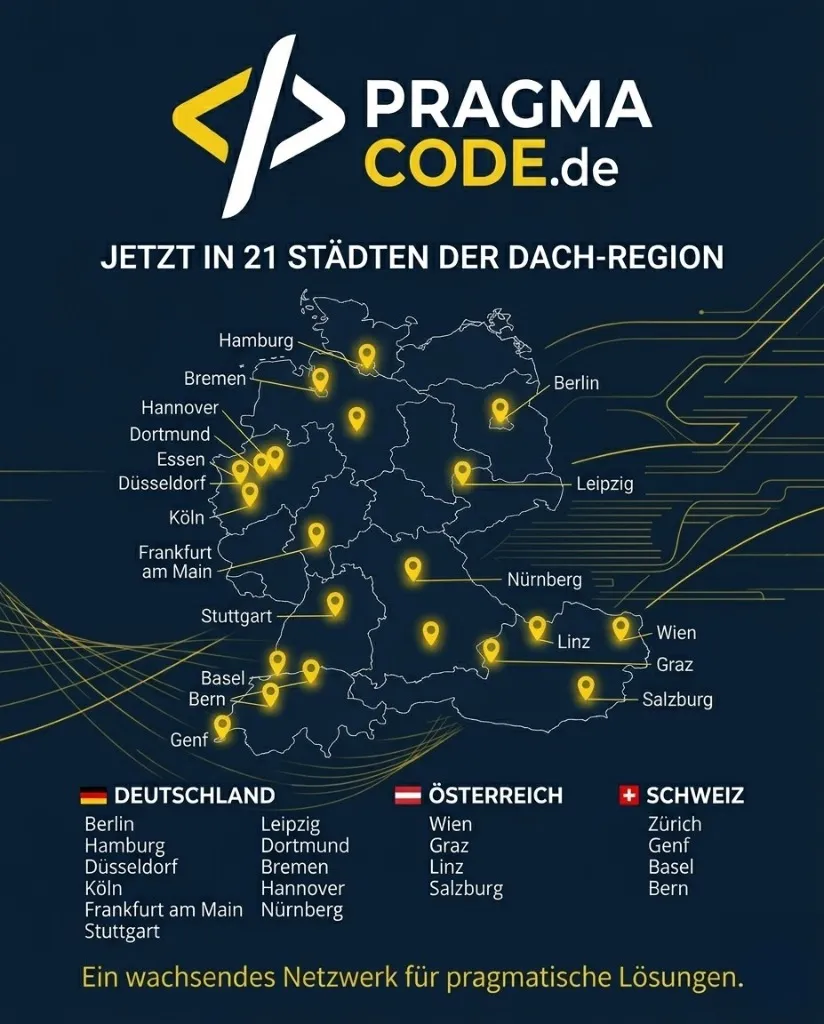
We are your digital partner – regionally anchored and successfully scaling across borders.
Web development for your business?
I deliver this for small and mid-sized businesses: at a fixed price agreed upfront, working directly with the person who builds it. Process, scope and pricing are on the service page.
See service & pricing Or request a free intro callExtended Specialized Glossary
Scrum
An agile framework for project and product management where self-organizing, cross-functional teams build complex software iteratively in short, time-boxed cycles known as sprints.
Sprint
A recurring, fixed time-box (typically 1 to 4 weeks) during which the engineering team plans, executes, and delivers a potentially shippable software increment.
Product Backlog
A dynamic, prioritized inventory of all desired features, technical enhancements, and bug fixes for a software product, curated and maintained by the Product Owner.
Definition of Done (DoD)
A shared, formal quality commitment defining the precise standards (e.g. automated unit tests, peer reviews, accessibility, staging deployment) required for a backlog item to be declared complete.
Agile Software Development
An engineering philosophy prioritizing rapid feedback, frequent delivery of working software increments, and adaptive collaboration over rigid upfront requirement specifications.