

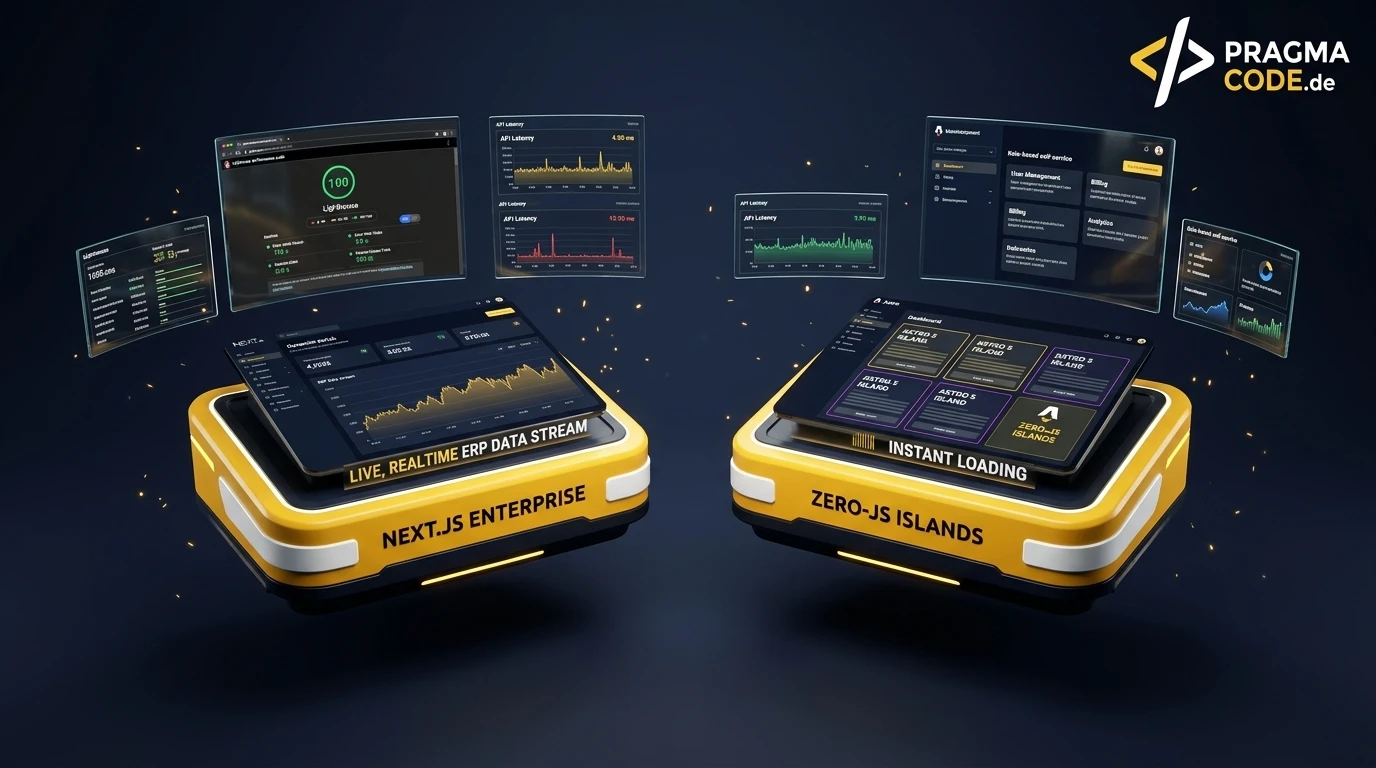
Legacy monolithic CMS platforms like TYPO3 or bloated WordPress configurations have hit a hard architectural ceiling in modern B2B customer self-service. Today's commercial buyers demand instantaneous dynamic pricing, autonomous account workflows, and sub-second execution speeds. In this architectural stack comparison, examine whether Next.js (App Router) or Astro 5 with Island Architecture delivers the superior foundation for your enterprise portal—and how a hybrid architecture yields the best of both worlds.
This article is an in-depth expert contribution from our content cluster. Discover the complete overview on our main page: Web Development & Progressive Web Apps →
The Sluggish Customer Portal as a Conversion Killer
In 2026, enterprise buyers, procurement executives, and distribution partners demand the same frictionless, instantaneous digital interaction they experience in consumer web applications. An enterprise customer portal that displays five-second loading spinners whenever a user requests an invoice download or inventory check degrades brand trust and forces business clients back to manual phone calls and email queues. The choice of underlying architectural framework dictates sub-second execution speeds, resilience under peak traffic, and long-term total cost of ownership.
- Next.js Dominates Complex Application State: Powered by React Server Components (RSC) and the App Router, Next.js is the definitive choice for transactional, state-heavy B2B dashboards requiring fine-grained RBAC and live ERP mutations.
- Astro 5 Leads in Performance & TCO: Through the zero-JavaScript paradigm of Island Architecture, Astro delivers technical documentation, knowledge bases, and product catalogs with perfect 100/100 Core Web Vitals while cutting hosting costs by up to 85%.
- The Hybrid Architecture Imperative: Forward-thinking enterprise organizations deploy a Hybrid Web Architecture: utilizing Astro for high-speed public marketing and documentation sections alongside Next.js for the authenticated customer workspace.
- 1. Requirements for Modern B2B Customer Portals in 2026: What Buyers Demand
- 2. The 4 Pillars of a Future-Proof B2B Portal Architecture
- 3. Technical Comparison: Next.js App Router versus Astro 5 Island Architecture
- 4. The 3-Year TCO Calculation: Development Velocity, Hosting & Maintenance
- 5. The Hybrid Architecture Blueprint: Best-of-Both-Worlds Under One Enterprise Domain
- 6. Authentication & ERP Security: RBAC, Single Sign-On and API Gateways
- 7. Implementation Roadmap: 5 Phases to a Modern B2B Customer Portal
- 8. Conclusion: Zero Compromises on B2B Performance and Operating Costs
1. Requirements for Modern B2B Customer Portals in 2026: What Buyers Demand
Commercial relationships have undergone an irrevocable transformation. Whereas enterprise customer portals historically served as passive document archives for invoice PDFs, in 2026 they function as the mission-critical operational nexus for customer transactions. A contemporary B2B portal must satisfy three foundational demands simultaneously:
First: Autonomous Self-Service. Business clients require instant visibility into negotiated tier pricing, contract parameters, recurring re-orders, and service ticket status—24 hours a day, without waiting for sales desk intervention. Latency during data retrieval directly damages client retention.
Second: Real-Time Synchronization with Core Systems. The portal cannot operate as a detached data silo. Stock levels, dispatch tracking, and financial ledgers must synchronize bi-directionally with backend ERP platforms (SAP S/4HANA, proALPHA, Microsoft Dynamics 365) and CRM systems. Response times exceeding one second are unacceptable in high-volume enterprise transactions (Sub-Second Latency).
Third: Enterprise Security & Multi-Tenant RBAC. Procurement agents, branch managers, and accounting personnel require differentiated role-based access controls. Legacy monolithic architectures fail under this complexity or demand fragile third-party plugin stacks that create severe security liabilities.
Expert Tip: Bounce Rates Correlate Directly with Latency
Operational data across enterprise portals reveals that when order history loading times rise from 800 milliseconds to 3.2 seconds, customer self-service adoption plummets by 38%. Clients abandon the digital interface and revert to manual telephone support—escalating per-incident service costs by a factor of eight.
2. The 4 Pillars of a Future-Proof B2B Portal Architecture
To deliver these capabilities without performance degradation, engineering teams deploy a decoupled Headless Architecture organized across four specialized architectural tiers:
Enterprise Identity & RBAC
Hardened authentication via OpenID Connect (OIDC), SAML 2.0, and Single Sign-On (SSO) integrated with Microsoft Entra ID or Okta. Granular role-based permissions enforce absolute multi-tenant tenant isolation.
High-Speed Rendering (Astro / Next.js)
Decoupled frontend optimized for minimal bundle size. Pure pre-rendered HTML for technical documentation and catalogs; reactive islands for cart operations, filtering, and live configuration modules.
API Gateways & Event Pipelines
A resilient middleware layer (powered by n8n, Node.js, or Rust microservices) that caches and normalizes ERP and CRM data while shielding legacy databases from concurrent traffic surges.
Enterprise ERP & Database Cores
The enterprise ERP (SAP, proALPHA) remains the immutable single source of truth for pricing structures, stock counts, and financial ledgers, isolated securely from public web exposure.
3. Technical Comparison: Next.js App Router versus Astro 5 Island Architecture
The definitive technical choice confronting engineering leaders is: Next.js or Astro? While both frameworks lead the modern TypeScript ecosystem, they represent fundamentally different architectural philosophies:
Framework Comparison: Next.js App Router vs. Astro 5 Island Architecture
- Rendering Paradigm: Full React ecosystem leveraging Server Components (RSC) and Client Components.
- Client JavaScript: Substantial runtime payload required for React hydration and in-browser state management.
- State Orchestration: Superior for deeply nested, stateful dashboards and continuous form mutations.
- Hosting Infrastructure: Requires Node.js execution environments or serverless edge compute (Vercel, AWS).
- Optimal Use Cases: Interactive transactional workspaces, billing suites, and live ordering portals.
- Rendering Paradigm: Zero-JS by default; selective client hydration of isolated interactive components.
- Client JavaScript: Near-zero KB payload for static pages; scripts load only where islands are explicitly declared.
- Framework Flexibility: Component-agnostic (React, Vue, Svelte, or vanilla JS can be mixed seamlessly).
- Hosting Infrastructure: Deploys as pure static HTML across cost-effective global CDNs (Cloudflare, IONOS).
- Optimal Use Cases: Technical documentation portals, product catalogs, knowledge centers, and support hubs.
4. The 3-Year TCO Calculation: Development Velocity, Hosting & Maintenance
For executive leadership, long-term architectural success is governed by the Total Cost of Ownership (TCO) across a 36-month horizon. We analyzed cost models for a typical B2B portal serving 15,000 active commercial users:
1. Hosting & Infrastructure Expenditure
Astro: Utilizing static site generation on edge CDNs results in predictable hosting fees of approximately €20 to €80 per month. Next.js: Dynamic SSR execution and serverless invocation tiers average €180 to €600 monthly. Legacy monoliths (TYPO3) frequently exceed €400 to €1,200 due to dedicated database server requirements.
2. Maintenance, Patching & Vulnerability Management
Astro & Next.js: As Git-governed headless architectures devoid of fragile third-party plugin markets, emergency security patching is largely eliminated. Ongoing maintenance overhead drops by 65% compared to traditional CMS environments that face perpetual CVE vulnerabilities.
3. Development Velocity & Extensibility
Next.js offers accelerated feature delivery for complex data grids and interactive reporting tools thanks to the vast React component ecosystem. Astro excels through modular agility: teams can construct UI components using React, Svelte, or plain JavaScript without specialized talent constraints.
5. The Hybrid Architecture Blueprint: Best-of-Both-Worlds Under One Enterprise Domain
The decisive insight from enterprise implementations is clear: you do not need to restrict your architecture to a single framework. The gold standard for mid-sized market leaders is deploying a unified Hybrid Web Architecture.
Behind a consolidated domain (e.g., portal.enterprise.com), a performant reverse proxy (Cloudflare Workers, Nginx, or AWS CloudFront) seamlessly routes traffic:
Astro: Technical Documentation & Knowledge Hub
All static sections—including engineering documentation, CAD repositories, user manuals, and searchable product catalogs—run on Astro 5. Benefits: instant page loads, flawless search indexing, and negligible infrastructure costs.
Next.js: Authenticated Transactional Workspace
The password-protected portal dashboard (/dashboard, /orders, /checkout) operates as an authenticated Next.js web application, providing immediate UI responsiveness and real-time ERP data streams.
Unified Design Tokens & Seamless SSO
For commercial clients, the framework transition is completely invisible: typography, design tokens, button styles, and the Single Sign-On session transition flawlessly across both environments.
6. Authentication & ERP Security: RBAC, Single Sign-On and API Gateways
In B2B commerce, data integrity and confidentiality are paramount. A data leak exposing proprietary pricing discounts or confidential technical drawings causes catastrophic reputational and legal consequences. Enterprise portal architectures must incorporate three lines of defense:
1. FIDO2 / Passkeys & Enterprise SSO
Eliminate vulnerable shared passwords. Users authenticate biometrically via Passkeys or through their company credentials via Microsoft Entra ID or Okta, slashing password-related support tickets by over 90%.
2. Decoupled API Gateways Over Direct Database Connections
The web layer never connects directly to the ERP database. An isolated API gateway (orchestrated via n8n or Rust microservices) validates every payload, enforces rate limiting, and protects backend systems from DDoS threats.
3. Fine-Grained Tenant & Role-Based Permissions
Rigorous RBAC prevents shop-floor workers from inspecting sensitive company-wide invoices, while procurement directors retain full managerial authorization and budgetary approval rights.
7. Implementation Roadmap: 5 Phases to a Modern B2B Customer Portal
Replacing legacy monolithic portals is executed most safely using the Strangler Fig migration pattern:
-
Phase 1: Workflow Analysis & API Contract Definition
Map core self-service journeys. Specify standardized REST/GraphQL endpoints linking ERP, CRM, and PIM systems with strict validation schemas.
-
Phase 2: Accessible Design System & Auth Foundation
Establish a WCAG-compliant design system and deploy the OIDC/SAML enterprise authentication gateway.
-
Phase 3: Pilot Launch: Documentation & Support Hub (Astro)
Deploy the high-velocity knowledge center and catalog on Astro, delivering immediate support deflection for customer care teams.
-
Phase 4: Transactional Dashboard Rollout (Next.js)
Launch interactive order histories, live tier pricing calculators, and warranty ticketing for selected enterprise pilot accounts.
-
Phase 5: Full Account Migration & Monolith Decommissioning
Onboard remaining accounts onto the hybrid platform and systematically decommission obsolete legacy infrastructure.
Quick-Check: Which Architecture Fits Your Portal Vision?
8. Conclusion: Zero Compromises on B2B Performance and Operating Costs
The era in which commercial clients tolerated sluggish, unintuitive, and brittle enterprise portals has permanently closed. In 2026, millisecond response latencies dictate buyer retention and operational efficiency. Monolithic CMS frameworks are obsolete for enterprise self-service.
With Next.js for high-intensity application workflows and Astro for blazing static content delivery, engineering leaders have two mature, battle-tested tools at their disposal. Harmonizing both frameworks in a unified hybrid architecture equips your enterprise with future-proof scalability, minimal TCO, and delighted customers. At Pragma-Code, we specialize in architecting and delivering high-performance B2B portal solutions tailored to your growth.
Official Sources & Primary Documentation
- Astro Documentation (2026): "Astro Islands Architecture & Server Islands Specification" – Official technical framework documentation on component isolation.
- Next.js by Vercel: "Next.js App Router & React Server Components Documentation" – In-depth guide to server-side data fetching and caching models.
- W3C Web Performance Working Group: "Core Web Vitals & Sub-Second Performance Metrics" – Official technical standards for frontend responsiveness and layout stability.
Planning a Modern, High-Performance B2B Customer Portal?
Schedule a Free Architectural ConsultationOur Regional Expertise
We are your digital partner – regionally anchored and successfully scaling across borders.
Have a vision?
Let's check together how we can make your idea take flight.
Book your free strategy call nowExtended Specialized Glossary
Island Architecture
A modern web architecture pattern where pages render as pure, static HTML by default and only isolated, interactive components (islands) are hydrated selectively with client-side JavaScript.
Hybrid Web Architecture
The strategic composition of complementary frameworks (e.g., Astro for documentation, Next.js for transactional dashboards) unified under a single domain routing layer.
Sub-Second Latency
System response and API execution times strictly below 1,000 milliseconds, crucial for driving user engagement in B2B enterprise self-service portals.
React Server Components (RSC)
Components that execute strictly on the server to eliminate client-side JavaScript bundle weight and streamline direct database queries.
TCO (Total Cost of Ownership)
A comprehensive lifecycle evaluation of software expenditures, incorporating development, cloud hosting, licensing, and ongoing maintenance.
Headless Architecture
The decoupling of the frontend presentation layer from the backend database logic, connected via high-performance API endpoints.