

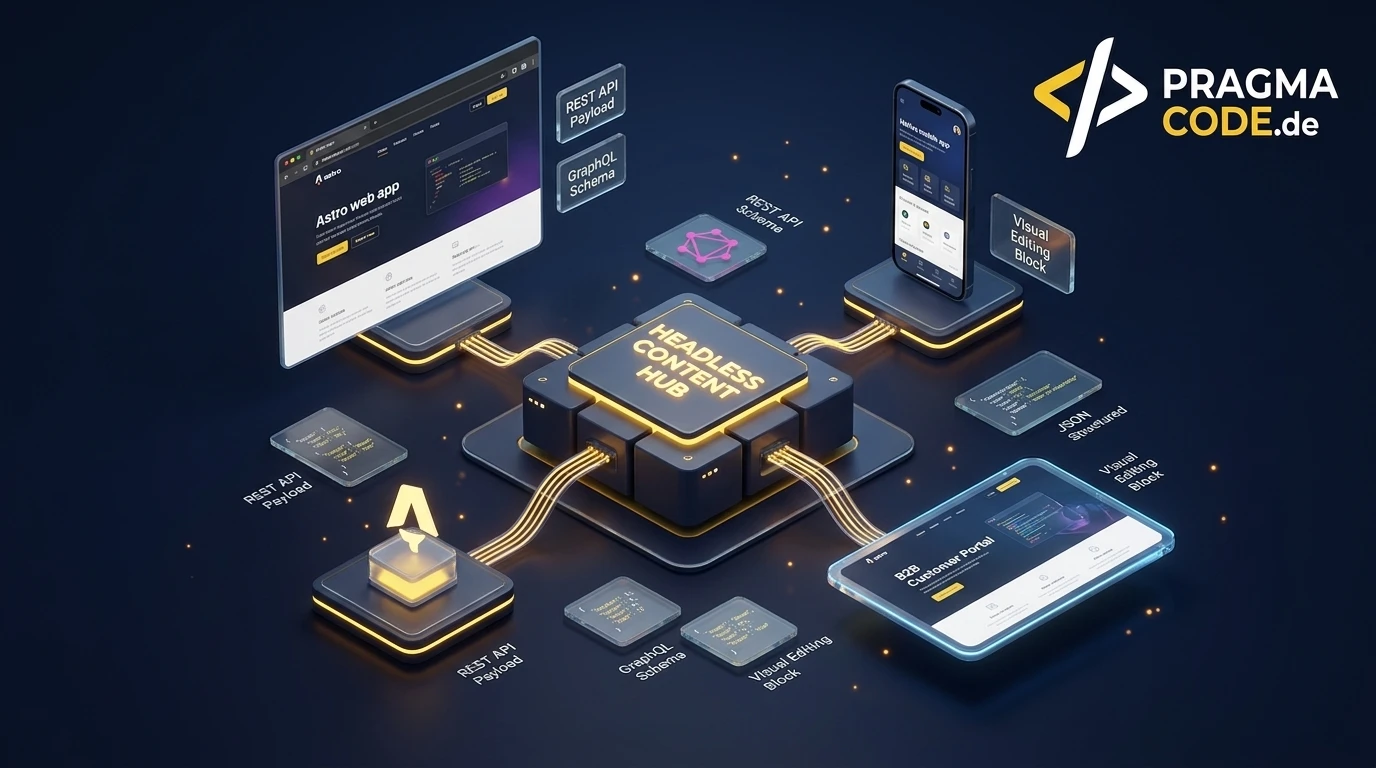
Traditional monolithic CMS platforms like WordPress or Drupal are hitting their performance and security limits in modern SME environments. Discover how decoupled headless CMS architectures with Next.js and Astro deliver sub-second speeds, impenetrable security, and flexible omnichannel content delivery for B2B enterprises.
This article is an in-depth expert contribution from our content cluster. Discover the complete overview on our main page: Web Development →
From Rigid CMS Monoliths to Agile API-First Content Platforms
For more than two decades, the standard playbook for small and medium-sized enterprises (SMEs) was straightforward: when launching a corporate website, deploy WordPress, Typo3, or Drupal. However, the technical requirements for B2B companies have transformed radically. Today, business clients demand sub-second load times on mobile devices, marketing departments require unified omnichannel campaigns across corporate portals and mobile apps, and IT leadership faces escalating cybersecurity regulations demanding an end to vulnerable third-party plugin ecosystems. The answer to these challenges is a Decoupled Architecture: A Headless CMS decouples editorial content authoring completely from client-side rendering.
Radical Frontend Freedom & Peak Performance
By separating the content repository from the presentation layer, modern frontends built with Astro or Next.js load up to 4 times faster than legacy PHP monoliths. Core Web Vitals effortlessly achieve perfect 100/100 Lighthouse scores.
A Unified Content Hub for Every Channel
A single centralized Content Hub simultaneously feeds your corporate website, secure B2B customer self-service portal, field-service mobile applications, and internal AI retrieval-augmented generation (RAG) agents via GraphQL and REST endpoints.
Maximum Cybersecurity & GDPR Sovereignty
Because end users only interact with pre-rendered, static HTML and edge assets, there is no direct public connection to your production database. SQL injection vectors and vulnerabilities stemming from insecure third-party plugins are completely eliminated.
Context & Positioning: While our comprehensive guide on Astro vs. WordPress outlines the speed advantages of static site generation and our analysis of B2B Customer Portals investigates dynamic authenticated environments, this technical brief focuses specifically on the underlying content engine: Selecting, architecting, and operating Headless CMS platforms in modern European and international SME organizations.
1. What is a Headless CMS and How Does the Architecture Work?
The core question „What is a headless CMS?“ is best understood through an anatomical metaphor: In a traditional content management system (such as WordPress, Typo3, or Drupal), the „body“ (the relational database and backend editorial dashboard) and the „head“ (the visual presentation layer consisting of HTML, CSS, and server-side PHP templates) are tightly coupled together. Every editorial modification, security patch, and installed plugin inevitably impacts both layers simultaneously.
A Headless CMS conceptually severs this head. It focuses exclusively on providing an intuitive authoring experience for editors and storing raw, structured content (JSON). The CMS does not dictate how, where, or in what visual styling that content appears to end users. Content is exposed cleanly over standardized application programming interfaces (APIs like REST or GraphQL).
The 4 Layers of Modern Headless Architecture
In enterprise engineering, a robust headless architecture consists of four distinct, decoupled tiers interacting over rigid API contracts:
1. Headless Content Hub
The centralized editorial management suite (such as Strapi, Directus, or Storyblok) where copy, multilingual localization, technical catalog specs, and digital media are modeled format-agnostically.
2. GraphQL & REST API Gateway
The high-throughput transport layer. Secure token-authenticated endpoints and automated webhooks push real-time updates to edge nodes or serve targeted payload queries.
3. Decoupled Edge Frontends
Ultra-fast client-facing applications built with modern frameworks like Astro (for content-driven marketing sites) or Next.js (for dynamic customer portals and enterprise web applications).
4. Multi-Channel Consumers
Beyond traditional desktop browsers, the same verified CMS repository fuels native iOS/Android mobile apps, interactive showroom kiosks, automated PDF spec sheet compilers, and corporate RAG chatbots.
Structured Content Modeling vs. Chaotic Page-Builder Sprawl
A pivotal shift in headless adoption centers on editorial authoring. In legacy monolithic environments like WordPress, marketing teams frequently rely on visual drag-and-drop page builders (such as Elementor, Divi, or WPBakery). While accessible initially, these tools produce bloated „shortcode spaghetti“: visual styling directives, inline CSS, and nested markup become inextricably fused with raw factual copy inside SQL tables. Reusing that data in a native mobile application or enterprise catalog generator becomes practically impossible.
In contrast, a headless CMS enforces disciplined Content Modeling: Copy and media are organized into typed, semantic schema fields. A complex industrial machinery spec sheet is not stored as an opaque HTML blob, but as structured JSON attributes:
{
  "product_id": "PRD-2026-X9",
  "title": "High-Precision 5-Axis CNC Milling Module ProLine",
  "slug": "cnc-milling-module-proline",
  "specifications": {
    "spindle_speed_rpm": 24000,
    "axis_count": 5,
    "power_rating_kw": 18.5,
    "cooling_type": "hybrid_internal"
  },
  "certifications": ["CE", "ISO-9001", "UL-Listed"],
  "marketing_lead": "Engineered for aerospace manufacturing with 99.8% guaranteed production uptime.",
  "downloads": [
    {
      "title": "Technical Datasheet PDF",
      "url": "https://assets.company.com/docs/proline-specs-en.pdf"
    }
  ]
}
This structured JSON paradigm delivers substantial engineering and commercial advantages:
Universal Reusability (COPE: Create Once, Publish Everywhere)
The technical metric 18.5 kW is curated exactly once in the headless backend. The corporate marketing website renders it within an interactive comparison table, the automated print engine embeds it into an exportable PDF, and the distributor portal uses it for parametric filtering.
Compile-Time Type Safety for Frontend Developers
Modern frontend engineering with TypeScript automatically generates static interfaces directly from your headless CMS schema. Broken references, missing required fields, or misspelled attributes are caught during build time—long before an editor pushes content live.
How Modern Frontends Consume Data from a Headless CMS
Connecting a modern frontend to a headless CMS involves lightweight API clients rather than complex database connections. For example, in the Astro framework, data is pre-rendered at build time (Static Site Generation, SSG), resulting in zero milliseconds of database latency for visitors:
// src/pages/products/[slug].astro
export async function getStaticPaths() {
  // 1. Fetch data directly from the headless CMS REST or GraphQL endpoint
  const response = await fetch('https://cms.company.com/api/products?populate=*', {
    headers: {
      'Authorization': `Bearer ${import.meta.env.STRAPI_API_TOKEN}`
    }
  });
  const { data: products } = await response.json();

  // 2. Generate pre-rendered static routes for each individual catalog product
  return products.map((item) => ({
    params: { slug: item.slug },
    props: { product: item }
  }));
}

const { product } = Astro.props;
Monolithic CMS vs. Headless CMS: Architectural System Comparison
Why are forward-thinking SMEs actively migrating away from traditional all-in-one monoliths? A direct comparison of foundational characteristics highlights the systemic bottlenecks of legacy architectures:
Architectural Comparison: Monolithic CMS vs. Headless CMS
- Coupling: Backend, MySQL database, PHP execution logic, and HTML rendering reside on the exact same server instance.
- Performance: Every visitor request triggers server-side PHP execution and database queries unless masked by fragile caching plugins.
- Security: Public administrative login routes (
/wp-admin) and unvetted third-party plugins create continuous attack vectors. - Maintenance: Heavy operational overhead for continuous security patching; minor core updates frequently break plugin dependencies.
- Vendor Lock-in: Engineering teams are locked into the CMS's proprietary templating engine and legacy PHP runtime.
- Channel Limitations: Strictly tailored for standard web browsers; feeding native apps or partner APIs requires fragile connector plugins.
- Coupling: Strict physical and logical separation between content management backends and frontend presentation layers via APIs.
- Performance: Static Site Generation (SSG) or intelligent global edge caching delivers pre-baked web assets in mere milliseconds.
- Security: Public-facing frontends possess zero database access; editorial dashboards can be completely isolated behind private VPNs.
- Maintenance: Zero plugin dependencies in the frontend; backend CMS maintenance updates never cause live website outages.
- Engineering Agility: Frontends are built using modern web standards (TypeScript, React, Astro, Vue) with zero framework lock-in.
- Omnichannel: A single authoritative content repository synchronizes corporate sites, portals, native mobile apps, and AI agents.
2. Key Strategic Advantages for Modern B2B Websites & Portals
Migrating to a headless architecture is not merely an engineering indulgence; it represents a tangible commercial lever for medium-sized enterprises. In practice, three primary operational areas experience immediate returns:
Exceptional Core Web Vitals & Organic Search Rankings
Search engines like Google have treated page load speed, responsiveness, and visual stability (Core Web Vitals) as definitive ranking signals for years. Monolithic content management systems frequently drag dozens of kilobytes of unused CSS, deprecated jQuery scripts, and render-blocking database calls into every page request.
When a headless CMS is paired with a modern compiler like Astro, the compilation process outputs pure, optimized HTML and CSS with zero unnecessary runtime JavaScript. The real-world results are definitive:
Sub-50ms Time-to-First-Byte (TTFB) Globally
Because marketing pages are distributed as pre-rendered static assets across distributed edge networks (Cloudflare, Vercel, IONOS), server response times remain under 50 milliseconds worldwide, regardless of traffic spikes.
Immunity to DDoS & Traffic Surges
A malicious botnet or viral marketing campaign can bombard a static edge deployment with millions of concurrent requests without overwhelming a live backend database. Operational availability remains steady at 99.99%.
Enterprise Cybersecurity & GDPR Data Sovereignty
The cybersecurity threat landscape facing European and international mid-market enterprises has escalated dramatically. Under regulatory mandates such as the EU NIS-2 Directive, corporate officers face direct personal accountability for IT system resilience. Monolithic systems like WordPress present an expansive attack surface: over 90% of documented CMS vulnerabilities originate from third-party plugins or deprecated PHP dependencies.
Headless architectures offer systemic resilience through physical and architectural isolation:
Private Network Isolation of Authoring Backends
The authoring CMS dashboard does not need to be publicly exposed on the open internet. It can operate entirely behind an internal corporate firewall, a secure VPN, or a Zero Trust identity tunnel (such as Cloudflare Access).
Elimination of Public SQL Injection Vectors
Public visitors interact exclusively with pre-compiled HTML, CSS, and WebP media distributed over CDN nodes. There is no active execution context or database connection capable of being exploited via SQL injection.
Single Source of Truth & Seamless Enterprise AI Integration
A persistent operational friction in B2B SMEs involves fragmented content silos: marketing specifications live in the website CMS, technical manuals exist in separate PDF repositories, and the B2B Customer Portal retrieves specifications from an isolated database. When a technical parameter updates, staff must manually revise three separate systems.
With a headless CMS, media-neutral Content Modeling establishes an authoritative single source of truth. Product data is recorded exactly once. The public marketing site renders it, the customer portal queries the identical API, and internal retrieval-augmented generation (RAG) AI chatbots ingest verified specs directly from GraphQL endpoints. Data drift and AI hallucinations are eliminated at the source.
Strategic Tip: Never Neglect the Editorial Authoring Experience
The most common failure in early headless implementations was alienating non-technical content editors. Requiring marketing personnel to fill out abstract form fields and publish blindly without immediate visual feedback damages productivity. Modern headless platforms like Storyblok and Sanity solve this challenge through Visual Live Preview: editors navigate the live frontend layout, modify modular blocks via drag-and-drop, and preview changes in real time.
Headless Commerce: High-Conversion Architectures for B2B Catalogs
For B2B manufacturers and distributors managing intricate product variants, tiered corporate pricing, and custom inquiry workflows, standard out-of-the-box shopping carts quickly fall short. Headless architecture allows businesses to blend editorial storytelling with robust transactional mechanics:
Decouple Existing Storefronts Without Re-Platforming
Enterprises running established WooCommerce installations can maintain their familiar backend order processing while replacing sluggish PHP templates with lightning-fast Next.js storefronts (explore our practical guide on Headless WooCommerce with Next.js).
Enterprise Scalability Free from Revenue Penalties
Fast-scaling B2B brands often face prohibitive transaction revenue fees with monolithic platforms like Shopify Plus. As detailed in our financial breakdown on Shopify Plus vs. Headless Next.js TCO, a custom headless commerce deployment delivers massive cost savings starting in year two.
3. Top Headless CMS Providers 2026 Compared (Strapi, Directus, Storyblok, Sanity)
The headless software ecosystem has matured significantly. For mid-market B2B enterprises, four dominant platforms have emerged, distinguished by their operational hosting model (self-hosted open source vs. managed cloud SaaS) and target users:
1. Strapi – The Open-Source Standard for 100% GDPR Data Sovereignty
Strapi represents the world’s most widely adopted open-source Node.js headless CMS. With the release of Strapi 5, the platform delivers improved plugin extensibility, granular content audit histories, and refined draft-and-publish approval flows. Strapi can be deployed entirely on self-managed infrastructure within EU-based data centers (e.g. Hetzner, OVH, or IONOS). Enterprises retain complete data sovereignty with zero vendor lock-in. Featuring customizable content types, granular role-based access control (RBAC), and automated REST and GraphQL generation, it remains the premier choice for compliance-driven manufacturers and privacy-focused SMEs.
2. Directus – Instant API & Management Layer for Relational SQL Databases
Directus takes an architectural approach that technical teams love: rather than enforcing an opinionated proprietary data store, Directus connects directly on top of existing PostgreSQL, MySQL, SQLite, or Microsoft SQL Server databases. It mirrors your existing database schema 1-to-1 into an intuitive web administration panel while instantly generating secure REST and GraphQL endpoints. This makes Directus uniquely powerful for companies where ERP, PIM, or internal CRM systems already populate relational SQL tables that need to be surfaced to web frontends. Native WebSocket support enables real-time dashboards without supplementary messaging middleware.
3. Storyblok – The Visual Authoring Favorite for Marketing Teams
Storyblok is an Austrian-founded managed cloud SaaS platform hosting all infrastructure within EU data centers. Its primary competitive advantage is an exceptional visual editor: marketing teams can assemble modular components via visual drag-and-drop and edit text directly within the live rendered frontend preview. Storyblok combines the architectural decoupling of a true headless system with the tactile ease of a modern site builder—an ideal balance for growing B2B enterprises with autonomous marketing departments. An integrated Digital Asset Management (DAM) suite automatically handles responsive image optimization and worldwide CDN distribution.
4. Sanity – The Composable Content Cloud for Complex Data Ecosystems
Sanity redefines content not as flat pages, but as an interconnected data graph. Featuring an open-source, customizable React/TypeScript editorial application known as Sanity Studio, development teams can craft bespoke editorial workflows tailored to intricate enterprise specifications. Using Sanity's proprietary open query language, GROQ, engineers can perform complex relational joins and filters in a single request. Sanity is unmatched in real-time multi-editor collaboration and deeply structured omnichannel catalogs where content must synchronize across dozens of digital touchpoints.
Comprehensive Feature & Suitability Matrix
The comparative table below outlines the core technical specifications and operational profiles of the four leading headless platforms:
| Evaluation Criteria | Strapi 5 | Directus | Storyblok | Sanity Studio |
|---|---|---|---|---|
| Deployment Model | Self-Hosted Private Server (Node.js) / Cloud | Self-Hosted Private Server (Docker) / Cloud | Managed SaaS EU Cloud (Data Center Austria) | Content Lake Managed Cloud Backend + Open Studio |
| Licensing Structure | Open Source Community (Free) & Enterprise | Open Source BSL 1.1 / Free Tier for SMEs | Proprietary SaaS Monthly User & Traffic Subscriptions | Freemium Cloud Free Quota + Pay-as-you-go |
| Database Architecture | Flexible Choice PostgreSQL, MySQL, MariaDB, SQLite | Existing SQL DB Direct Connection to Postgres/MySQL/MSSQL | Cloud-Managed Fully Abstracted Storage | Document Graph NoSQL Content Lake (JSON Documents) |
| Visual Live Preview | Basic Preview Supported via Community Plugins | Live Preview Via Frontend Routing & Live Hooks | Best-in-Class Native Drag-and-Drop Visual Editor | Very Strong Sanity Presentation Tool & Live Sync |
| APIs & Protocols | REST & GraphQL Webhooks & Custom API Endpoints | REST, GraphQL & WS Native WebSockets for Real-Time Dashboards | REST & GraphQL High-Speed Global Edge CDN | GROQ & GraphQL Real-Time Event Streaming & GROQ Joins |
| Ideal SME Fit | 100% GDPR Data Sovereignty Sensitive On-Premises Infrastructure | ERP & Relational SQL Data Modernize Existing Enterprise Tables | Marketing & Content Teams Maximum Editorial Visual Autonomy | Complex Omnichannel Systems Interconnected Data & Developer Control |
4. Decision Matrix, 3-Year TCO & Migration Roadmap
Selecting the optimal headless platform depends directly on your internal development capacity, regulatory compliance profile, and editorial workflows:
Strategic Framework: Which Headless CMS Best Fits Your Business?
Financial Analysis: 3-Year Total Cost of Ownership (TCO)
A prevalent misconception regarding headless architectures is that „decoupled systems are substantially more expensive than standard WordPress setups.“ While initial development investment for custom frontend engineering may be slightly higher, a comprehensive three-year total cost of ownership analysis proves otherwise:
Monolithic WordPress Operations (The Hidden Maintenance Trap)
Monthly patch cycles, regression fixes after core updates, ongoing premium plugin licenses, and frequent emergency agency interventions steadily erode IT budgets. Furthermore, redesigning the site every 3 to 4 years requires rebuilding the entire system from the ground up.
Decoupled Headless Architecture (Predictable, Minimal Overhead)
Because the presentation layer is isolated from the database, the frontend design can be refreshed in the future without disrupting the underlying editorial database schema. Static edge distribution on Cloudflare or IONOS costs a fraction of dedicated managed PHP clusters while minimizing security downtime.
Case Study: How an Industrial Manufacturer Cut Maintenance Costs by 60%
A representative case from our consulting engagements illustrates this dynamic: A German precision machinery manufacturer with 180 employees managed a legacy WordPress multisite instance across four regional languages. Burdened by 45 disparate plugins, average mobile page load times exceeded 3.8 seconds. Each routine plugin update endangered live lead forms and product catalogs.
The solution: The enterprise migrated its catalog into a self-hosted Directus backend hosted on secure domestic infrastructure. The public web frontend was rebuilt from scratch using Astro. After six months in production, the outcomes were clear:
Page Load Reduction from 3.8s to 380ms
Time-to-Interactive decreased by 90%. Google Lighthouse performance ratings jumped from 38 to a clean 99/100, generating a direct, measurable lift in qualified organic B2B inquiries.
Zero Emergency Maintenance Outages
Editorial teams update technical specifications once within Directus. The automated Astro build pipeline compiles and deploys static production assets globally in under 45 seconds.
In 5 Steps from Monolith to Modern Headless Architecture
Transitioning away from a legacy CMS does not require an unpredictable „big bang“ cutover. We advise mid-market companies to follow a structured, phased migration methodology:
-
1. Content Audit & Data Modeling
Perform an exhaustive inventory of all existing content types. Unstructured legacy blog and page copy is systematically mapped into reusable, modular components (e.g. hero banners, feature grids, client testimonials, and structured FAQ entities).
-
2. CMS Provisioning & Role Setup
Deploy Strapi or Directus within a secured container cluster or initialize a dedicated Storyblok European cloud workspace. Configure role-based permissions (authors, editors, admins) and automated webhook endpoints.
-
3. Automated Content Migration
Engineer reliable ETL scripts (utilizing Python or n8n workflow pipelines) to extract legacy data via REST APIs or database dumps, sanitize messy HTML, and populate the new headless content schemas.
-
4. Frontend Development with Astro or Next.js
Develop the accessible, ultra-fast presentation layer. Integrate GraphQL and REST queries, configure visual live previews, and optimize all Core Web Vitals to achieve 100/100 Lighthouse benchmarks.
-
5. Zero-Downtime Go-Live & Edge Deployment
Switch domain DNS routing to global edge delivery networks, configure strict 301 redirection rules for legacy URL patterns, and conduct editorial onboarding sessions for the publishing team.
Planning Your Transition to a Modern Headless CMS?
Schedule a Free Technical Consultation5. Sources & Official Documentation (As of October 2026)
- Strapi Official Documentation & Open Source Architecture: Official developer specifications and Node.js self-hosting guides (docs.strapi.io, accessed October 2026).
- Directus Documentation: Official Open Data Platform documentation and SQL schema mirroring architecture (docs.directus.io, accessed October 2026).
- Storyblok Visual CMS Architecture: Guide to component-based content modeling and real-time visual editing (storyblok.com/docs, accessed October 2026).
- Sanity Composable Content Cloud: Specification on GROQ query optimization and Sanity Studio React framework (sanity.io/docs, accessed October 2026).
- W3C & Google Core Web Vitals Guidelines: Industry standards for page performance metrics (LCP, INP, CLS) in decoupled web architectures (web.dev).
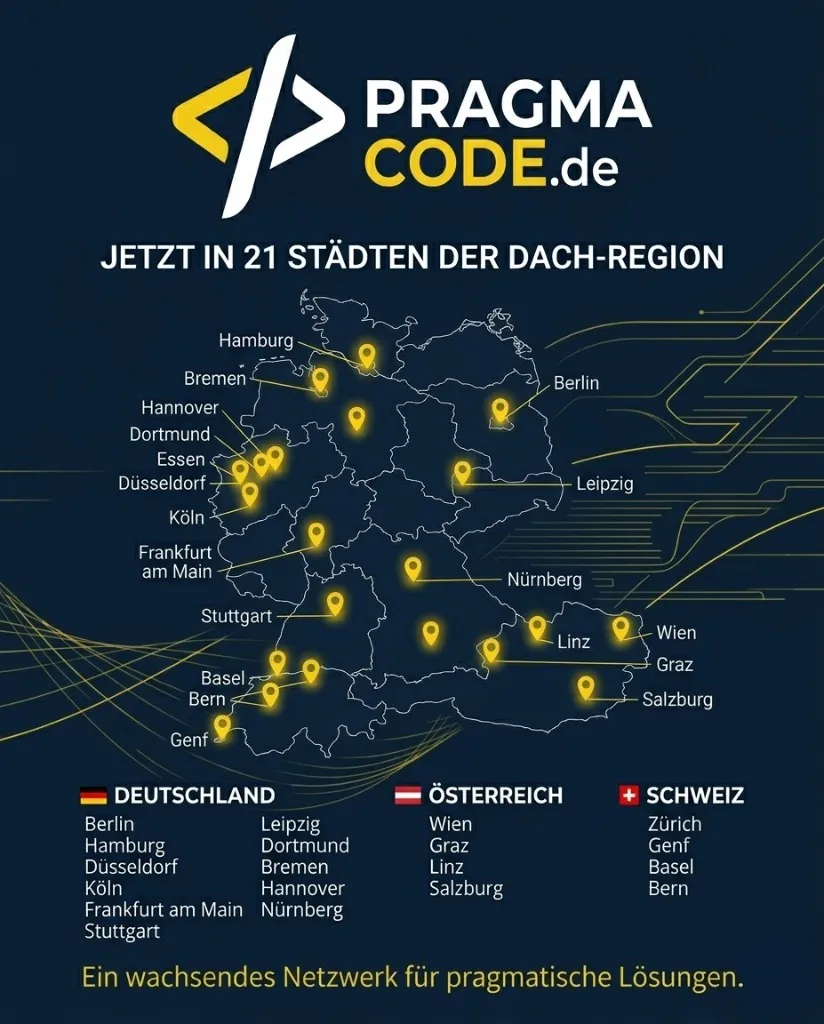
Our Regional Expertise
We are your digital partner – regionally anchored and successfully scaling across borders.
Have a vision?
Let's check together how we can make your idea take flight.
Book your free strategy call nowExtended Specialized Glossary
Headless CMS
A content management system without a hard-wired frontend presentation layer, delivering content exclusively via structured APIs (REST or GraphQL).
Content Hub
A centralized platform for managing digital content format-agnostically across websites, mobile apps, customer portals, and AI assistants.
Decoupled Architecture
The complete architectural separation between backend content storage and frontend rendering layers to maximize security and scalability.
Visual Live Preview
An interactive real-time preview mechanism within headless systems enabling editors to modify content directly within the rendered frontend interface.
GROQ
Graph Relational Object Queries: A powerful open-source query language developed by Sanity for structured JSON document filtering.
Content Modeling
The structured definition of reusable content types, taxonomies, and relational fields independent of specific output display channels.