

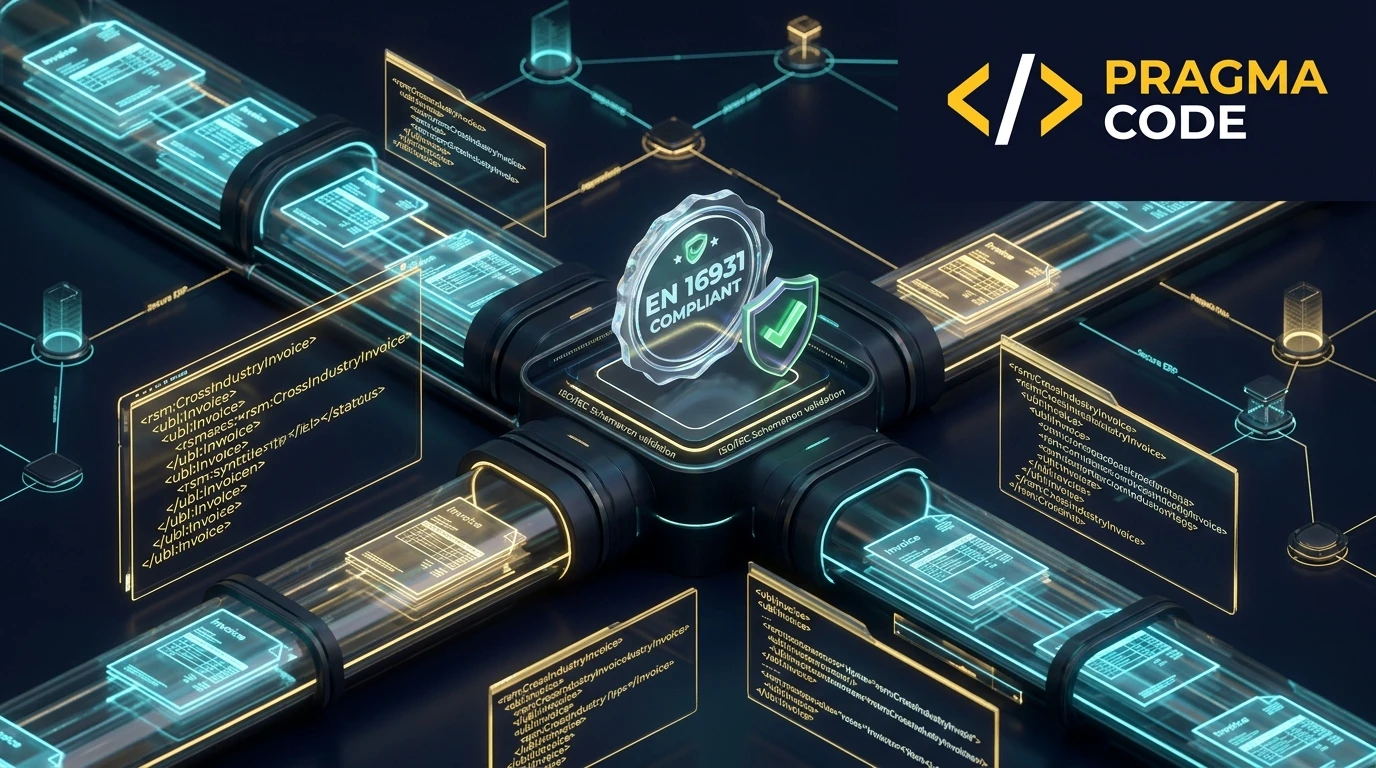
While many organizations still mistake e-invoicing for a routine tax update, the actual battlefield lies within software architecture: European standard EN 16931 establishes a rigid semantic data model and strict XML syntaxes. In this technical deep-dive, discover how to implement UBL and UN/CEFACT CII without syntax errors, automate two-stage Schematron validation, and integrate resilient e-invoicing pipelines into existing enterprise ERP systems.
This article is an in-depth expert contribution from our content cluster. Discover the complete overview on our main page: IT Security & Compliance →
From PDF Misconceptions to True API Pipelines – Why EN 16931 Is a Software Engineering Challenge, Not a Bookkeeping Routine
Across countless small and mid-sized enterprises (SMEs), a critical misconception still prevails: the belief that attaching a standard visual PDF to an outgoing email satisfies digital invoicing requirements. European legislation and national tax authorities tell a very different story: Under EU Directive 2014/55/EU and national mandates such as Germany's Growth Opportunities Act, businesses are legally obligated to issue structured electronic invoices conforming to the European standard EN 16931. If an incoming XML payload fails due to missing mandatory elements (Business Terms), rounding discrepancies across VAT categories, or invalid UNTDID codes, automated ERP gateways reject the invoice outright. The immediate consequences: frozen cash flows, procurement halts, and hours of costly manual debugging. This technical guide equips software architects, IT managers, and enterprise engineers with the architectural principles required for flawless implementation.
Semantic Uniformity Over File Anarchy
The EN 16931 standard harmonizes over 65 semantic Business Terms (BT). Every invoice field — from invoice identifiers to tax breakdown nodes — has a mathematically unambiguous, pan-European commercial and fiscal definition.
Two Official Syntaxes – UBL and UN/CEFACT CII
The standard intentionally standardizes two XML syntax bindings: OASIS UBL (the standard for pure XRechnung XML & Peppol BIS) and UN/CEFACT CII (the standard for hybrid ZUGFeRD 2.3 / Factur-X PDFs). Both serialize the identical semantic core.
Rigid Schematron Validation as Mandatory Gate
Syntactic XML well-formedness is insufficient. Only invoices that pass both XSD schema validation and ISO/IEC Schematron business rule verification via tools like the KoSIT Validator are legally valid, audit-compliant, and processable.
- 1. What Is the EN 16931 Standard? Origins, Scope & Legal Framework
- 2. The Semantic Data Model in Detail: Business Terms (BT) & Mandatory Elements
- 3. Syntax Comparison in Code: OASIS UBL vs. UN/CEFACT CII
- 4. Validation in Practice: XSD Schema vs. KoSIT Schematron
- 5. Format Comparison: XRechnung vs. ZUGFeRD 2.3 vs. Peppol BIS Billing
- 6. Developer & IT Roadmap: Integrating E-Invoice Pipelines into Existing ERPs
- 7. The 4 Most Common EN 16931 Validation Traps in SMEs & Troubleshooting
- 8. References & Official Standard Documentation
Context & Scope: While our overarching analysis of the E-Invoicing Mandate & Deadlines covers regulatory milestones and transition periods, this technical guide provides a complete architectural reference implementation for software developers, ERP system administrators, and IT decision-makers navigating mid-market digital supply chains.
1. What Is the EN 16931 Standard? Origins, Scope & Legal Framework
For several decades, European electronic invoicing was fragmented across a chaotic landscape of proprietary EDI systems, bespoke bilateral arrangements, and incompatible file formats. Whether utilizing traditional EDIFACT, automotive industry dialects, or raw PDF files, nearly every ERP vendor built isolated transaction silos. Recognizing this friction as a massive barrier to cross-border commerce, the European Parliament enacted Directive 2014/55/EU, granting the standard body CEN/TC 434 a strict mandate to establish a unified European e-invoicing standard. The resulting specification is the EN 16931 norm family.
EN 16931 follows a fundamental software architecture principle: strict decoupling of semantics, syntax, and network transport. The standard explicitly answers what commercial information an invoice must contain from an accounting and fiscal viewpoint, independent of any particular XML serialization or network protocol over which the data travels.
The 3 Architectural Pillars of European E-Invoicing
To design resilient financial integrations, engineering teams must understand the three interconnected layers of the European e-invoicing framework:
1. EN 16931-1: Semantic Model
Defines the core invoice data model: Over 65 standardized Business Terms (BT), exact data types (quantities, amounts, dates, codes), mandatory versus optional flags, and mathematical calculation rules.
2. CEN/TS 16931-2: Bindings
Specifies the two officially sanctioned XML structures: OASIS Universal Business Language (UBL 2.1) and UN/CEFACT Cross Industry Invoice (CII D16B). Every semantic business term maps directly to a concrete XML node.
3. Transmission & Gateways
Delivery of invoice payloads: In public procurement (B2G) and cross-border transactions, delivery occurs across the Peppol eDelivery Network (AS4 protocol); in domestic B2B trade, delivery can occur via secure REST APIs, SFTP, or email.
In European tax law and German fiscal mandates, EN 16931 represents the non-negotiable benchmark: An invoice qualifies as a genuine electronic invoice only if it is issued, transmitted, and received in a structured electronic format that strictly conforms to EN 16931 or maintains verified interoperability with its core semantic model. Simple PDFs or raster scans are categorized as unstructured invoices and fail statutory compliance.
2. The Semantic Data Model in Detail: Business Terms (BT) & Mandatory Elements
At the center of EN 16931-1 lies the comprehensive catalog of Business Terms (BT) and Business Groups (BG). Instead of dealing with disparate proprietary column names such as inv_no, bill_id, or Rechnungs_Nr, the standard establishes an unambiguous, machine-readable semantic vocabulary.
The 4 Core Functional Groups of EN 16931
A compliant B2B e-invoice comprises document header metadata, party details (supplier, buyer, tax representatives, delivery locations), payment terms, allowance/charge aggregates, tax totals, and detailed line items:
Invoice Header & Metadata
BT-1: Unique invoice identifier (max 100 characters).
BT-2: Issue date in standard format (YYYY-MM-DD).
BT-3: Invoice type code per UNTDID 1001 (e.g., 380 for Commercial Invoice, 381 for Credit Note, 384 for Corrected Invoice).
BT-5: Invoice currency code per ISO 4217 (e.g., EUR).
Seller & Buyer Parties (BG-4 & BG-7)
BT-27 / BT-44: Legal trading names of seller and buyer.
BT-31 / BT-48: VAT identification numbers (e.g., DE123456789).
BT-10: Buyer reference (in German public procurement, strictly encoded as a validated Leitweg-ID routing address).
BG-5 / BG-8: Postal addresses including ISO 3166-1 alpha-2 country codes.
Tax Breakdown & Subtotals (BG-23)
BT-116: Taxable amount per tax category and rate.
BT-118: VAT category code (e.g., S for standard rate, Z for zero rated, AE for reverse charge).
BT-119: VAT rate percentage (e.g., 19.00).
BT-117: Calculated tax amount, rounded with exact arithmetic precision.
Invoice Line Items (BG-25)
BT-126: Unique line item identifier.
BT-129: Invoiced item quantity.
BT-130: Unit of measure code per UN/ECE Rec 20 (e.g., C62 for one piece, HUR for hours, KGM for kilograms).
BT-146: Net item unit price.
BT-131: Net line item total amount.
Understanding Cardinality Rules: When Fields Are Mandatory
In CEN/TC 434 specifications, every data element is governed by strict mathematical cardinality rules. Development teams must validate these rules directly against their database export pipelines before generating XML:
Cardinality 1..1 (Mandatory)
Must occur exactly once in the document. If missing (e.g., BT-1 Invoice Number or BT-2 Issue Date), the document fails schema and business rule checks instantly.
Cardinality 0..1 (Optional, Max 1x)
May be omitted, but must never appear more than once. Typical example: BT-9 Due Date (which can alternatively be represented by textual payment conditions in BT-20).
Cardinality 1..n (Repeatable, Min 1x)
Must occur at least once and may repeat indefinitely. Typical example: BG-25 Invoice Line (every valid invoice must contain at least one line item).
Cardinality 0..n (Freely Repeatable)
May appear multiple times or be omitted completely. Typical example: BT-22 Invoice Note or binary file attachments (BG-24).
3. Syntax Comparison in Code: OASIS UBL vs. UN/CEFACT CII
While EN 16931-1 specifies semantic meaning, Part 2 (CEN/TS 16931-2) governs the actual syntax binding. Because European standardization delegates were unable to agree upon a single XML language, the European Commission officially adopted two co-equal syntax bindings:
Syntax 1: OASIS Universal Business Language (UBL 2.1)
OASIS UBL is globally adopted and forms the foundational syntax for the Peppol eDelivery Network as well as Germany's pure-XML XRechnung standard. Architecturally, UBL enforces a strict division between basic leaf properties (CommonBasicComponents / cbc) and composite aggregate branches (CommonAggregateComponents / cac):
<!-- Snippet: UBL 2.1 Invoice (XRechnung 3.0 Standard) -->
<?xml version="1.0" encoding="UTF-8"?>
<Invoice xmlns="urn:oasis:names:specification:ubl:schema:xsd:Invoice-2"
         xmlns:cac="urn:oasis:names:specification:ubl:schema:xsd:CommonAggregateComponents-2"
         xmlns:cbc="urn:oasis:names:specification:ubl:schema:xsd:CommonBasicComponents-2">
    <!-- BT-24: Specification Identifier (CustomizationID) -->
    <cbc:CustomizationID>urn:cen.eu:en16931:2017#compliant#urn:xeinkauf.de:kosit:xrechnung_3.0</cbc:CustomizationID>
    <!-- BT-1: Invoice Number -->
    <cbc:ID>INV-2026-0042</cbc:ID>
    <!-- BT-2: Issue Date -->
    <cbc:IssueDate>2026-10-10</cbc:IssueDate>
    <!-- BT-3: Invoice Type Code (380 = Commercial Invoice) -->
    <cbc:InvoiceTypeCode>380</cbc:InvoiceTypeCode>
    <!-- BT-5: Document Currency -->
    <cbc:DocumentCurrencyCode>EUR</cbc:DocumentCurrencyCode>
    <!-- BT-10: Buyer Reference / Leitweg-ID -->
    <cbc:BuyerReference>04011000-12345-67</cbc:BuyerReference>

    <!-- BG-4: Seller Party Information -->
    <cac:AccountingSupplierParty>
        <cac:Party>
            <cac:PartyName>
                <cbc:Name>Pragma Code GmbH</cbc:Name>
            </cac:PartyName>
            <cac:PostalAddress>
                <cbc:StreetName>Technologiepark 1</cbc:StreetName>
                <cbc:CityName>Muehltal</cbc:CityName>
                <cbc:PostalZone>64367</cbc:PostalZone>
                <cac:Country>
                    <cbc:IdentificationCode>DE</cbc:IdentificationCode>
                </cac:Country>
            </cac:PostalAddress>
            <cac:PartyTaxScheme>
                <cbc:CompanyID>DE321654987</cbc:CompanyID>
                <cac:TaxScheme>
                    <cbc:ID>VAT</cbc:ID>
                </cac:TaxScheme>
            </cac:PartyTaxScheme>
        </cac:Party>
    </cac:AccountingSupplierParty>
</Invoice>
Syntax 2: UN/CEFACT Cross Industry Invoice (CII D16B)
UN/CEFACT CII originated within the United Nations Centre for Trade Facilitation and Electronic Business and serves as the core technical engine behind the Franco-German hybrid invoice standard ZUGFeRD / Factur-X. In ZUGFeRD implementations, this XML payload is embedded invisibly inside a PDF/A-3 document as an attached file:
<!-- Snippet: UN/CEFACT CII CrossIndustryInvoice (ZUGFeRD 2.3 EN 16931) -->
<?xml version="1.0" encoding="UTF-8"?>
<rsm:CrossIndustryInvoice xmlns:rsm="urn:un:unece:uncefact:data:standard:CrossIndustryInvoice:100"
                          xmlns:ram="urn:un:unece:uncefact:data:standard:ReusableAggregateBusinessInformationEntity:100"
                          xmlns:udt="urn:un:unece:uncefact:data:standard:UnqualifiedDataType:100">
    <rsm:ExchangedDocumentContext>
        <ram:GuidelineSpecifiedDocumentContextParameter>
            <!-- Specification Identifier according to EN 16931 -->
            <ram:ID>urn:cen.eu:en16931:2017</ram:ID>
        </ram:GuidelineSpecifiedDocumentContextParameter>
    </rsm:ExchangedDocumentContext>
    <rsm:ExchangedDocument>
        <!-- BT-1: Invoice Number -->
        <ram:ID>INV-2026-0042</ram:ID>
        <!-- BT-3: Invoice Type Code -->
        <ram:TypeCode>380</ram:TypeCode>
        <!-- BT-2: Issue Date -->
        <ram:IssueDateTime>
            <udt:DateTimeString format="102">20261010</udt:DateTimeString>
        </ram:IssueDateTime>
    </rsm:ExchangedDocument>
    <rsm:SupplyChainTradeTransaction>
        <!-- BG-4 & BG-7: Transaction parties, line items, and totals -->
    </rsm:SupplyChainTradeTransaction>
</rsm:CrossIndustryInvoice>
Engineering Gotcha: Notice Date Format Discrepancies!
While UBL encodes dates natively using standard ISO 8601 formatting YYYY-MM-DD (e.g., 2026-10-10), UN/CEFACT CII defaults to UNTDID format 102 (string YYYYMMDD without hyphenation, e.g., 20261010). Ingestion pipelines that do not account for this syntax distinction will trigger immediate parsing exceptions during format conversion.
4. Validation in Practice: XSD Schema vs. KoSIT Schematron
A widespread assumption among software engineers new to e-invoicing is: "Our XML output validates successfully against the XSD schema, so our invoice is fully compliant." This is dangerously incorrect. The validation of an EN 16931 document requires a mandatory two-stage verification pipeline:
The Two-Stage Validation Architecture
Stage 1: Structural XSD Validation
Validates raw XML grammar and structure: Are all XML tags closed properly? Does element hierarchy adhere to the schema? Do data types match constraints (e.g., decimal values, date formatting)? XSD cannot evaluate business or accounting logic.
Stage 2: Semantic Schematron Validation
Validates domain business rules governed by ISO/IEC 19757-3: Does the sum of line item totals equal the taxable amount? Is a customer VAT ID provided for reverse-charge intracommunity deliveries? Validates mathematical and fiscal integrity.
Official KoSIT Schematron Business Rules
In Germany, the KoSIT (Coordination Center for IT Standards) maintains the official Schematron rule packages for XRechnung and EN 16931. The rules are organized into two distinct hierarchical sets:
- CEN Business Rules (
[BR-...]): Approximately 80 pan-European business rules defined directly in EN 16931-1 (for example,[BR-CO-15]enforcing consistency between item tax categories and invoice VAT subtotals). - National Extensions (
[BR-DE-...]): Country-specific requirements, such as mandatory German public procurement rules (for example,[BR-DE-1]mandating a valid routing Leitweg-ID).
Local Terminal Validation Command
To inspect and validate invoice payloads before dispatch in CI/CD pipelines or automated backend queues, KoSIT provides a standalone Java validator:
# Validate an electronic invoice against the official KoSIT rule package (2026 release)
java -jar validator-1.5.0-standalone.jar \
  -s /path/to/kosit-scenarios.xml \
  -h /path/to/invoice-2026-0042.xml

# Output: Validation report in HTML or XML format with exit codes:
# [valid]: Document conforms 100% to EN 16931 and XRechnung specifications.
# [invalid]: Schematron failure with precise XPath location and rule identifier (e.g., [BR-CO-17]).
An exit code of 0 verifies clean conformity. If the validator exits with code 1, the XML payload must be rejected by the invoicing service before being submitted to customer ERP gateways or Peppol Access Points.
5. Format Comparison: XRechnung vs. ZUGFeRD 2.3 vs. Peppol BIS Billing
During enterprise architecture reviews, mid-market decision-makers consistently ask: Which format should our ERP output by default? The answer is clear: All three formats are based on EN 16931, but serve distinct operational and commercial environments:
| Criterion | EN 16931 Core | XRechnung 3.0 | ZUGFeRD 2.3 / Factur-X | Peppol BIS Billing 3.0 |
|---|---|---|---|---|
| File Format & Container | Pure XML Syntax-agnostic model | Pure XML Zero visual PDF layer | PDF/A-3 Hybrid Visual PDF + embedded XML | Pure XML Standard Peppol payload |
| Supported Syntax | UBL or CII Both dialects valid | UBL & CII UBL predominant in practice | UN/CEFACT CII Embedded as factur-x.xml | OASIS UBL 2.1 Strictly mandated syntax |
| Human Readability | None (Raw Data) Requires dedicated parser | Viewer Required Inconvenient for humans | Native PDF Opens in any PDF reader | Viewer Required Automated ERP ingestion |
| Primary Target Domain | European Standard Regulatory baseline | German B2G Sector Mandatory for public entities | B2B Commercial Mid-Market Ideal transition format | International & Pan-EU B2B Automated 4-corner network |
6. Developer & IT Roadmap: Integrating E-Invoice Pipelines into Existing ERPs
Upgrading legacy enterprise resource planning systems (such as SAP, Microsoft Dynamics 365, Infor, ProAlpha, or custom proprietary databases) to full EN 16931 compliance demands a structured five-phase architectural roadmap:
-
Phase 1: Master Data Audit & Mandatory Field Enrichment
Enrich customer and vendor master tables with EN 16931 required fields: verified VAT identification numbers (
BT-31 / BT-48), ISO 3166-1 country codes, designated electronic billing email endpoints, and mandatory Buyer References / Leitweg-IDs for public sector clients. Without complete master data, downstream serialization engines will fail systematically. -
Phase 2: Serialization Engine & XML Templating Architecture
Implement an isolated, high-performance templating or serialization service. In modern tech stacks, utilize audited XML serialization libraries such as lxml (Python), fast-xml-parser / xmlbuilder2 (Node.js), or JAXB (Java). Generate canonical XML payloads for both UBL 2.1 and UN/CEFACT CII, taking extreme care with exact XML namespace attributes.
-
Phase 3: Automated Validation Sandbox & Quality Gates
Embed an automated validation gateway into the invoicing workflow. Integrate the KoSIT Schematron Validator as a containerized microservice or asynchronous worker process. An invoice record must remain in a draft state within the database until Schematron validation returns a clean exit code 200 without warnings or errors.
-
Phase 4: Dynamic Dual-Channel Routing & Peppol Integration
Deploy an intelligent dispatch router: Invoices destined for public institutions with valid Leitweg-IDs are routed as pure XRechnung XML across a certified Peppol Access Point. Commercial B2B invoices are rendered as hybrid ZUGFeRD 2.3 documents (PDF/A-3 containing embedded CII XML) and transmitted securely via authenticated API or encrypted email.
-
Phase 5: Audit-Proof & Tamper-Resistant Long-Term Archiving
Configure your document management system (DMS) to preserve the original XML invoice payload in an immutable, audit-compliant archive for statutory retention periods (typically 10 years). For hybrid ZUGFeRD invoices, storing only the visual PDF is legally inadequate: under tax auditing standards, the embedded structured XML stream constitutes the legally binding primary record.
7. The 4 Most Common EN 16931 Validation Traps in SMEs & Troubleshooting
In real-world integrations, e-invoices rarely fail due to malformed XML syntax. Instead, rejections stem from subtle rounding rules and strict semantic typing enforced by European business rules:
Quick-Check: The 4 Deadliest Schematron Pitfalls
[BR-CO-17]): ERP databases frequently calculate unit prices with 4 decimal places, whereas Schematron enforces strict cent precision at invoice summary level. The formula Taxable Base + VAT = Invoice Total must match exactly to the cent.
BT-130): Free-text unit labels like "pcs", "hrs", or "flat-rate" cause instant Schematron rejections. Only official UN/ECE Rec 20 alphanumeric codes are allowed (e.g., C62 for pieces, HUR for hours, MON for months).
[BR-AE-...]): Invoices leveraging reverse charge mechanisms (tax category AE) must include both the buyer's VAT ID (BT-48) and a statutory exemption clause (BT-120 / BT-121).
Real-World Case Study: Achieving 100% Ingestion Success with Tier-1 Enterprise Customers
A typical scenario from our engineering consulting practice: A specialized machinery manufacturer with 85 employees updated its billing software to output XRechnung XML. Within two weeks, the procurement portal of a major Tier-1 automotive customer rejected 100% of submitted invoices with the cryptic error code [BR-CO-15] The Tax category code in an Invoice line shall exist in the VAT breakdown.
Diagnostic: Tax Category Mismatch in XML Payload
The ERP middleware had tagged line freight charges with the tax category Standard, but in the invoice header VAT breakdown (BG-23), the freight cost was mistakenly lumped into an exempt category. The automated Schematron validator instantly flagged the mathematical inconsistency.
Remediation & Automated Quality Gate
We engineered an automated tax-aggregation middleware module and connected the KoSIT Schematron validator as a pre-flight pipeline check. As a result, invoice acceptance rose to 100%, and payment cycles were compressed by an average of 9 business days.
Are you preparing your ERP systems for EN 16931 compliance?
Schedule a Free Technical Architecture Consultation8. References & Official Standard Documentation (As of October 2026)
- CEN TC 434 (European Committee for Standardization): Official Specification EN 16931-1 (Semantic Data Model) and CEN/TS 16931-2 (Syntax Bindings for UBL and CII) (standards.cencenelec.eu, Status: October 2026).
- KoSIT (Coordination Center for IT Standards): Official XRechnung 3.0.x Specification, Schematron Rules, and Standalone Validator (xeinkauf.de, Status: 2026).
- FeRD (Forum for Electronic Invoicing Germany): ZUGFeRD 2.3 / Factur-X Specifications, Profile Definitions, and PDF/A-3 Embedding Guidelines (ferd-net.de, Status: 2026).
- OpenPeppol AISBL: Peppol BIS Billing 3.0 Specifications and 4-Corner Network Architecture (peppol.org, Status: October 2026).
- German Federal Ministry of Finance (BMF): Administrative Guidance on the Mandatory Introduction of E-Invoicing under § 14 UStG (bundesfinanzministerium.de, Published: October 2024).
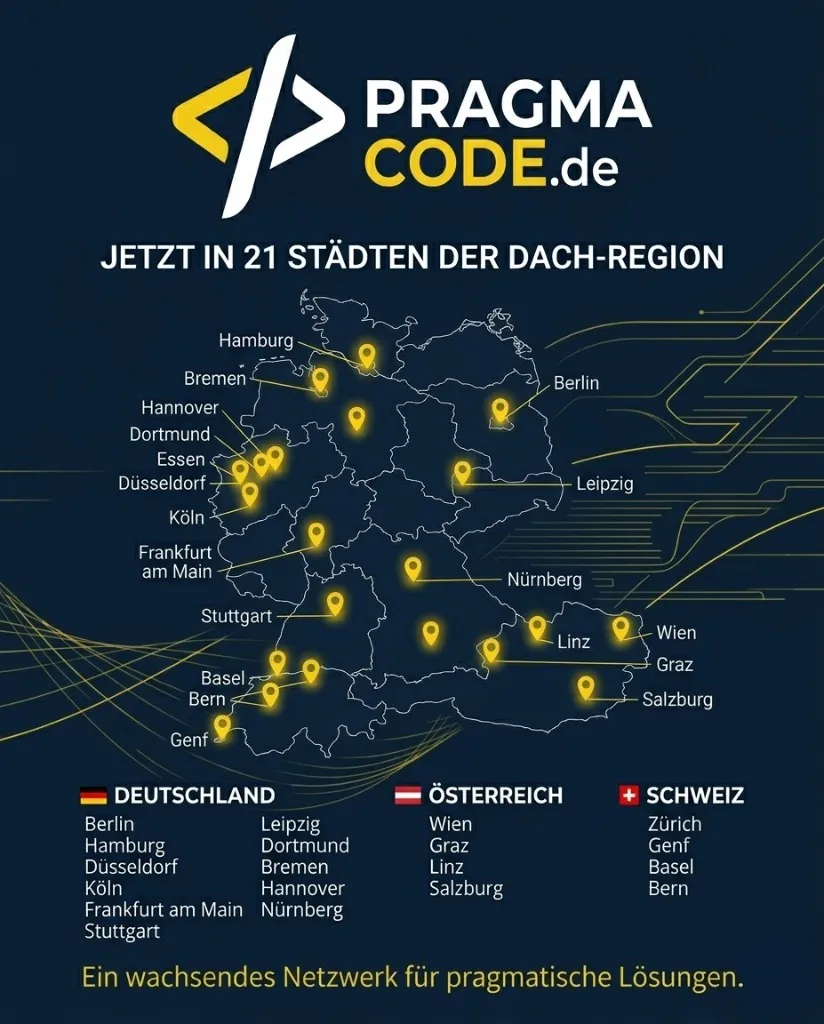
Our Regional Expertise
We are your digital partner – regionally anchored and successfully scaling across borders.
Have a vision?
Let's check together how we can make your idea take flight.
Book your free strategy call nowExtended Specialized Glossary
EN 16931
The European standard defining the semantic data model for electronic invoicing. It specifies which fields an e-invoice must contain and how they are to be interpreted. XRechnung and the EN 16931 profiles of ZUGFeRD both implement this standard.
CEN/TC 434
The technical committee of the European Committee for Standardization (CEN) responsible for creating and maintaining the European electronic invoicing standard EN 16931.
Business Terms (BT)
The standardized semantic data elements defined in the EN 16931 standard (e.g. BT-1 for Invoice Number, BT-10 for Buyer Reference) that represent business concepts independently of any specific XML syntax.
UN/CEFACT CII
Cross Industry Invoice — one of the two official XML syntaxes approved under European standard EN 16931 for electronic invoicing, commonly embedded inside hybrid PDF/A-3 formats like ZUGFeRD and Factur-X.
OASIS UBL
Universal Business Language — an open XML standard for structured business documents and one of the two primary syntaxes under EN 16931, serving as the technical core for XRechnung and Peppol BIS Billing.
KoSIT Validator
The official German reference validation tool provided by the Coordination Center for IT Standards for automated technical and Schematron business rule verification of electronic invoices.
Schematron Validation
A rule-based verification method that checks an XML invoice not only for syntactic well-formedness but against the business rules of EN 16931 — for example whether tax categories and totals are mutually consistent.