


Trade secrets, proprietary source code, and confidential customer records have no place in external US hyperscaler clouds. Discover in this comprehensive enterprise architecture guide how mid-market organizations build true model sovereignty and simpler GDPR compliance using quantized open-weight models, vLLM inference clusters, private RAG pipelines, and air-gapped network designs.
This article is an in-depth expert contribution from our content cluster. Discover the complete overview on our main page: AI Consulting & Integration →
- Data Sovereignty Instead of Cloud Dependency: On-premise operation makes GDPR compliance easier and largely rules out access under the US CLOUD Act, provided no US service providers have access (support, telemetry, updates). With open-weight models on your own hardware and properly implemented air-gapping, confidential engineering designs, client contracts, and financial records do not leave your corporate data center.
- Predictable Fixed Costs vs. Token Escalation: Investing in dedicated on-premise inference hardware can break even within roughly 6 to 8 months for high-volume document automation compared to cloud API subscription tiers (experience-based rough estimate, excluding power, maintenance, and staff).
- Enterprise Performance with vLLM & Hybrid RAG: Modern serving engines equipped with PagedAttention and Continuous Batching handle dozens of simultaneous employee requests (depending on GPU, model, and context length), grounded in role-based vector stores (pgvector / Qdrant).
- 1. Why Enterprises Are Shifting to On-Premise LLMs
- 2. Hardware Sizing: VRAM Requirements, GPUs & Small Data Centers
- 3. Inference Engines Put to the Test: vLLM vs. Ollama vs. TGI
- 4. The 4 Pillars of a Secure Enterprise RAG Platform
- 5. Network Integration & Orchestration via n8n & MCP
- 6. Cybersecurity, Air-Gapping & GDPR Compliance
- 7. 5-Step Roadmap: From PoC to Production On-Premise LLM
- 8. Quick-Check & Strategic Outlook
The Maturity Milestone of Local Corporate AI
The gap between proprietary cloud models and open-weight architectures has narrowed for many enterprise tasks. Established open-weight models such as Llama 3.3 (70B), Qwen 2.5 Coder, and DeepSeek-V3 can be run on private enterprise infrastructure; whether they are sufficient for your use case should be measured up front. For enterprise architects and executive leadership, the core strategic question has fundamentally changed: It is no longer whether local AI is viable, but how private inference clusters, hybrid RAG layers, and air-gapped networks are engineered for sustained operational scale.
1. Why Enterprises Are Shifting to On-Premise LLMs
In the wake of rapid generative AI adoption, many enterprises began by integrating US-hosted cloud APIs. However, what proved straightforward in initial prototyping quickly revealed severe friction points as production scale expanded. Chief Information Security Officers (CISOs), Data Protection Officers (DPOs), and CFOs are actively transitioning workloads to private infrastructure driven by three decisive enterprise imperatives:
1. Uncontrollable Compliance & IP Risks
Routing trade secrets, CAD schematics, client case files, or patent filings to foreign cloud endpoints can bring the US CLOUD Act into play. Even with contractually guaranteed server locations in the EU, US authorities can demand data from US providers. For auditors, critical infrastructure (KRITIS) operators, and sensitive sectors (healthcare, defence, specialized machinery), this third-country transfer under Art. 44 et seq. GDPR represents a significant liability risk.
2. Escalating Token Consumption & SaaS Surcharges
Commercial AI APIs charge strictly per processed token. In data-heavy enterprise workflows—such as automated multi-page invoice processing, contract clause comparisons, or enterprise-wide semantic search—monthly API expenses quickly surpass thousands of dollars. Compounding this challenge, proprietary credit schemes (such as Microsoft Copilot Credits) introduce volatile overage meters that disrupt corporate budget planning.
Conversely, operating an on-premise LLM completely decouples business growth from software subscription fees and variable token costs. Once the hardware is commissioned within your enterprise network, marginal cost per token is close to zero; fixed costs for hardware, power, and operations remain.
Expert Tip: The TCO Breakeven Threshold
A reliable rule of thumb for mid-market enterprises: If your organization processes more than 15 million tokens daily across automated workflows or internal AI assistants, a dedicated GPU inference server (acquisition cost approx. €25,000 to €45,000 depending on configuration, see the table in section 2) can amortize within roughly 6 to 8 months compared to the cost of current frontier cloud APIs. This is an experience-based rough estimate excluding power, maintenance, and staff – not a measurement.
2. Hardware Sizing: VRAM Requirements, GPUs & Small Data Centers
The single most consequential mistake when architecting local AI infrastructure is underestimating Video RAM (VRAM) capacity. Unlike conventional database or application servers where CPU clock speeds and host system RAM dominate, real-time LLM inference performance and concurrent throughput are largely dictated by GPU VRAM capacity and memory bandwidth (GB/s).
The Exact Mathematical Formula for VRAM Sizing
Deploying a production model for multi-user enterprise workloads requires significantly more memory than simply holding the raw model parameter weights. Total required VRAM is governed by three non-negotiable variables:
1. Static Model Weights Footprint
Calculated directly from the parameter count (e.g., 8B, 32B, 70B) and numerical quantization precision. A 70-billion-parameter model in uncompressed 16-bit floating point (FP16) requires 140 GB of pure VRAM. With modern 4-bit quantization (such as AWQ or EXL2), static weight memory drops to approximately 38 to 42 GB. 4-bit quantization (AWQ) typically costs little quality, but should be measured against your own use case.
2. Dynamic Key-Value (KV) Cache
Every token retained within the attention context window (e.g., 8,192 to 32,768 tokens per request) allocates dynamic GPU memory for transformer self-attention calculations. Worked example for Llama 3.3 70B (80 layers, 8 KV heads, head dimension 128, FP16 cache): 2 (key and value) × 80 × 8 × 128 × 2 bytes = 327,680 bytes ≈ 0.33 MB per token. At 16,384 tokens that is ≈ 5.4 GB per request; 50 concurrent requests with full 16k contexts would need ≈ 268 GB (≈ 134 GB with an FP8 KV cache). In practice, vLLM allocates the cache dynamically (PagedAttention), and rarely are all requests fully occupied at the same time. With a shorter context of 4,096 tokens, the figure is ≈ 1.3 GB per request and ≈ 67 GB for 50 requests (FP16). Together with roughly 40 GB of weights, that is well over 100 GB before the safety margin – 2 GPUs with 96 GB are not enough, 4 GPUs with 192 GB are. If this dynamic allocation exceeds physical memory boundaries, the serving runtime crashes with a catastrophic CUDA Out-of-Memory (OOM) error.
3. Runtime Overhead & CUDA Execution Buffer
Underlying Linux kernel drivers, CUDA runtime libraries, inter-GPU Tensor Parallelism communication channels, and temporary activation tensors require, as a rule of thumb, an overhead buffer of roughly 15% to 20% of total physical VRAM.
Enterprise Hardware Architectures Compared
Depending on organizational scale, user concurrency, and physical site requirements, three proven hardware configurations have emerged across enterprise deployments:
| Hardware Class | Typical Configuration | VRAM & Memory Bandwidth | Target Models & Workload | Estimated Investment & Deployment |
|---|---|---|---|---|
| Enterprise GPU Server (19″ Rack) | 2x to 4x NVIDIA RTX 6000 Ada / L40S, Dual AMD EPYC, 512 GB DDR5 RAM | 96 GB to 192 GB GDDR6 (up to 960 GB/s per GPU) | Llama 3.3 70B (AWQ/FP8) with high multi-user concurrency (many simultaneous users, depending on context length and quantization) | approx. €25,000 – €45,000; standard corporate server room with 19-inch rack cooling |
| Mid-Market Workstation / Entry Cluster | 2x NVIDIA GeForce RTX 4090 (24 GB) with blower cooling, PCIe 4.0, 128 GB RAM | 48 GB GDDR6X (1,008 GB/s per GPU) | Qwen 2.5 32B (Q4/Q8) or Llama 3.3 70B (EXL2 quantized, up to 15 concurrent users) | approx. €8,000 – €12,000; departmental R&D lab or dedicated automation node |
| Apple Silicon Unified-Memory Cluster | Mac Studio M2/M3 Ultra, 24-core CPU, 76-core GPU, 192 GB Unified Memory | 192 GB Unified Memory (800 GB/s system-wide bandwidth) | Llama 3.3 70B (unquantized / Q8) or 120B+ models under low concurrency (1–10 users) | approx. €8,500; whisper-quiet operation directly in open-plan office environments without rack cooling |
For context: DeepSeek-V3 (671 billion parameters, Mixture-of-Experts with 37 billion active parameters) needs more than 300 GB of VRAM even when quantized (weights in FP8 ≈ 671 GB, in 4-bit ≈ 336 GB) and therefore a multi-GPU server of the H100/H200 class. It does not fit the configurations shown above.
The B2B Small Data Center: Physical Site Infrastructure
Deploying enterprise-grade on-premise AI does not demand a massive colocation facility; it requires a properly engineered Small Data Center. A dedicated 19-inch enclosure inside an existing on-site server room must satisfy four essential physical requirements:
Thermal Heat Dissipation
A server housing four active enterprise GPUs generates between 1,200 and 1,800 watts of continuous thermal dissipation under load. Redundant in-row precision cooling or direct rack extraction is mandatory to avoid thermal clock throttling.
Uninterruptible Power Supply (UPS)
Voltage dips or sudden outages during active vector index updates or long-running inference jobs cause severe database corruption. An online double-conversion UPS providing at least 15 minutes of battery buffer time protects computational state.
High-Throughput NVMe Storage
Transferring a 70B model into GPU memory over standard SATA drives takes noticeably longer. Dedicated PCIe 4.0/5.0 NVMe RAID storage arrays (read speeds > 7,000 MB/s) shorten cold-start model load times considerably.
3. Inference Engines Put to the Test: vLLM vs. Ollama vs. TGI
Selecting the serving software layer determines whether your expensive GPU investment operates at peak hardware efficiency or stalls under concurrent employee traffic. Many companies mistakenly bring workstation-grade tools into multi-user production environments.
A note on TGI: according to Hugging Face, Text Generation Inference (TGI) is in maintenance mode; Hugging Face recommends vLLM or SGLang for new projects. TGI is therefore not examined further here.
Comparative Analysis: Developer Runtimes (Ollama) vs. Enterprise Serving (vLLM)
- Batching Architecture: Parallel requests are possible (environment variable
OLLAMA_NUM_PARALLEL, see the Ollama FAQ). - Memory Management: Simple VRAM management without PagedAttention.
- Concurrency Scaling: Optimized for single-seat use and small teams; for heavy parallel load, vLLM with continuous batching is the better fit.
- Multi-GPU Support: Basic layer offloading via llama.cpp, lacking true inter-card tensor parallelism.
- Best Suited For: Developer workstations, single-seat experimentation, and rapid offline PoCs.
- Batching Architecture: True iteration-level Continuous Batching with zero queue starvation.
- Memory Management: Revolutionary PagedAttention (virtualized memory paging inspired by OS design).
- Concurrency Scaling: Serves dozens of concurrent requests, depending on GPU, model, and context length.
- Multi-GPU Support: Enterprise-grade Tensor and Pipeline Parallelism powered by NCCL.
- Best Suited For: Production enterprise RAG platforms, n8n automation pipelines, and enterprise copilots.
Why PagedAttention in vLLM Sets the Enterprise Benchmark
In conventional inference engines, memory for the maximum possible sequence context length must be pre-allocated contiguously in VRAM before generation begins. Because actual response lengths cannot be known in advance, existing systems waste a significant share of KV-cache memory through fragmentation, according to the vLLM paper. vLLM resolves this fundamental bottleneck through PagedAttention: KV caches are partitioned into discrete memory pages, mirroring the virtual memory paging of operating systems. According to the paper, this yields a 2x to 4x throughput improvement over FasterTransformer and Orca at the same latency.
4. The 4 Pillars of a Secure Enterprise RAG Platform
A base open-weight model possesses no inherent awareness of your internal sales manuals, engineering standards, or vendor contracts. Rather than embarking on costly, rapidly outdated fine-tuning, enterprises implement a modular four-tier Enterprise RAG (Retrieval-Augmented Generation) platform:
Document Parsing & Semantic Chunking
Unstructured sources (SharePoint, internal network drives, ERP exports, PDFs) are ingested through structured parsing pipelines. Tables and document layouts are preserved; semantic chunkers segment content into coherent passages of 400 to 800 tokens.
Vector & Hybrid Storage Engine
Dense embeddings are indexed within scalable vector databases. Crucial for enterprise accuracy is Hybrid Search: fusing dense semantic vector retrieval (Cosine distance via HNSW) with exact sparse lexical search (BM25) for part numbers, SKUs, and ISO standards.
Cross-Encoder Reranking
Initial vector search returns the 25 most relevant candidate snippets. A subsequent cross-encoder reranking model evaluates query-context relevance jointly, stripping out irrelevant noise. This improves the relevance of the context and thereby lowers the risk of hallucinations.
RBAC & Automated PII Masking
Before any retrieved context is injected into the LLM prompt, an on-premise Presidio pipeline redacts sensitive personal data. Simultaneously, role-based access controls (RBAC) ensure employees only receive grounded answers from documents they are authorized to read.
5. Network Integration & Orchestration via n8n & MCP
An on-premise AI cluster delivers maximum commercial value when connected into day-to-day enterprise operations. Here, pairing self-hosted n8n with the Model Context Protocol (MCP) creates an agile, private orchestration engine.
The Private n8n Orchestration Pipeline
Self-hosted n8n operates as an intelligent mediator bridging line-of-business applications with the private vLLM serving layer:
Event-Driven Ingestion Triggers
Incoming emails, new contract uploads in SharePoint, or webhook status changes in your ERP (SAP, proALPHA, Salesforce) automatically trigger n8n workflows across local LAN networks.
Drop-In OpenAI-Compatible Endpoints
Because vLLM exposes standard OpenAI-compatible REST endpoints (/v1/chat/completions), standard LangChain and AI nodes in n8n integrate without proprietary adapter code, routing prompts directly to local GPUs.
Model Context Protocol (MCP) Tool Calling
Through secure, containerized MCP servers, the local LLM executes validated, type-safe queries against private SQL databases, verifies inventory levels, or drafts ERP journal entries without human intervention.
An illustrative scenario (not a client project): When a customer complaint arrives by email, n8n reads the text, anonymizes contact details via local regex filters, passes the case to the local Llama 3.3 model to check the root cause against the internal knowledge base, and automatically creates a ticket in the internal ERP – fully isolated within the corporate LAN.
6. Cybersecurity, Air-Gapping & GDPR Compliance
Housing servers on-site does not automatically guarantee full information security. Without disciplined network zoning, systems remain vulnerable to lateral network traversal or unintended software telemetry leakage.
1. Physical & Logical Air-Gapping
The GPU inference server and vector databases reside in an isolated Demilitarized Zone (DMZ) VLAN. Outbound internet connectivity is completely blocked at the firewall level (egress rule: DROP all). Authorized internal clients connect exclusively via encrypted mTLS proxies.
2. Zero-Trust API Gateway & Quota Governance
Client requests never hit the vLLM server directly; they terminate at a reverse proxy gateway (such as Caddy as a reverse proxy in front of a LiteLLM gateway). The gateway validates internal bearer tokens, enforces departmental rate limits, and exports structured audit logs.
3. Dynamic Active Directory ACL Synchronization
An enterprise RAG system must never disclose payroll or executive data to unauthorized staff. Automated background synchronization reconciles user group memberships from Microsoft Active Directory or OpenLDAP directly into vector payload security filters.
4. EU AI Act & NIS-2 Risk Management
Because internal RAG assistants run strictly private knowledge workflows without prohibited biometric categorization or behavioral profiling, a local RAG system can usually be classified as "Minimal Risk" under the EU AI Act (to be verified case by case). Even then, the AI literacy obligation (Art. 4) and the transparency obligations for chatbots (Art. 50) apply. For NIS-2 entities, on-premise operation reduces the supply-chain risk of external cloud providers. Access under the US CLOUD Act is largely ruled out, provided no US service providers have access (support, telemetry, updates).
For detailed implementation strategies regarding API protection and token rotation, review our technical guide on Zero-Trust Security in n8n Automations.
7. 5-Step Roadmap: From PoC to Production On-Premise LLM
To deliver enterprise AI infrastructure reliably within defined timelines and capital budgets, Pragma-Code enforces a phased 5-step implementation lifecycle:
-
1. Needs Assessment, Model Selection & VRAM Sizing
Audit core use cases (internal knowledge search, coding assistance, document summarization) and estimate concurrent request volume. Select the target model architecture (e.g., Llama 3.3 70B AWQ) and compute precise VRAM and hardware headroom requirements.
-
2. Server Room Prep & Hardware Commissioning
Verify electrical circuits, UPS capacity, and thermal cooling inside your on-site server room. Rackmount GPU hardware, configure RAID NVMe arrays, and deploy a hardened enterprise Linux distribution (Ubuntu Server LTS with certified NVIDIA drivers and CUDA runtimes).
-
3. Software Stack Deployment (vLLM & Qdrant)
Deploy vLLM in containerized Docker or Kubernetes environments, enabling PagedAttention and Tensor Parallelism. Commission the vector database (Qdrant or PostgreSQL/pgvector) and initialize multi-threaded document ingestion pipelines.
-
4. Network Hardening, Presidio Filtering & IAM Mapping
Isolate the inference host within an isolated VLAN with complete outbound egress blocking. Configure local Presidio PII redaction and connect Active Directory to enforce existing file-level access rights across semantic search results.
-
5. Pilot Testing, Benchmark Validation & Rollout
Execute multi-user stress tests measuring Time-to-First-Token (TTFT) and throughput stability under load. Train internal system administrators, connect production n8n workflows, and roll out the private copilot to operational departments.
8. Quick-Check & Strategic Outlook
Transitioning to an on-premise LLM architecture is far more than a financial calculation: It establishes the structural foundation for corporate digital sovereignty, uncompromised cybersecurity, and autonomous innovation in the AI era.
Quick-Check: Is Your Organization Ready for On-Premise LLMs?
Enterprises that anchor critical intelligence workflows on sovereign infrastructure build an enduring buffer against geopolitical shifts, cloud vendor pricing shocks, and regulatory liabilities. By combining established open-weight models, vLLM high-throughput serving, and robust network zoning, Pragma-Code transforms private enterprise hardware into high-yield AI assets.
Official Sources & Primary Documentation
- Kwon et al. (2023): "Efficient Memory Management for Large Language Model Serving with PagedAttention" – Paper (arXiv) on PagedAttention and the throughput comparison with FasterTransformer and Orca.
- NVIDIA: GeForce RTX 4090 – Technical specifications (24 GB GDDR6X, 1,008 GB/s, PCIe 4.0 x16).
- DeepSeek-AI: DeepSeek-V3 model card – 671 billion parameters (Mixture-of-Experts, 37 billion active).
- Ollama: FAQ – Parallel requests via
OLLAMA_NUM_PARALLEL. - European Parliament & Council (2024): "Regulation (EU) 2024/1689 (EU AI Act)" – Legal framework for artificial intelligence, risk tier categorization, and compliance duties for AI deployers (incl. AI literacy under Art. 4 and transparency under Art. 50).
Are you planning an on-premise LLM deployment for your organization?
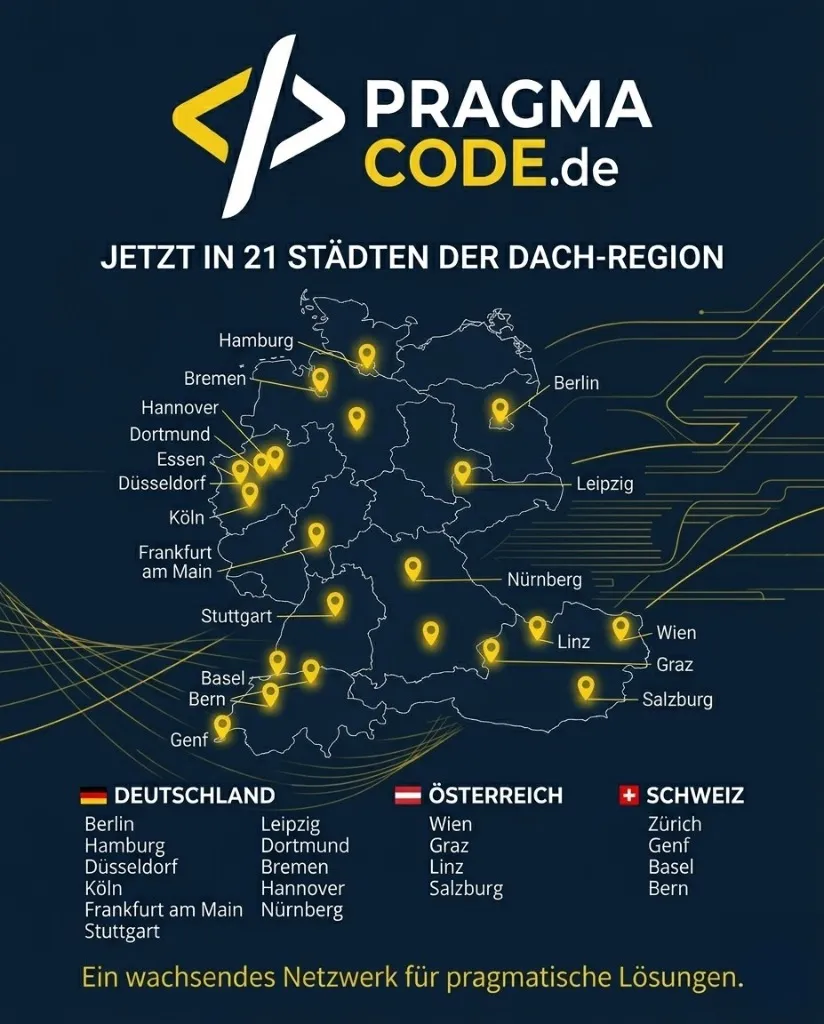
Schedule a Free Architecture ConsultationOur Regional Expertise
We are your digital partner – regionally anchored and successfully scaling across borders.
AI automation for your business?
I deliver this for small and mid-sized businesses: at a fixed price agreed upfront, working directly with the person who builds it. Process, scope and pricing are on the service page.
See service & pricing Or request a free intro callExtended Specialized Glossary
vLLM
A high-throughput, memory-efficient open-source inference engine for LLMs featuring PagedAttention and continuous batching for heavy concurrent workloads.
Continuous Batching
An iteration-level dynamic batching mechanism that injects incoming inference requests immediately into active GPU compute cycles, reducing idle time.
Small Data Center
A compact, on-premise corporate server infrastructure (19-inch racks, UPS, precision cooling) providing strictly isolated compute within company firewalls.
Air-Gapped
A cybersecurity architecture where mission-critical IT and AI inference systems are physically or logically disconnected from the public internet.
Reranking
A two-stage semantic retrieval technique in RAG pipelines where a specialized cross-encoder re-evaluates vector search candidates to reduce hallucination risk.