


The European Digital Economy and Society Index (DESI) 2026 reveals a sobering reality: Germany has fallen to 17th place in the EU ranking. Bureaucratic hurdles, sluggish public administration APIs, and delayed infrastructure projects are holding back the economy. For C-level executives and SMB leaders, the message is clear: Stop waiting for state infrastructure! Taking digital sovereignty into your own hands through agile self-initiative ('Make or Buy' & 'Germany-Stack') and AI automation unlocks decisive competitive advantages.
This article is an in-depth expert contribution from our content cluster. Discover the complete overview on our main page:Strategic IT Consulting & Digitalization →
- DESI Index 2026 Context: Germany slides to 17th in the EU Digital Ranking — primarily due to cumbersome administrative processes, lacking public sector APIs, and heavy regulatory friction.
- The Infrastructure Trap: Companies waiting for state initiatives, national fiber rollout, or federal e-government standards lose competitive ground every single day to agile EU competitors.
- Liberation via Self-Initiative ("Germany-Stack"): Forward-thinking SMBs leverage the modular 'Germany-Stack' — combining sovereign cloud infrastructure, API-first integrations (e.g. n8n), and GDPR-compliant on-premise/hybrid AI models.
- Interactive Maturity Check: With our integrated Maturity Matrix, executives evaluate their digital performance across 4 core dimensions in under 3 minutes.
- 1. The Wake-Up Call: Why Germany Slips to 17th in DESI 2026
- 2. The Public Infrastructure Trap: Risks for SMBs
- 3. Strategic Self-Initiative: Germany-Stack & Make-or-Buy
- 4. Interactive Widget: Digital Maturity Check 2026
- 5. 5-Step Action Plan for C-Level Executives
- 6. Conclusion: From DESI Laggard to Industry Leader
1. The Wake-Up Call: Why Germany Slips to 17th in DESI 2026
The release of the Digital Economy and Society Index (DESI) 2026 by the European Commission delivers a harsh reality: Germany ranks only 17th out of 27 EU member states. While Scandinavian nations (Finland, Denmark) and the Netherlands have prioritized digital innovation for years, Europe’s largest economy remains stuck in the lower mid-pack.
This decline is not accidental; it is the result of structural bottlenecks. The DESI evaluates EU digital performance across four key dimensions:
1. Human Capital
Strong density of core IT specialists, yet a widening skills gap in practical AI deployment and data engineering within mid-sized businesses.
2. Connectivity
Fiber and 5G expansion in rural industrial hubs still lag behind EU targets, leaving regional manufacturers struggling with bandwidth stability.
3. Integration of Digital Tech
Large corporations adopt cloud & AI quickly, while medium-sized enterprises frequently remain trapped in legacy software silos without APIs.
4. Public Services (Main Bottleneck)
Sluggish administrative digitalization, fragmented municipal software, and paper-based compliance requirements prevent seamless B2G interaction.
Particularly in digital public services (E-Government), Germany scores in the bottom third of the EU. Businesses spend countless administrative hours submitting compliance proofs, permits, and tax data via outdated portals. Learn more in our guide on the DACH Digitalization Backlog.
DESI 2026 Key Stat: 42% Administrative Overhead
Mid-sized enterprises in Germany spend on average 42% more internal capacity navigating regulatory and administrative processes than comparable SMBs in Denmark or the Netherlands.
2. The Public Infrastructure Trap: Risks for SMBs
Many SMB executives tend to postpone strategic IT modernizations until government grant schemes open up or authorities define unified digital standards. In 2026, this passive approach has become a dangerous infrastructure trap.
Waiting for state initiatives exposes companies to severe competitive risks:
1. Speed Loss & Disadvantage
While domestic firms wait for municipal permits, international rivals automate supply chains, customer portals, and quotes using Agentic AI Workflows.
2. Unmitigated Labor Shortages
Demographic shifts hit medium-sized businesses hard. Without automating routine workflows, key personnel loss cannot be compensated.
3. Escalating Regulatory Burden
Regulations like the EU AI Act, NIS2, or Accessibility Acts (BFSG) mandate digital proof. Manual processes directly lead to compliance fines.
"Decouple from Public Sluggishness"
Agile market leaders do not wait for municipal fiber or state APIs. They build their own digital sovereignty — leveraging redundant edge links, cloud middleware, and open-source automation.
3. Strategic Self-Initiative: Germany-Stack & Make-or-Buy
How can decision-makers escape the DESI trap? The answer lies in a hybrid strategy combining the "Germany-Stack" approach with a clear Make-or-Buy framework.
The Germany-Stack principles advocate for building IT systems not as rigid monoliths, but from sovereign, open-source, and API-connected modules:
Sovereign Cloud Foundation
Utilizing GDPR-compliant European cloud providers or on-premise container clusters for sensitive corporate data.
API-First Middleware
Deploying flexible workflow automation engines such as n8n Automation to seamlessly connect CRM, ERP, and E-Commerce.
Modular Frontends
High-performance custom web applications built on Next.js or Astro, ensuring top speed and WCAG AAA accessibility.
The Make-or-Buy Decision Matrix 2026
Executives must evaluate where off-the-shelf SaaS suffices and where custom software development ("Make") creates defensible moats:
| Category | Recommended Approach | Technology Example | Strategic Value |
|---|---|---|---|
| Customer Interfaces & Shops | MAKE (Custom Frontend) | Next.js / Headless Commerce | Full independence, maximum conversion & Core Web Vitals |
| Process Orchestration | HYBRID (Open Source Middleware) | n8n / Node.js Microservices | Zero vendor lock-in, rapid adaptability |
| Standard Finance & HR | BUY (Standard SaaS) | DATEV / Standard SaaS | Legal compliance without dev overhead |
4. Interactive Widget: Digital Maturity Check 2026
📊 Digital Maturity Check 2026
Answer 4 brief questions & receive your personalized evaluation in 60 seconds.
☁️ Dimension 1: Cloud Infrastructure & Sovereignty
🤖 Dimension 2: AI Integration & Workflows
⚡ Dimension 3: Process Automation & APIs
🛡️ Dimension 4: Compliance, GDPR & Security
5. 5-Step Action Plan for C-Level Executives
To establish digital sovereignty independent of public sector delays, we recommend executive leaders follow these 5 pragmatic implementation steps:
Step 1: Process Audit & Shadow IT Removal
Identify manual media breaks, spreadsheet workarounds, and unmonitored SaaS accounts. Map all internal and external data flows.
Step 2: Deploy Enterprise Middleware
Implement an open-source workflow automation platform (e.g. n8n). Connect ERP, CRM, E-Commerce, and logistics in real-time.
Step 3: Deploy AI Agents for Routine Tasks
Relieve staff from repetitive tasks. Deploy AI-powered invoice extraction, automated customer support bots, and predictive analytics.
Step 4: Sovereign Security & Compliance
Prepare for the EU AI Act, NIS2, and accessibility mandates. Enforce automated security and code audits to eliminate liability risks.
Step 5: Leverage Digitalization Grants: Take advantage of public innovation grants such as BAFA Funding for AI & Digitalization to subsidize up to 50% of consulting and development costs.
6. Conclusion: From DESI Laggard to Industry Leader
Ranking 17th in the EU DESI Index is a wake-up call for Germany — but it is by no means the destiny of your business. While bureaucracy slows down state infrastructure, agile SMBs have the complete freedom to claim market leadership through digital self-initiative.
By adopting the Germany-Stack, flexible API architectures, and autonomous AI workflows today, you break free from public delays — turning a regional location disadvantage into an unassailable competitive moat.
Quick-Check: Your Roadmap to Digital Sovereignty
Do you have questions about your company's digital sovereignty?
Book your free strategy sessionOur Regional Expertise
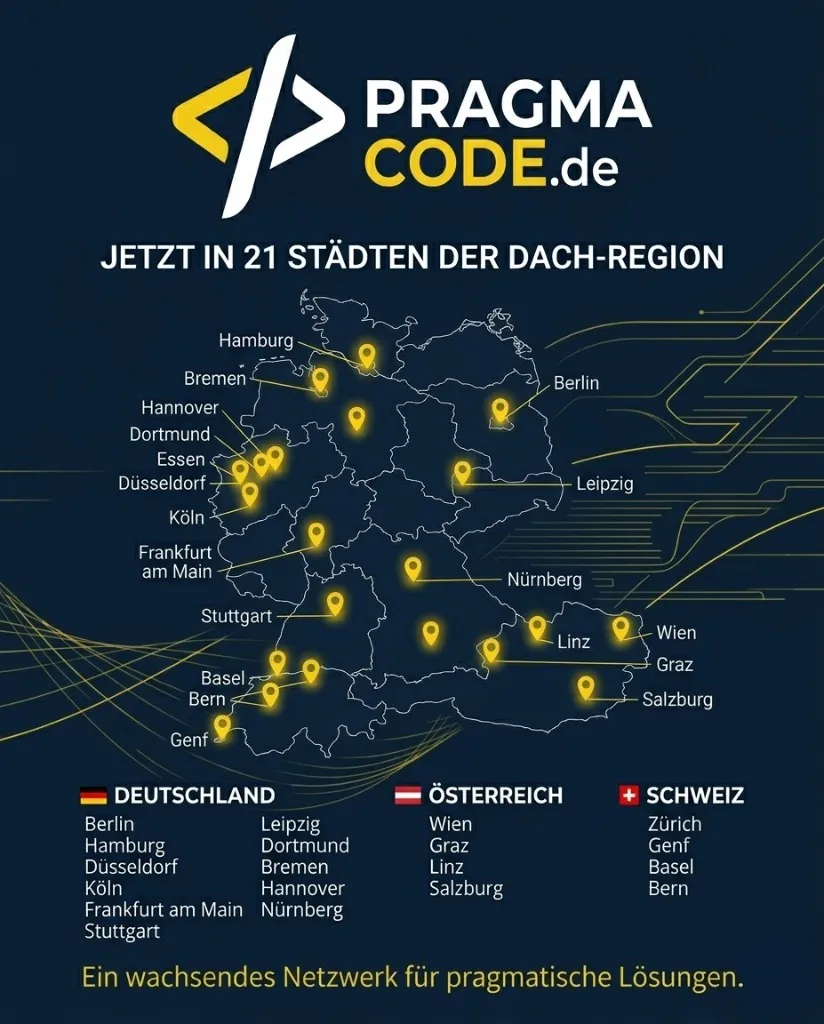
We are your digital partner – regionally anchored and successfully scaling across borders.
Have a vision?
Let's check together how we can make your idea take flight.
Book your free strategy call nowExtended Specialized Glossary
DESI Index (Digital Economy and Society Index)
The annual performance index by the European Commission measuring digital progress across EU member states in Human Capital, Infrastructure, Integration of Digital Technology, and Digital Public Services.
Germany-Stack
A standardized, modular IT architecture leveraging open-source software, open APIs, and GDPR-compliant cloud infrastructures to eliminate proprietary data silos.
Digital Maturity Matrix
A structured assessment method for measuring an enterprise's technological and organizational digital readiness across key dimensions (Cloud, AI, Automation, Compliance).