

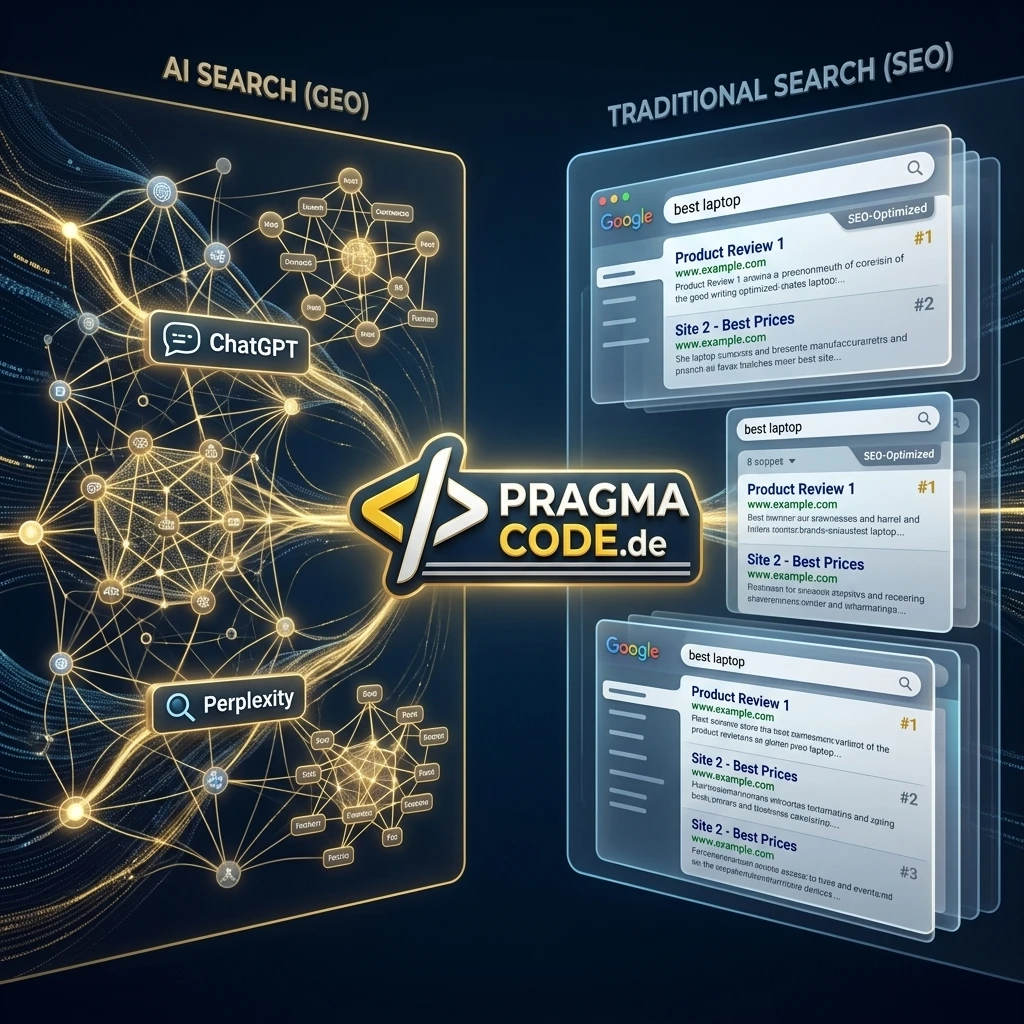
From blue search engine links to synthesized AI responses: Why traditional SEO loses traction in 2026, how Generative Engine Optimization (GEO) establishes your brand inside ChatGPT, Perplexity & SearchGPT—and how our AI Visibility Monitor guarantees your market lead.
This article is an in-depth expert contribution from our content cluster. Discover the complete overview on our main page: GEO Optimization & Content Strategy →
- Radical Shift in Search Behavior: Over 48% of commercial B2B buyer journeys across Europe in 2026 no longer initiate on traditional search engine results pages, but inside AI conversational interfaces like ChatGPT, Perplexity Pro, Claude 3.5/4, or Google AI Overviews.
- The Zero-Click Reality: Instead of scanning ten blue links, executive decision makers demand single, authoritative synthesized answers. Brands not recognized by Large Language Models (LLMs) as dominant category entities disappear from consideration sets completely.
- Pragma-Code Technology & Services: Through our specialized GEO Optimization, machine-readable data architecture, and our proprietary AI Visibility Monitor, we make your brand presence inside AI responses measurable, controllable, and continuously scalable.
If You Are Not Cited, You Do Not Exist to the Market
While traditional SEO agencies continue tracking clicks and keyword positions, AI answer engines decide in milliseconds which two to three vendors are recommended to a corporate buyer. GEO is the essential technological response to this digital transformation.
- 1. Introduction: The End of Blue Links & The Rise of AI Search
- 2. What Is Generative Engine Optimization (GEO)?
- 3. How AI Engines (ChatGPT Search, Perplexity, AI Overviews) Recommend Brands
- 4. The 4 Pillars of a High-Impact GEO Strategy
- 5. Agentic Search: When Autonomous AI Agents Take Over B2B Procurement
- 6. Product Spotlight: Pragma-Code AI Visibility Monitor & Free Check
- 7. Our Service Portfolio: End-to-End GEO Transformation & Grants
- 8. Benchmark Comparison: Traditional SEO vs. Pragma-Code GEO Strategy
- 9. Step-by-Step Roadmap: 5 Phases to AI Market Leadership
- 10. Conclusion & Outlook: Secure Your AI Dominance Today
1. Introduction: The End of Blue Links & The Rise of AI Search
For more than two decades, digital B2B marketing adhered to a predictable playbook: research high-volume keywords, optimize web pages for keyword density, accumulate backlinks, and compete for top positions on page 1 of Google SERPs. The underlying logic was simple: high rankings win clicks, and clicks drive qualified visitors into the sales funnel.
By 2026, this model has broken down across B2B, industrial manufacturing, and enterprise technology sectors. The catalyst is a profound transformation in user behavior: C-level executives, senior engineers, IT directors, and procurement teams no longer enter fragmented keywords like "ERP software comparison SME machinery" into a search bar only to sift through ten sponsored links. Instead, they interact with multimodal AI conversational engines like ChatGPT Search, Perplexity Pro, Claude 3.5 Sonnet, or Google AI Overviews using highly detailed prompts:
“Compare the top three GDPR-compliant cloud ERP solutions for custom machinery manufacturers in Europe with 50 to 250 employees. Account for open REST APIs, interfaces to Siemens PLC automation, and average deployment timelines, providing explicit vendor recommendations.”
The Uncompromising Zero-Click Reality
Conversational AI search engines do not present endless lists of URLs. They synthesize billions of latent vectors into exactly one authoritative answer. If your enterprise is omitted from this synthesized response, prospective enterprise clients disqualify your solution before ever visiting your website. As demonstrated in our organic visibility field report, the entire discovery and evaluation phase has migrated directly into the chat interface.
As a result, traditional Search Engine Optimization (SEO) experiences a steep decline in commercial return. Taking its place is Generative Engine Optimization (GEO): The disciplined engineering practice of structuring digital entities, software capabilities, case studies, and empirical datasets so Large Language Models (LLMs) and Retrieval-Augmented Generation (RAG) pipelines cite and recommend them as definitive primary sources.
2. What Is Generative Engine Optimization (GEO)?
Generative Engine Optimization represents the evolution of search marketing built specifically for the mechanics of artificial intelligence. Where legacy SEO sought to satisfy document-retrieval ranking algorithms (such as PageRank or BM25), GEO optimizes digital knowledge representations for neural language models and dynamic vector databases.
From Document Indexing to Knowledge Graph Ingestion
Generative models do not match raw strings when responding to commercial buyer prompts. They evaluate semantic entity graphs, verified fact triples, and authoritative E-E-A-T proof points. GEO structures enterprise data so AI bots absorb it directly into their internal weights and vector spaces during Knowledge Graph Ingestion.
For modern CMOs and digital leaders, GEO moves past the outdated question “Where does my page rank for Keyword X?” to answer the existential commercial questions of our era:
1. When and in what context is your brand mentioned?
Does ChatGPT or Perplexity cite your enterprise when prospective buyers ask for solutions to complex technical challenges, or does the engine exclusively recommend your closest competitors?
2. What core attributes does the model associate with your brand?
Do language models classify your portfolio as a „cutting-edge modular platform“, an „overpriced legacy product“, or an „unreliable niche provider“?
3. Is your offering cited as an authoritative primary source?
Do AI answer engines link directly to your whitepapers and solution pages in their citation chips as factual proof, or is all knowledge extracted from third-party aggregators and forums?
3. How AI Engines (ChatGPT Search, Perplexity, AI Overviews) Recommend Brands
Securing dominant visibility in AI answer engines requires a precise technical understanding of Retrieval-Augmented Generation (RAG) and neural search pipelines. Modern answer engines evaluate brand authority through a four-stage real-time cycle:
Prompt Parsing & Intent Extraction
The system decomposes the user query into semantic entities, underlying commercial intents (transactional, comparative, technical), and contextual constraints such as industry sector, regional compliance (GDPR, NIS-2), and target budgets.
Realtime Vector Search & Retrieval
The AI agent queries the live web and pre-indexed vector stores using cosine similarity rather than keyword matching. Here, machine-readable AI Crawler Optimization and structured endpoints are essential.
Entity Verification & E-E-A-T Scoring
Retrieved documents are filtered for empirical consistency and domain authority. Algorithms strongly prioritize pages exhibiting rigorous Schema.org entity markup, verified authorship, verifiable benchmarks, and authoritative industry citations.
Synthesis & Citation Generation
The neural network generates a cohesive narrative response. Interactive citation bubbles are awarded primarily to sources delivering the highest Information Gain Score without redundant marketing fluff.
4. The 4 Pillars of a High-Impact GEO Strategy
Sustainable GEO performance cannot be achieved through superficial copywriting or arbitrary tag stuffing. It demands a rigorous 4-pillar architectural framework integrating editorial rigor with machine-readable infrastructure:
1. Semantic Entity Architecture
Transform unstructured HTML into explicit knowledge graphs. Using comprehensive Schema.org JSON-LD (Organization, Service, Product, DefinedTermSet, FAQPage) alongside SameAs references to Wikidata, Wikipedia, and registries, AI engines accurately comprehend your identity and capabilities.
2. Radical Content Authority
Large Language Models filter commoditized, AI-spun generic content in fractions of a second. They cite original data: real-world customer benchmarks, hard engineering telemetry, proprietary calculation models, and verified subject matter experts with documented industry track records.
3. Technical Bot Accessibility & llms.txt
AI bots such as GPTBot, ClaudeBot, and PerplexityBot operate under strict latency and computational budgets. We deploy standardized llms.txt and llms-full.txt files alongside lightweight Markdown endpoints, serving models essential documentation without JavaScript overhead.
4. Continuous AI Visibility Monitoring
You cannot optimize what you do not measure. Through automated, scheduled prompt evaluations across all frontier LLMs, we track citation rates, sentiment shifts, and competitor movements across hundreds of commercial queries.
5. Agentic Search: When Autonomous AI Agents Take Over B2B Procurement
The paradigm shift in 2026 extends far beyond human buyers chatting with conversational bots. We are experiencing the exponential rise of Agentic Search: Autonomous AI procurement agents (such as enterprise agents powered by Anthropic Claude Computer Use or custom procurement bots) conducting vendor discoveries, comparing specifications, and qualifying RFPs autonomously.
An autonomous procurement agent does not look at promotional banners or emotional copywriting. It operates strictly across Application Programming Interfaces (APIs), vector stores, and machine-readable frameworks like the Model Context Protocol (MCP):
1. Machine-Readable Specifications & Data Architecture
If API specifications, ISO certifications, and pricing structures are not accessible in standardized, crawlable formats like JSON-LD or Markdown, the autonomous agent cannot evaluate your offerings—disqualifying your brand from vendor shortlists.
2. Programmatic Openness as a Critical Evaluation Metric
Autonomous agents strongly favor vendors whose documentation demonstrates seamless data import, export, and webhook synchronization. As detailed in our guide to Performance Marketing & AI Search, machine accessibility is the ultimate B2B currency.
3. Cross-Platform Factual Consistency & Validation
An autonomous agent continuously cross-references claims on your website with corporate business registries, LinkedIn employee profiles, and developer communities. Inconsistent data immediately degrades the agent's confidence score, eliminating you from selection matrices.
6. Product Spotlight: Pragma-Code AI Visibility Monitor & Free Check
The single greatest operational challenge confronting digital marketing teams in 2026: Google Search Console and Google Analytics track organic clicks from traditional browsers, yet remain completely blind to millions of commercial interactions unfolding inside ChatGPT, Claude, and Perplexity.
To eliminate this blind spot, Pragma-Code engineered a dedicated platform: the AI Visibility Monitor.
Automated Multi-Engine Prompt Tracking
Our platform simulates hundreds of industry-specific B2B buying prompts daily across major frontier engines (ChatGPT Search, Perplexity Sonar Reasoning, Claude 3.5/4, Google Gemini Pro) to track when and how your brand is cited.
Share-of-Voice & Citation Score
Obtain an empirical index score (0–100%) quantifying your brand's citation percentage compared directly against your top five competitors in synthesized responses.
Sentiment & Brand Attribute Intelligence
Our algorithms evaluate qualitative sentiment beyond basic mentions: Does the model present your solution as an „innovative enterprise benchmark“, a „cost-effective alternative“, or a „clunky legacy system“?
Actionable GEO Gap Recommendations
Discover precisely which technical questions AI engines fail to answer accurately about your portfolio—and close those gaps systematically using targeted GEO assets.
Looking for a baseline audit of your digital presence? With our free AI visibility check, we analyze whether Gemini, Tavily, Perplexity, and Brave recommend your brand for key industry queries—and reveal which competitors are cited instead. Receive your customized report directly via email.
7. Our Service Portfolio: End-to-End GEO Transformation & Grants
Continuous monitoring uncovers reality—yet decisive technical and structural execution turns insights into revenue. Pragma-Code delivers end-to-end GEO transformation services for European enterprises:
1. AI Visibility Audit & GEO Strategy
A rigorous examination of your digital footprint, entity graph relationships, and knowledge ingestion barriers, complete with an actionable engineering roadmap.
€1,200 Fixed PriceTurnaround approx. 1 week. Delivers unambiguous priorities for development and marketing teams.
2. Monthly Execution Retainers (Package B: SEO & Content)
Continuous creation of authoritative E-E-A-T whitepapers, schema expansions, and systematic citation tracking across all major answer engines.
€890 / MonthIncludes 2 research-backed articles/month, monthly AI reporting and ongoing on-page work.
8. Benchmark Comparison: Traditional SEO vs. Pragma-Code GEO Strategy
Comparing traditional SEO tactics against modern GEO architecture demonstrates why legacy search strategies suffer steep performance declines:
Comparison: Legacy SEO (2020) vs. Pragma-Code GEO Architecture (2026)
- Core Objective: Rank on Page 1 of Google SERPs for specific keywords.
- Primary Metrics: Organic clicks, impressions, SERP positions.
- Content Format: Artificially elongated articles stuffed with keyword variations.
- Technology: Basic XML sitemaps, simple meta tags, standard CMS plugins.
- Monitoring: Completely blind to conversational queries in ChatGPT and Perplexity.
- Core Objective: Secure definitive brand recommendations and citations in AI chats.
- Primary Metrics: AI citation rates, entity authority & Share-of-Voice in the monitor.
- Content Format: Information-dense, verifiable assets with maximum Information Gain.
- Technology: Schema.org knowledge graphs, machine-readable
llms.txt& Astro speed. - Monitoring: Continuous real-time tracking across all major frontier AI models.
9. Step-by-Step Roadmap: 5 Phases to AI Market Leadership
Transitioning from traditional SEO to an enterprise GEO architecture requires a structured, iterative implementation process. Follow our proven 5-stage transformation roadmap:
-
Phase 1: AI Visibility Audit & Baseline Benchmark
Configure the AI Visibility Monitor for your brand and top five competitors across 50 commercial prompts to establish your initial citation index.
-
Phase 2: Entity & Knowledge Graph Structuring
Re-architect corporate profiles, product offerings, and service pages using rich Schema.org schemas and disambiguating links to Wikidata and industry taxonomies.
-
Phase 3: Machine-Readable Endpoint Deployment (llms.txt)
Deploy structured machine endpoints (
llms.txtandllms-full.txt) in your domain root directory and optimize server response latency (TTFB) for high-frequency AI web bots. -
Phase 4: High E-E-A-T Content Engine & Citation Building
Publish original research, empirical benchmarks, and technical whitepapers cited across authoritative publications, training LLMs to rely on your data as a primary authority.
-
Phase 5: Continuous Optimization & AI Share-of-Voice Tracking
Evaluate monthly citation metrics inside the AI Visibility Monitor, refining content assets and entity graphs to capitalize on new LLM releases (such as GPT-5 or Claude 4.5).
10. Conclusion & Outlook: Secure Your AI Dominance Today
The pivot from SEO to Generative Engine Optimization is not a temporary marketing trend—it represents the most profound shift in digital customer acquisition since the advent of modern search engines. Enterprises that take decisive action to structure digital assets for AI answer engines and autonomous agents will secure category dominance for the next decade. Those who hesitate risk disappearing entirely from ChatGPT, Perplexity, and Google AI Overviews.
Combining our strategic GEO Optimization, custom headless web development, and our proprietary AI Visibility Monitor, Pragma-Code guides your brand reliably through this transformation.
Quick-Check: Your 2026 GEO Action Plan
llms.txt file for AI search crawlers.
Ready to see how visible your brand truly is inside ChatGPT & AI Search engines?
Try AI Visibility Monitor NowOur Regional Expertise
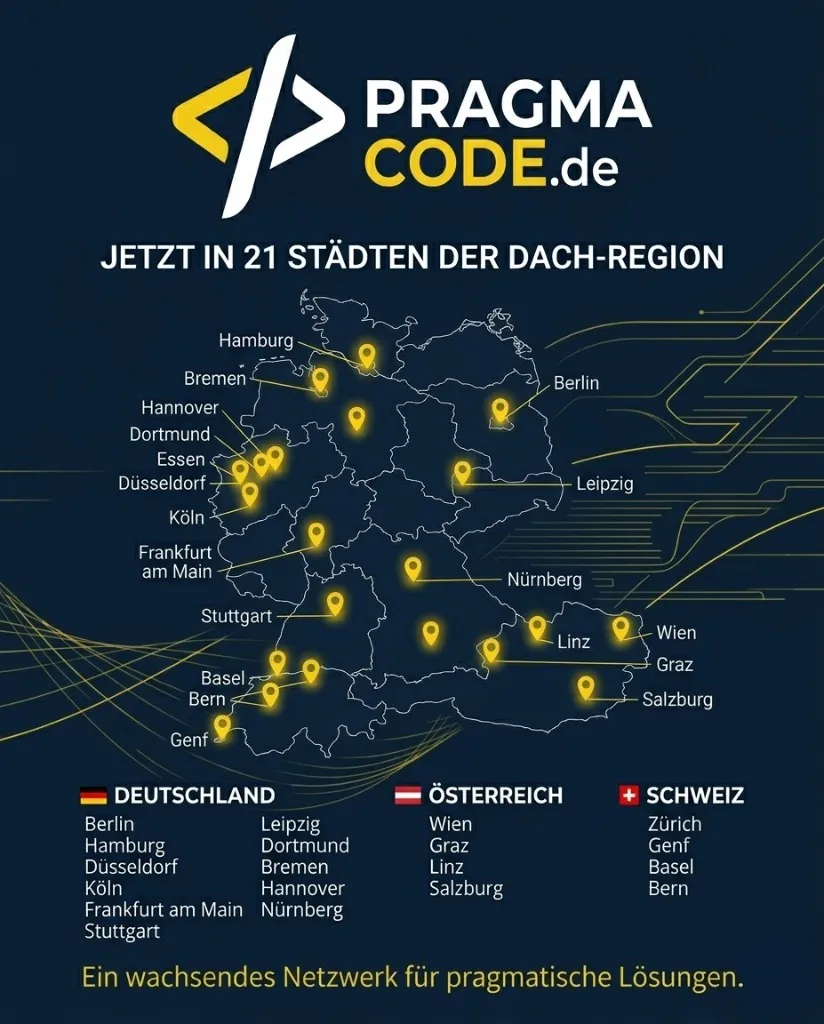
We are your digital partner – regionally anchored and successfully scaling across borders.
SEO & content for your business?
I deliver this for small and mid-sized businesses: at a fixed price agreed upfront, working directly with the person who builds it. Process, scope and pricing are on the service page.
See service & pricing Or request a free intro callExtended Specialized Glossary
AI Visibility Monitor
Pragma-Code's proprietary analytics platform for tracking and measuring brand presence, citation shares, and recommendation metrics across AI search engines such as ChatGPT, Perplexity, Claude, and SearchGPT.
Generative Engine Optimization (GEO)
Strategic optimization of digital content for generative AI search engines via semantic entity structuring, authoritative E-E-A-T signals, and machine-readable data architecture.
Knowledge Graph Ingestion
Process by which AI models and LLM crawlers absorb structured enterprise data, entity relations, and knowledge graphs into their internal knowledge representations.
AI Crawler Optimization
Targeted technical configuration of server infrastructure, machine-readable files (robots.txt, llms.txt), and crawling budgets for AI bots like GPTBot or ClaudeBot.